How to Count Calories: A Beginner’s Guide in 6 Steps
By the DietX team · Updated · 6 min read
To count calories, set a daily target, record everything you eat and drink, and compare your total with that target. As a rough guide, the NHS puts the average woman at 2,000 kcal a day and the average man at 2,500 kcal, but your own number may differ by hundreds.
A calorie, written kcal on most labels, is a unit of the energy in food. Here is how to count calories in six steps, with or without an app.
Step 1: Set a daily calorie target
Your target starts with your maintenance calories, roughly what you can eat without your weight changing. The Mifflin-St Jeor formula estimates your basal metabolic rate (BMR), the energy your body burns at rest, and you multiply that by a rough activity factor.
For a 35-year-old woman who is 165 cm tall and weighs 70 kg, BMR comes to 1,395 kcal. With light activity (× 1.375), maintenance is about 1,918 kcal. Our guide to how many calories you need a day has the full formula and the multipliers.
How to count calories to lose weight
Aim a little below maintenance and keep the pace gradual. The NHS suggests losing 0.5 to 1 kg (1 to 2 lb) a week, and the CDC notes that people who lose weight gradually are more likely to keep it off. Our calorie deficit guide shows how to set the gap. Results vary from person to person.
Step 2: Pick a way to log
| Method | Works well for | Trade-off |
|---|---|---|
| App with photo, text, voice or barcode | Busy days, meals out | Estimates you need to check |
| Kitchen scale and food labels | Homemade meals, foods you eat often | Slower, hard away from home |
| Notebook or spreadsheet | Anyone who would rather skip an app | You look up every value yourself |
A 2020 review of image-assisted methods found that less burdensome methods are less accurate and that no method suits every setting, so a mix is reasonable: weigh at home, then use a photo or your voice when you're out. Effort matters too. In a study of 142 adults, participants spent 23.2 minutes a day logging in the first month and 14.6 by month six. Choose what you'd keep doing.
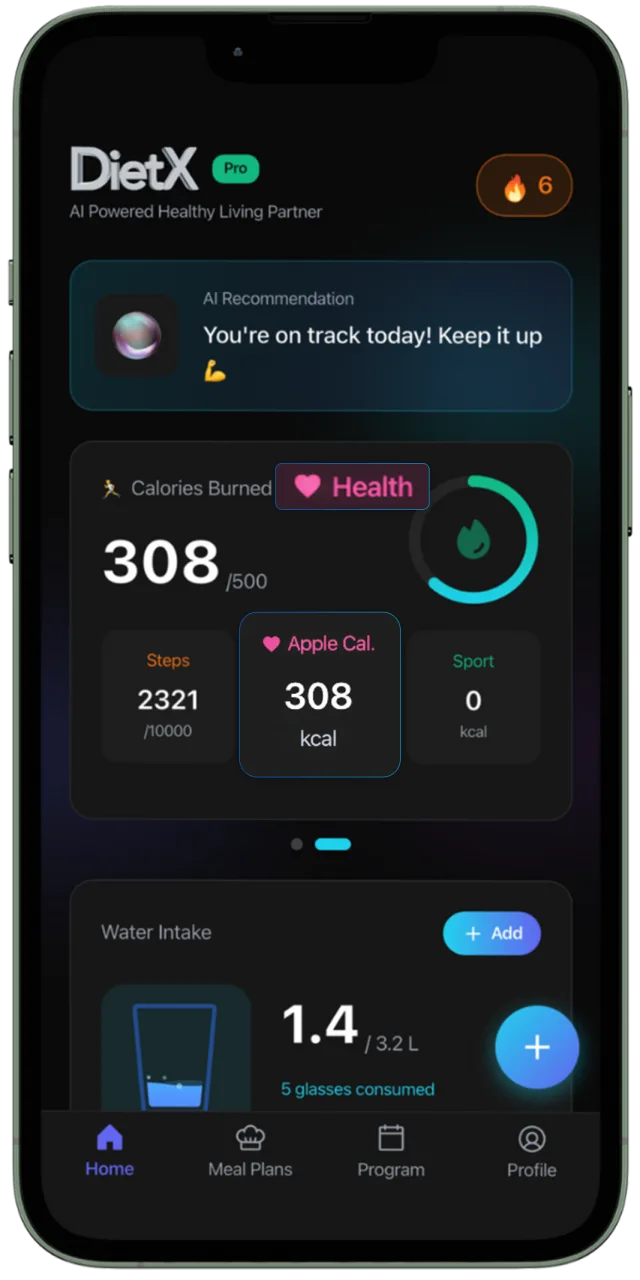
If you want an app, DietX, the one we make, sets calorie and macro targets from your age, height, weight, activity level and goal, and logs by photo, description, voice or barcode. It's free to download with a free trial, and Premium is a subscription. We compare it with others in our guide to the best calorie counter apps.
How to count calories without an app
You need one sum: kcal per 100 g × grams you ate ÷ 100. The kcal figure comes from the label, or from the USDA FoodData Central database for food without a label. Here is a breakfast, using USDA values for the state shown:
| Food | Amount | Sum | kcal |
|---|---|---|---|
| Oats, dry | 40 g | 389 × 40 ÷ 100 | 156 |
| Milk, 1% | 200 g | 42 × 200 ÷ 100 | 84 |
| Banana | 100 g | 89 × 100 ÷ 100 | 89 |
| Total | 329 |
Step 3: Log everything for one week
For the first week, eat as you normally do and just record it. You're collecting information, and changing your diet on day one hides what a normal week looks like.
- Log as you go, because waiting until bedtime invites forgetting.
- Include drinks, cooking oil, sauces and the bites you take while cooking.
- Log the meals you'd rather not write down. They tell you the most.
- Aim for complete over perfect. A rough entry beats a blank one.
Is it worth the bother? A review of 22 studies consistently linked self-monitoring (keeping a record of what you eat and do) with weight loss, though the evidence was rated weak because of limits in the methods.
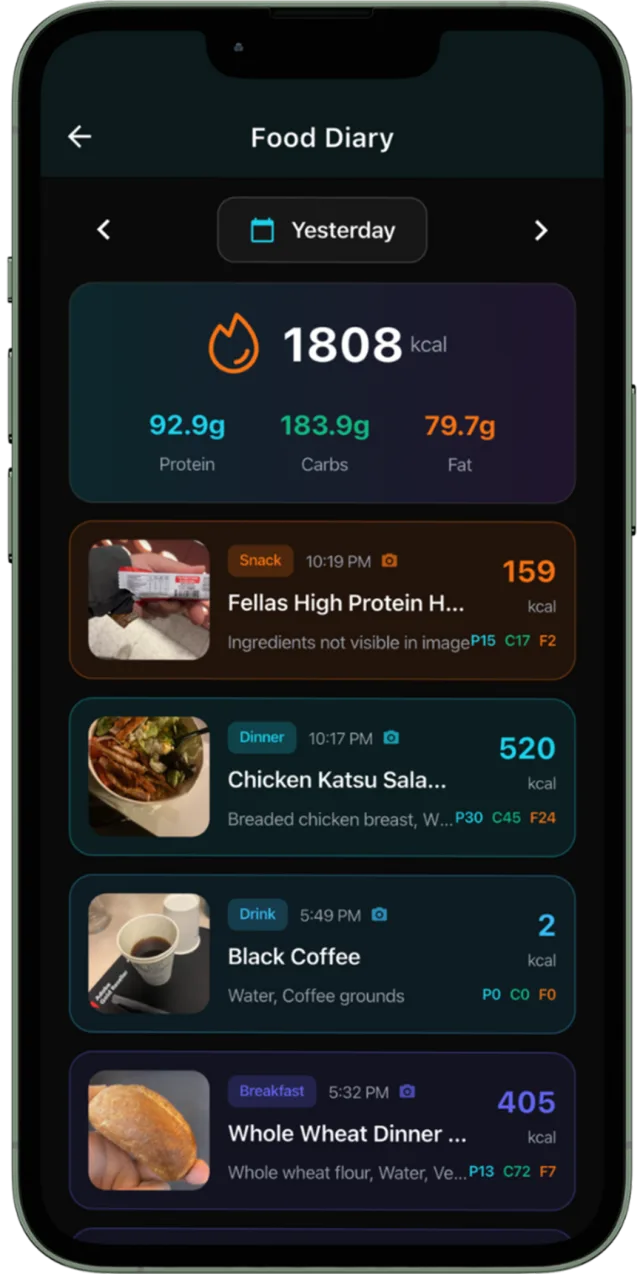
Whatever tool you use, you want to end up with something like this: calories and macros (protein, carbs and fat) per meal, with a daily total. If macros interest you, see how to track macros.
Step 4: How to count calories in homemade meals
Add up the ingredients, then divide. Weigh each one in the state that matches the value you use: raw with raw, cooked with cooked. Here is a simple lentil and rice pot using USDA values for the prepared foods shown:
| Ingredient | Amount | kcal |
|---|---|---|
| Lentils, boiled | 600 g | 696 |
| White rice, cooked | 400 g | 520 |
| Tomato | 300 g | 54 |
| Olive oil | 2 tbsp (about 27 g) | about 240 |
| Whole pot | about 1,510 |
Split evenly into four, that's about 378 kcal a portion. Portions rarely come out even, so you can weigh the finished pot instead. If it weighs 1,200 g, a 350 g bowl is 1,510 × 350 ÷ 1,200, or about 440 kcal.
Step 5: How to count calories without a food scale
A scale helps, but you can start without one.
- Use the package. A 500 g bag of dry pasta split into five even portions gives you 100 g dry in each.
- Use spoons. Measure oil by the tablespoon (about 13.5 g, so about 120 kcal) instead of pouring from the bottle.
- Count units. Eggs, slices of bread and pieces of fruit are easy to count and look up.
- Use a photo or description. An app can estimate the amount, and you check it against what you see.
- Take extra care with dense foods. Misjudging spinach by 50 g costs about 12 kcal, and misjudging almonds by 50 g costs about 299 kcal (USDA). When unsure about nuts, oil or cheese, round up.
Step 6: Keep logging on weekends
It's tempting to stop logging on Saturday, but those days count as much as any other. Research on weekly weight rhythms found that weight tends to rise on weekends and fall during the week, and those bumps are normal.
Think in weekly totals. Eating 1,800 kcal on five days and 2,200 kcal on two gives 9,000 + 4,400 = 13,400 kcal, an average of about 1,914 kcal a day. That sits close to a 1,900 kcal target even with two higher days. Easing back a little during the week is fine, but please don't skip meals to pay for a big night.
How to tell if it's working
After two or three weeks, compare your plan with what happened. Weigh yourself regularly and watch the trend, since daily swings are normal. A review of self-weighing linked it with more weight loss and not with negative psychological outcomes, but if the scale upsets you, it's fine to stop.
If the trend isn't moving as you expected, look through the common calorie counting mistakes before you change your target. Weight also responds slowly to a change in intake, and loss tends to taper off over time, so recalculate as your weight changes.
Frequently asked questions
How do I start counting calories as a beginner?
Work out a daily target from your age, height, weight and activity, choose an app or a scale with food labels, then log everything you eat and drink for a week without changing your diet. That first week shows you where your calories come from.
Do I need a food scale to count calories?
No. You can use package amounts, tablespoons, countable units such as eggs or slices, and app estimates. A scale is more reliable, so it’s worth using when you can, especially for dense foods such as oil, nuts and cheese.
Should I weigh food raw or cooked?
Either works if the value you log matches. White rice is about 365 kcal per 100 g raw and about 130 kcal per 100 g cooked, so using the wrong one can put you hundreds of calories out.
How do I count calories without an app?
Keep a notebook or spreadsheet. For each food, multiply the kcal per 100 g by the grams you ate and divide by 100. Take the kcal figure from the label, or from a food database such as USDA FoodData Central when there is no label.
Is calorie counting right for everyone?
No. If tracking food makes you anxious or you have a history of disordered eating, skip it and talk to a professional. Anyone who is pregnant, breastfeeding or has a medical condition should get advice before changing how they eat.
Sources
- NHS: Understanding calories
- Mifflin et al. (1990), Am J Clin Nutr: A new predictive equation for resting energy expenditure
- NHS: Tips to help you lose weight
- CDC: Steps for losing weight
- NHS: Eating disorders
- Review of the validity and feasibility of image-assisted methods for dietary assessment (2020), Int J Obes
- Harvey et al. (2019), Obesity: Log Often, Lose More
- USDA FoodData Central (SR Legacy)
- Burke et al. (2011), J Am Diet Assoc: Self-monitoring in weight loss, a systematic review
- Orsama et al. (2014), Obes Facts: Weight rhythms across the week
- Zheng et al. (2015), Obesity: Self-weighing in weight management, a systematic review
- Hall et al. (2011), Lancet: Quantification of the effect of energy imbalance on bodyweight
General information, not medical advice. Talk to a doctor or dietitian before changing your diet, especially if you are pregnant, under 18 or have a health condition. If tracking food makes you anxious or you have a history of disordered eating, please skip calorie counting and ask a professional for support.