Log Food by Voice: How to Describe a Meal So the Calories Add Up
By the DietX team · Updated · 6 min read
To log food by voice, you say what you ate in a normal sentence, and a calorie tracker turns it into food items with estimated calories for you to check. The detail you give decides how good the estimate can be: "some pasta" leaves the app guessing, while "200 g of cooked pasta with a tablespoon of olive oil" comes to about 436 kcal by USDA values.
Everything below applies just as well if you type the description instead of saying it.
When voice or text beats a photo
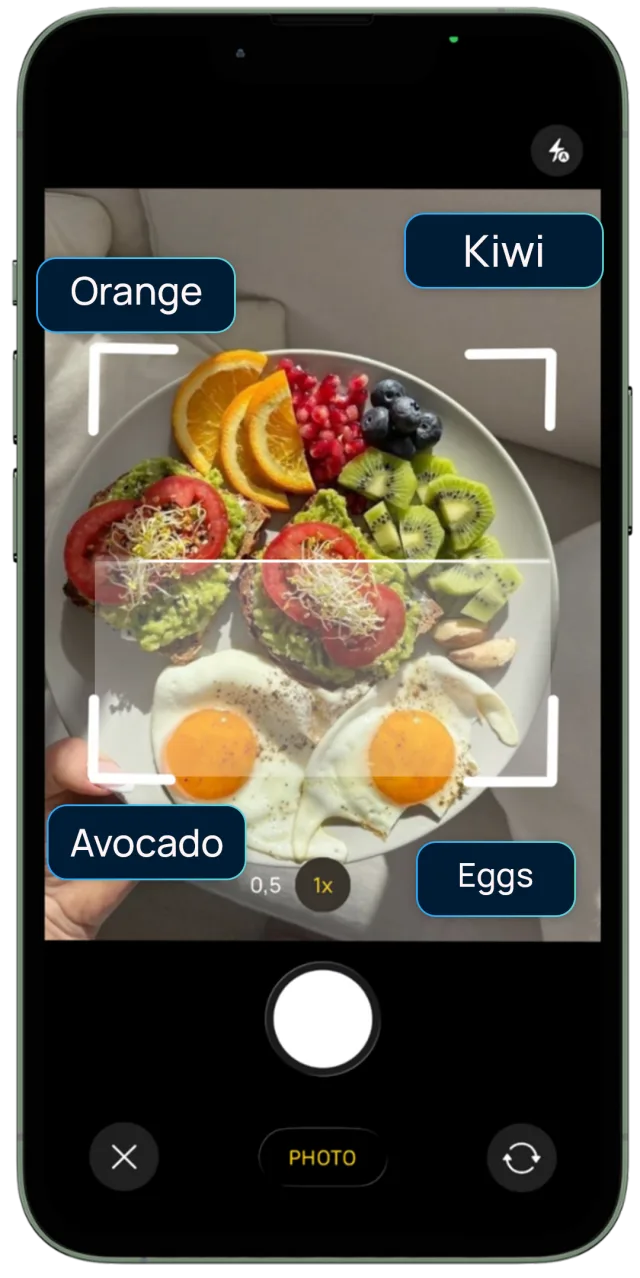
A camera is handy when the food is in front of you and easy to see. A description tends to win in these situations:
- A dark restaurant or bar. A 2025 validation study found that photo accuracy depends on clear images where the food is visible, and a dim room works against that.
- You've already eaten. There's no plate left to photograph, but you can still say what was on it.
- Homemade meals. The camera sees a bowl of stew. You know it has two tablespoons of oil in it, which is about 240 kcal (USDA).
- Food you can't see into. A wrap, a smoothie or a loaded burrito shows little from the outside.
A photo still has the edge when you don't know what's in a dish or can't picture the amounts, because it gives you a starting point to correct. For anything packaged, a barcode or the nutrition label is usually the better route.
How to log food by voice: what to say
A good description answers four questions.
- How much? Use grams if you know them. Otherwise use spoons, cups, slices or pieces, and say if you left some.
- How was it cooked? Say fried, grilled, boiled, raw or cooked. By USDA figures, 200 g of white rice is 260 kcal cooked and 730 kcal raw, so one word can change the entry by 470 kcal.
- Which brand or restaurant? Packaged foods and chain meals may have their own figures, and a brand name gives the app a better match.
- What went on it? Oil, butter, sauce, cheese and the type of milk are easy to leave out. By USDA figures, 250 g of whole milk is about 153 kcal, and the same amount of 1% is 105 kcal.
Good and bad example phrases
| Too vague | Better | What it adds |
|---|---|---|
| "Chicken and rice" | "150 g roasted chicken breast with 200 g cooked white rice" | Amounts, cooked state |
| "A coffee" | "Medium latte with whole milk and one sugar" | Size, milk type, sugar |
| "Some pasta" | "Two cups of cooked pasta, jarred tomato sauce, a spoon of parmesan" | Amount, sauce, topping |
| "A protein bar" | Full brand name and flavor | The exact product |
| "Stir-fry" | "Homemade beef and broccoli stir-fry, one tablespoon of oil, about a cup and a half" | Ingredients, fat, amount |
| "Salad for lunch" | "Large chicken Caesar from a cafe, dressing mixed in, ate about three quarters" | Size, dressing, share eaten |
| "A couple of drinks" | "Two 175 ml glasses of 12% wine" | Size, strength |
That last one matters: the NHS puts a 175 ml glass of 12% wine at up to 158 kcal, so two come to up to 316 kcal. More in our guide to calories in alcohol.
A full example
Say this: "For dinner I had about 150 g of roasted chicken breast, 200 g of cooked white rice, 100 g of boiled broccoli and a tablespoon of olive oil." By USDA values, that comes to 248 + 260 + 35 + 120 = 663 kcal. "Chicken, rice and broccoli" gives the app no amounts and leaves out the oil.
Tips for better voice entries
- Log soon after eating. Self-reports can miss a lot. In a small study of 10 adults who called themselves diet-resistant, people under-reported their food by 47%. That's a small, specific group, but it's a good reason not to wait until bedtime.
- Describe one meal at a time. A day's worth of food in one breath is harder to check.
- Say what you ate, not what was served. "I ate about half" is useful information.
- Read it back. Spoken numbers can be misheard, and "fifteen" and "fifty" sound close. Fix any wrong item before you save.
- Round up dense foods when unsure. A guess on oil, nuts or cheese matters far more than a guess on salad leaves.
The limits of voice food logging
A description has weak spots of its own.
- You can only describe what you know. In a restaurant you can't know how much oil went in. Even stated menu figures can run high: across 269 restaurant foods, 19% had at least 100 kcal more per portion than stated. See our guide to counting calories when eating out.
- Your amounts are guesses too. "200 g" is only 200 g if you weighed it. Using a kitchen scale for a week or two can teach you what your usual portions look like.
- The app fills in what you leave out. Say "chicken" and it has to assume a cut, a portion and a cooking method. Its assumption may not match your plate.
- AI results are estimates. DietX's own App Store listing says estimates may vary, and that goes for any app.
- There's no independent scorecard. The sources we use contain no independent head-to-head test of consumer calorie apps, so we can't tell you how voice compares with a photo in accuracy, or which app handles it best.
- Noise and privacy. A loud room can garble your words, and you may not want to read out your lunch on a train. Typing does the same job.
Which calorie trackers have voice logging?
MyFitnessPal, Lose It! and Cronometer keep voice on a paid tier. We couldn't confirm voice logging for YAZIO, fatsecret or MacroFactor.
| App | Voice or text logging | Tier |
|---|---|---|
| DietX | Voice and typed description | Free to download with a free trial; Premium is a subscription |
| MyFitnessPal | Voice Log | Premium only |
| Lose It! | AI Voice | Premium |
| Cronometer | Voice; text search | Voice on Gold only; text search is free |
| Lifesum | Voice and text | Not stated |
| SnapCalorie | Voice notes | Not stated |
| Cal AI | Describe a meal; voice not confirmed | Not stated |
If you want typed food search at no cost, Cronometer's free text search beats DietX on that point, because DietX has no free subscription tier. If you want to say a whole meal in a sentence and correct the result, DietX is built to do that alongside photo and barcode logging, and you can edit any item before saving.
You don't have to settle on one method. Use the camera when the plate is in front of you and your voice when it isn't. If you're new to all this, start with our beginner's guide to counting calories.
Frequently asked questions
Can you log food by voice?
Yes. Several calorie trackers let you say what you ate and then estimate the calories from your description. Include amounts, cooking method, brand and any oil or sauce, then check the items before saving.
What should I say when logging food by voice?
Say how much you ate, how it was cooked, the brand or restaurant if there is one, and what went on it. “150 g of roasted chicken breast with 200 g of cooked white rice” gives an app far more to work with than “chicken and rice”.
Is voice logging as accurate as a photo?
We can’t say. The sources we use contain no independent head-to-head test of consumer calorie apps. Voice depends on the detail you give, and a photo depends on what the camera can see, so each does better in different situations.
Which calorie trackers have voice logging?
As of November 2026, DietX has voice logging, MyFitnessPal and Lose It! offer it with Premium, Cronometer offers it with Gold, Lifesum lists voice and text, and SnapCalorie lists voice notes. Features can change, so check the app’s own page.
Sources
- USDA FoodData Central (SR Legacy)
- Customized multimodal GPT-4o and image-based dietary assessment against weighed food records (2025), Am J Clin Nutr
- NHS: Calories in alcohol
- Lichtman et al. (1992), N Engl J Med: Self-reported and actual caloric intake and exercise
- Urban et al. (2011), JAMA: Accuracy of stated energy contents of restaurant foods
- DietX on the App Store
- MyFitnessPal: Premium
- Lose It! on the App Store
- Cronometer: Gold
- Lifesum
- SnapCalorie
- Cal AI
General information, not medical advice. Talk to a doctor or dietitian before changing your diet, especially if you are pregnant, under 18 or have a health condition. If tracking food makes you anxious or you have a history of disordered eating, please skip calorie counting and ask a professional for support.