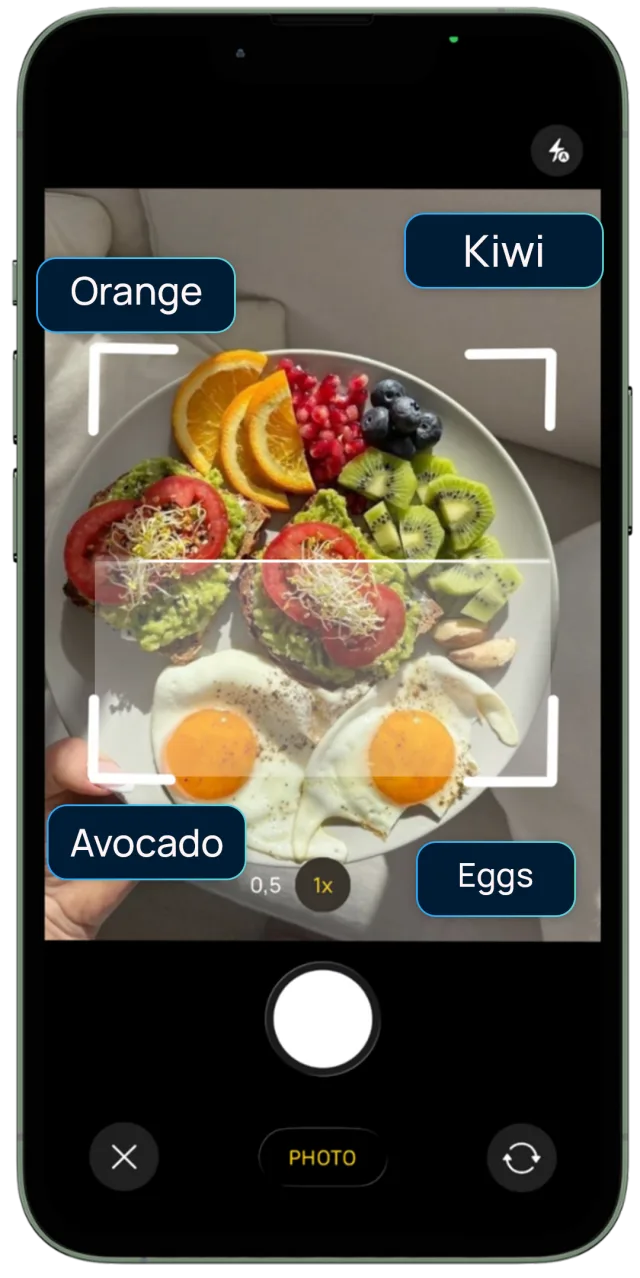
How to Track Macros: A Simple Guide With a Worked Example
By the DietX team · Updated · 7 min read
To track macros, set a daily calorie target, turn it into grams of protein, carbs and fat, then log what you eat against those numbers. At 1,800 kcal, one balanced split is 112 g of protein, 203 g of carbs and 60 g of fat. This guide shows how to work out your own numbers, how to count macros in a real meal, and how to do it without letting it take over your day.
What are macros?
Macros, short for macronutrients, are the three nutrients that supply nearly all your calories: protein, carbohydrates and fat. Each has a known energy value, according to the FAO:
| Macro | Calories per gram | What it's mainly for |
|---|---|---|
| Protein | 4 kcal | Building and repairing tissue |
| Carbohydrates | 4 kcal | Everyday fuel, including fiber |
| Fat | 9 kcal | Stored energy, hormones, absorbing some vitamins |
Alcohol has 7 kcal per gram but isn't a macro you need. Our guide to calories in alcohol explains how to handle it in your numbers.
Those values are the whole trick. Once you know how many grams you want, the calories follow, and the reverse works too.
How much of each macro should you eat?
The Dietary Reference Intakes give acceptable ranges for adults, as a share of calories. Here they are at 1,800 kcal:
| Macro | Range | Calories at 1,800 kcal | Grams at 1,800 kcal |
|---|---|---|---|
| Carbs | 45 to 65% | 810 to 1,170 kcal | 203 to 293 g |
| Fat | 20 to 35% | 360 to 630 kcal | 40 to 70 g |
| Protein | 10 to 35% | 180 to 630 kcal | 45 to 158 g |
These ranges are wide on purpose, so there's no single correct split. The WHO adds two useful guides: total fat at 30% of energy or less helps prevent unhealthy weight gain, and protein at 10 to 15% of energy is generally sufficient for adults. People who train regularly often aim higher on protein, as we'll see next.
How to count macros: a worked example at 1,800 kcal
You don't need a macro calculator. Four steps and a pen will do it. We'll use a 70 kg person who exercises regularly, eating 1,800 kcal.
Step 1: set your calories. Use your own number here. Our guide to how many calories you need a day shows how to find it. 1,800 kcal is only an example.
Step 2: set protein first. For people who exercise, a position stand from the International Society of Sports Nutrition says 1.4 to 2.0 g per kg a day is enough for most. Taking 1.6 g per kg: 70 × 1.6 = 112 g, and 112 × 4 = 448 kcal. Protein goes first because it depends on your body rather than your calories. If you're less active, you can set it lower, and our guide to how much protein per day goes through the options.
Step 3: set fat. Taking 30% of calories: 1,800 × 0.30 = 540 kcal, and 540 ÷ 9 = 60 g.
Step 4: carbs get the rest. 1,800 − 448 − 540 = 812 kcal, and 812 ÷ 4 = 203 g.
| Macro | Grams | × kcal per gram | Calories | Share |
|---|---|---|---|---|
| Protein | 112 g | 4 | 448 kcal | 25% |
| Fat | 60 g | 9 | 540 kcal | 30% |
| Carbs | 203 g | 4 | 812 kcal | 45% |
| Total | 1,800 kcal | 100% |
All three sit within the ranges above. If you'd like more carbs and less fat, shift them: at 25% fat you'd have 50 g of fat and about 226 g of carbs, with protein unchanged.
To reuse this for your own numbers:
- Protein grams = your weight in kg × your g per kg
- Fat grams = your calories × 0.30 ÷ 9
- Carb grams = (your calories − protein grams × 4 − fat grams × 9) ÷ 4
How to log macros in a real meal
Add up each ingredient from its label, a food database or an app. Here's one dinner, using USDA values for the prepared state shown:
| Food | Calories | Protein | Carbs | Fat |
|---|---|---|---|---|
| Chicken breast, roasted, 150 g | 248 kcal | 46.5 g | 0 g | 5.4 g |
| White rice, cooked, 150 g | 195 kcal | 4.1 g | 42.3 g | 0.5 g |
| Broccoli, boiled, 100 g | 35 kcal | 2.4 g | 7.2 g | 0.4 g |
| Olive oil, 5 g | 44 kcal | 0 g | 0 g | 5.0 g |
| Total | 522 kcal | 53.0 g | 49.5 g | 11.3 g |
That one meal gives you 47% of the protein target for 29% of the calories, so one or two meals like it make the rest of the day much easier. Our list of high protein foods has more options.
If you run this through 4/4/9, you get about 511 kcal rather than 522 kcal. That's normal. Those factors are general values and foods differ slightly, so don't chase the gap.
A few habits keep your log honest:
- Match the state. Raw and cooked values are far apart: white rice is 365 kcal per 100 g raw and 130 kcal cooked. Weigh it the way the entry describes it.
- Measure fats. Oil, butter and nut butters take up little space and add up fast.
- Start with the serving size on a label. The FDA puts it first for a reason.
- Save your repeats. If you eat the same breakfast most days, log it once and reuse it.
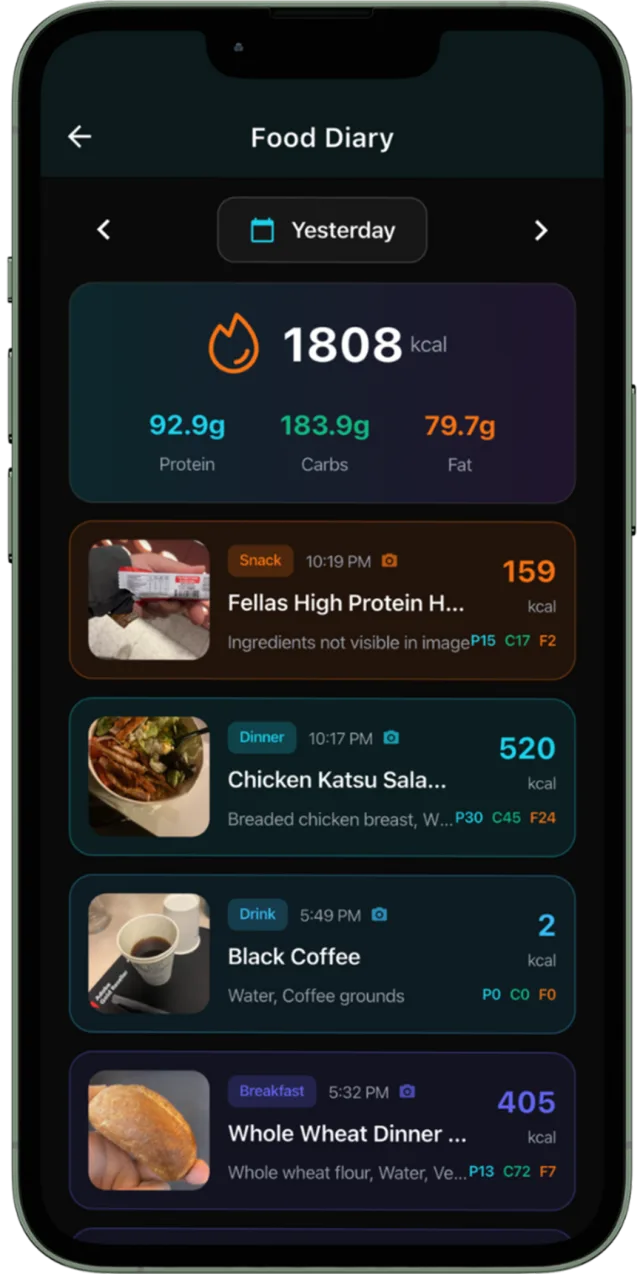
An app does the adding for you. DietX sets daily calorie and macro targets from your age, height, weight, activity level and goal, then estimates calories, protein, carbs and fat from a photo, a description, your voice or a barcode. You can edit any item before you save it, and estimates can vary, so it's worth a look. It's free to download with a free trial, and Premium is a subscription. If you're choosing between apps, we compare the options in our guide to the best macro tracker apps.
How to track macros without obsessing
Macros are a tool, and it's easy to let them become a job. These rules help keep them in their place.
- Aim for ranges. Getting protein within about 10 g and calories close to target is plenty. Carbs and fat can flex from day to day.
- Look at the week. A high-fat Tuesday means nothing if your week averages out.
- Simplify if it's too much. If you only keep two numbers, make them calories and protein. A review of higher-protein diets found more weight and fat loss and more lean mass kept in shorter controlled trials, though long-term results depend on sticking with it.
- Expect it to get faster. In one study of 142 adults, self-monitoring took 23.2 minutes a day in the first month and 14.6 by the sixth.
- Remember what macros can't show. The WHO advises at least 400 g of fruit and vegetables and 25 g of fiber a day, and macros say nothing about either. In a small, short, tightly controlled study of 20 adults, people offered ultra-processed food ate 508 kcal a day more than on a less processed diet, even though the meals offered were matched for calories and macros.
Tracking isn't for everyone. If it makes you anxious, or you've had a difficult relationship with food, it's fine to stop, and the NHS has advice on where to find help. If you're using macros to lose weight, keep your target above about 1,200 kcal and avoid extreme restriction. If you're pregnant or have a medical condition, talk to a doctor or dietitian first.
Frequently asked questions
How do I calculate my macros?
Start with your daily calories. Set protein from your body weight, such as 1.6 g per kg if you exercise regularly. Set fat at about 30% of calories and divide by 9. Whatever calories are left go to carbs, divided by 4.
What is the best macro split for weight loss?
There is no single best split. Calories set the pace, and higher protein may help you keep lean mass and feel fuller. Stay within the ranges of 45 to 65% carbs, 20 to 35% fat and 10 to 35% protein, and choose a mix you can keep up.
How many grams of protein, carbs and fat should I eat on 1,800 calories?
One balanced split is 112 g of protein, 203 g of carbs and 60 g of fat. That is about 25% protein, 45% carbs and 30% fat. Your own numbers will depend on your body weight and activity.
Do I need a food scale to track macros?
Not always, though a scale helps most with calorie-dense foods such as oil, nuts and cheese. Using a scale for a week or two also trains your eye, so your estimates get better afterward.
Do I need to count macros if I already count calories?
No, calories alone can be enough for weight change. Adding protein is a useful next step if you want to keep lean mass or feel fuller. Tracking carbs and fat as well is optional for most people.
Sources
- FAO: Food energy, methods of analysis and conversion factors
- National Academies: Dietary Reference Intakes for energy and macronutrients
- WHO: Healthy diet
- Jäger et al. (2017), J Int Soc Sports Nutr: ISSN position stand on protein and exercise
- USDA FoodData Central (SR Legacy)
- FDA: How to understand and use the Nutrition Facts label
- Leidy et al. (2015), Am J Clin Nutr: The role of protein in weight loss and maintenance
- Harvey et al. (2019), Obesity: Log Often, Lose More
- Hall et al. (2019), Cell Metab: Ultra-processed diets and calorie intake
- NHS: Eating disorders
General information, not medical advice. Talk to a doctor or dietitian before changing your diet, especially if you are pregnant, under 18 or have a health condition. If tracking food makes you anxious or you have a history of disordered eating, please skip calorie counting and ask a professional for support.