Best Macro Tracker Apps: 6 Options, Free and Paid
By the DietX team · Updated · 7 min read
For a free macro tracker app, start with Cronometer: its $0 Basic plan lets you set custom macro and micronutrient targets and includes a barcode scanner. For serious macro coaching, MacroFactor is the specialist at $71.99 a year on the US App Store. DietX, the app we make, suits you if logging effort is what stops you.
Macros, short for macronutrients, are the three nutrients that supply most of your calories: protein, carbs and fat.
What a macro tracker app needs
Start with what the app has to do for you, using a real set of numbers. Protein and carbs have 4 kcal per gram and fat has 9. So a day of 1,800 kcal split 30% protein, 45% carbs and 25% fat works out like this:
| Macro | Share | Calories | Grams |
|---|---|---|---|
| Protein | 30% | 540 kcal | 135 g |
| Carbs | 45% | 810 kcal | about 203 g |
| Fat | 25% | 450 kcal | 50 g |
Those shares fall inside the acceptable ranges for adults: carbs 45 to 65%, fat 20 to 35%, protein 10 to 35%. The 1,800 is only an example, and your own number will differ. Our guide on how to track macros walks through setting yours.
From that example, here's what to look for:
- Targets in grams that you control. You need to see 135 g, and be able to change it, since a percentage alone is hard to act on at lunchtime.
- A protein figure you can trust. Protein is usually the number you're steering by. A daily 135 g is about 1.9 g per kg for a 70 kg person, inside the 1.4 to 2.0 g/kg range that's sufficient for most people who exercise. It's far above the RDA of 0.8 g/kg, which would be 56 g. See how much protein you need a day.
- A way to handle mixed meals. Barcodes are great for packaged food and useless for your stir-fry, so check how the app deals with home cooking.
- Easy correction. Macro estimates are only as good as the entry. If an app can't let you change the oil in a dish, your fat total will drift.
The 6 macro tracker apps compared
Prices are US App Store listings. "Not stated" means the app's own pages didn't say. It's quite possible the app does it, so check before you pay.
| App | Macro features | Logging | Free plan | Paid |
|---|---|---|---|---|
| MacroFactor | Built for serious macro coaching | Barcode, AI label scanning, AI recipe import; meal photos not stated | None; 7-day trial | $71.99/year, $47.99/6 months, $11.99/month |
| Cronometer | Custom macro and micronutrient targets, on the free plan | Barcode and text search free; photo and voice Gold only | Basic $0 | Gold $59.99/year or $10.99/month |
| DietX (ours) | Calorie and macro targets from your details and goal | Photo, voice, text, barcode | None; free trial | $17.99 to $29.99/year, $5.99 to $11.99/month |
| MyFitnessPal | Custom goals in grams or percent, per weekday, Premium only | Meal Scan, Voice Log and barcode are Premium only | Food, weight and exercise tracking, with ads | $79.99/year or $19.99/month; also $9.99 and $49.99 |
| YAZIO | Macro and nutrition analysis in the tracker | Barcode under the free tracker; photo tier not stated | Free tracker, no signup | "12 Months" $23.90 or $47.90 |
| Lifesum | Macro tracker and nutrition plans; tier not stated | Photo, voice, text, barcode; tiers not stated | Limited features | $49.99/year or $7.49/month |
Who each macro tracker suits
MacroFactor is for people who treat macros as a project. It's built for coaching, and in that area it's a stronger choice than DietX. The cost depends heavily on how you pay: $11.99 monthly comes to $143.88 over a year, two 6-month plans come to $95.98, and the yearly plan is $71.99, about half the monthly route. Meal photo logging isn't stated, so don't choose it for that.
Cronometer is for anyone who also cares about what's inside the food. Lab-verified foods and micronutrient depth set it apart, and it also beats DietX on price of entry, because you can stay at $0. If you later want photo or voice logging, Gold is $59.99 a year, compared with $131.88 for 12 months at the monthly rate. It runs on web, iOS and Android, which helps if you prefer to log at a computer.
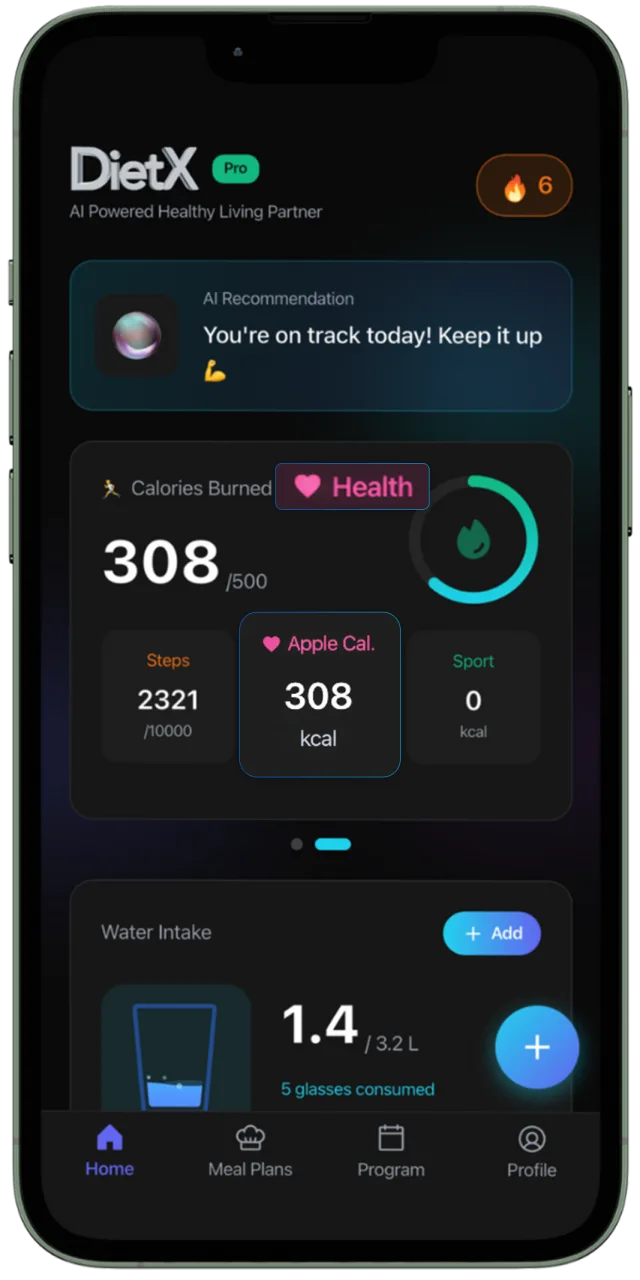
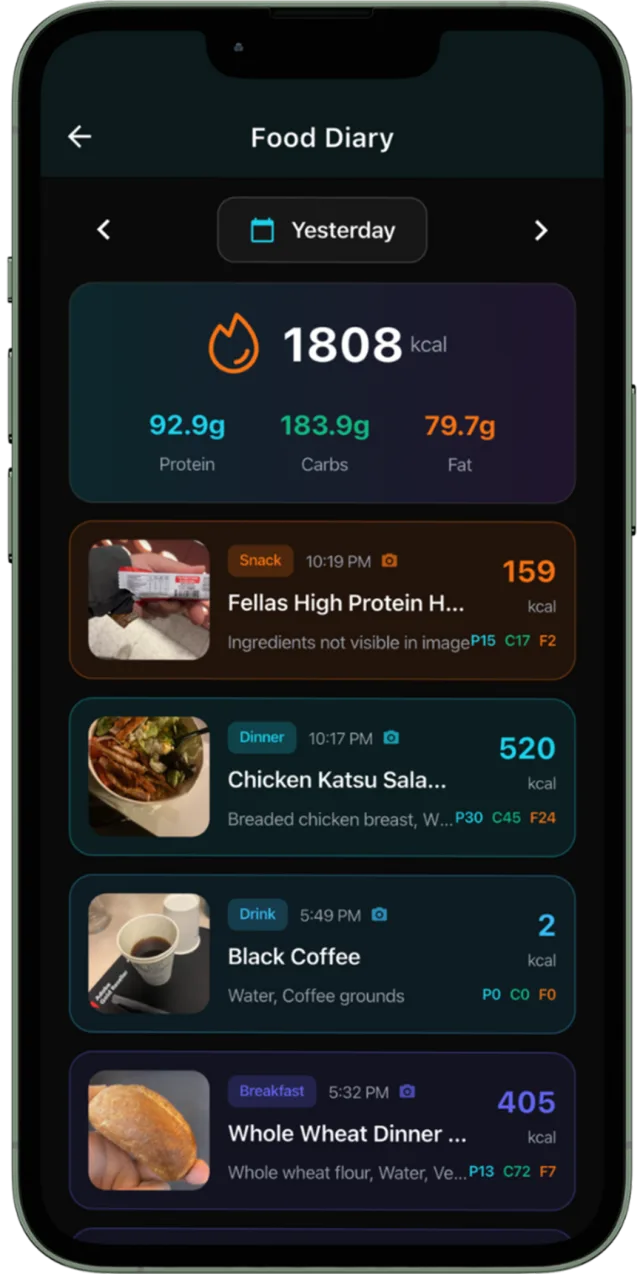
DietX is for people who've given up on macro tracking because it took too long. You can log a meal by photo, description, voice or barcode, and AI estimates calories, protein, carbs and fat, which you can edit before saving. It works out your targets from your age, height, weight, activity level and goal, and it can suggest meal plans that fit. The limits: it's not free, it's young, it isn't built as a coaching program, and estimates may vary. You can see how DietX logs macros on its page.
MyFitnessPal is the familiar option, with the longest history here and a far larger user base than DietX. Its free plan covers food tracking with ads, but scanning, AI logging and custom macro goals need Premium. With Premium you can view macros in grams or percent and set different goals for each day of the week, which helps if your training days differ.
YAZIO suits a low-commitment start, with a free tracker, no signup and barcode scanning listed under it. It has 4M+ foods, its calorie counter analyzes macros and nutritional values, and Pro adds custom meal plans. Whether you can set your own macro targets for free isn't stated.
Lifesum suits you if you'd like meal plans with grocery lists to do the planning for you. It lists a macro tracker and nutrition plans, though not which of them are free, and the free plan is limited.
Is there a good free macro tracker?
Yes, and Cronometer is the one we can point to with confidence, because custom macro targets are stated as part of its $0 plan. YAZIO's free tracker analyzes macros, but custom targets aren't stated, so try setting one before you commit. On MyFitnessPal, custom macro goals need Premium. Our list of the best calorie counter apps has more options if macros are only part of what you need.
You can also use a spreadsheet
It costs nothing, nobody shows you ads, and it makes you learn the numbers. List each food's values per 100 g, multiply by what you ate, and add up. Here's one dinner using USDA values for the prepared foods:
| Food | Amount | kcal | Protein | Carbs | Fat |
|---|---|---|---|---|---|
| Chicken breast, roasted | 150 g | 248 | 46.5 g | 0 g | 5.4 g |
| White rice, cooked | 200 g | 260 | 5.4 g | 56.4 g | 0.6 g |
| Broccoli, boiled | 100 g | 35 | 2.4 g | 7.2 g | 0.4 g |
| Olive oil | 1 tbsp (13.5 g) | 119 | 0 g | 0 g | 13.5 g |
| Total | 662 | 54.3 g | 63.6 g | 19.9 g |
Against the example targets, that dinner gives you about 40% of the day's protein and about 37% of the calories. Doing that by hand once is useful. Doing it for every meal for months is where an app starts to earn its place.
Macro mistakes an app won't catch for you
No tracker fixes these, whichever one you choose:
- Raw versus cooked. USDA values give white rice 80.0 g of carbs per 100 g raw and 28.2 g cooked. Choosing the wrong entry is a 51.8 g error for every 100 g.
- Forgotten fat. That single tablespoon of oil supplied 13.5 g of the dinner's 19.9 g of fat.
- Chasing every gram. Being a few grams off is fine. Getting protein and calories roughly right, and letting carbs and fat vary within the ranges above, is a simpler goal.
Macro tracking isn't for everyone. If hitting exact numbers starts to feel stressful, or you've struggled with disordered eating, look for support instead of a better app. Please don't cut calories drastically to make the numbers fit, and speak to a professional first if you're pregnant or have a medical condition.
Frequently asked questions
What is the best free macro tracker app?
Cronometer is the clearest choice, because its $0 Basic plan includes custom macro and micronutrient targets, a barcode scanner and 1M+ verified foods. YAZIO has a free tracker that analyzes macros, and MyFitnessPal has a free plan, but its custom macro goals need Premium.
What is the best macro tracker app for coaching?
MacroFactor is built for serious macro coaching. It has no free plan, only a 7-day trial, and is listed at $71.99 a year, $47.99 for 6 months or $11.99 a month on the US App Store.
How do I work out my macro targets?
Choose a calorie target and a split, then divide by 4 for protein and carbs and by 9 for fat. For example, 1,800 kcal at 30% protein, 45% carbs and 25% fat is 135 g protein, about 203 g carbs and 50 g fat.
Can I track macros in a spreadsheet?
Yes. List each food’s values per 100 g, multiply by the amount you ate and add them up. It’s free and teaches you the numbers, but it takes longer than an app for mixed meals.
Does DietX track macros?
Yes. It sets daily calorie and macro targets and estimates calories, protein, carbs and fat for what you log, and you can edit items before saving. It is free to download with a free trial, and Premium is a subscription.
Sources
- FAO: Food energy, methods of analysis and conversion factors
- National Academies: Dietary Reference Intakes for energy and macronutrients
- Jäger et al. (2017), J Int Soc Sports Nutr: ISSN position stand on protein and exercise
- MacroFactor on the App Store
- Cronometer: Gold
- Cronometer on the App Store
- DietX on the App Store
- MyFitnessPal: Premium
- MyFitnessPal on the App Store
- YAZIO on the App Store
- Lifesum on the App Store
- USDA FoodData Central (SR Legacy)
- NHS: Eating disorders
General information, not medical advice. Talk to a doctor or dietitian before changing your diet, especially if you are pregnant, under 18 or have a health condition. If tracking food makes you anxious or you have a history of disordered eating, please skip calorie counting and ask a professional for support.