High Protein Foods: Ranked per 100 g and per 100 kcal
By the DietX team · Updated · 7 min read
The high protein foods with the most protein per 100 g in USDA data are roasted chicken breast (31.0 g) and turkey breast (30.1 g). For protein per calorie, the leaders are canned light tuna at 22.6 g per 100 kcal, turkey breast at 20.5 g, chicken breast at 18.8 g and nonfat Greek yogurt at 17.3 g. Among plant protein sources, firm tofu leads at 12.0 g per 100 kcal.
Why protein per 100 kcal matters
Protein per 100 g tells you how concentrated a food is. Protein per 100 kcal tells you how much protein you get for the calories you spend, which is often the better question when you're watching your intake.
The sum is simple: protein ÷ kcal × 100. For chicken breast, that's 31.0 ÷ 165 × 100 = 18.8.
Cheddar shows why you need both. At 24.3 g per 100 g it looks like a great protein source, but it comes with 410 kcal, so it gives you only 5.9 g per 100 kcal. Peanut butter works the same way: a big number per 100 g (22.2 g), a small one per calorie (3.7 g).
All values below are from USDA FoodData Central, for the prepared state shown. Cooking changes weight, so a raw portion won't match them.
High protein animal foods
Sorted by protein per 100 kcal:
| Food, per 100 g | Calories | Protein | Protein per 100 kcal |
|---|---|---|---|
| Tuna, light, canned in water | 86 kcal | 19.4 g | 22.6 g |
| Turkey breast, roasted | 147 kcal | 30.1 g | 20.5 g |
| Chicken breast, roasted | 165 kcal | 31.0 g | 18.8 g |
| Greek yogurt, plain nonfat | 59 kcal | 10.2 g | 17.3 g |
| Cottage cheese, 2% | 81 kcal | 10.5 g | 13.0 g |
| Salmon, farmed Atlantic, cooked | 206 kcal | 22.1 g | 10.7 g |
| Ground beef, 85% lean, broiled | 250 kcal | 25.9 g | 10.4 g |
| Egg, hard-boiled | 155 kcal | 12.6 g | 8.1 g |
| Milk, 1% | 42 kcal | 3.4 g | 8.1 g |
| Cheddar, sharp | 410 kcal | 24.3 g | 5.9 g |
| Milk, whole | 61 kcal | 3.2 g | 5.2 g |
A low rank here doesn't make a food a poor choice. Salmon and eggs rank lower because they carry more fat, and that fat is part of why people like eating them. This table only measures one thing.
High protein plant foods
Also sorted by protein per 100 kcal, with fiber added, because it's one of the things plants bring that animal foods don't:
| Food, per 100 g | Calories | Protein | Protein per 100 kcal | Fiber |
|---|---|---|---|---|
| Spinach, raw | 23 kcal | 2.9 g | 12.6 g | 2.2 g |
| Tofu, firm (calcium sulfate) | 144 kcal | 17.3 g | 12.0 g | 2.3 g |
| Lentils, boiled | 116 kcal | 9.0 g | 7.8 g | 7.9 g |
| Broccoli, boiled | 35 kcal | 2.4 g | 6.9 g | 3.3 g |
| Black beans, boiled | 132 kcal | 8.9 g | 6.7 g | 8.7 g |
| Chickpeas, boiled | 164 kcal | 8.9 g | 5.4 g | 7.6 g |
| Whole-wheat bread | 252 kcal | 12.5 g | 5.0 g | 6.0 g |
| Oats, dry | 389 kcal | 16.9 g | 4.3 g | 10.6 g |
| Peanut butter, smooth | 598 kcal | 22.2 g | 3.7 g | 5.0 g |
| Quinoa, cooked | 120 kcal | 4.4 g | 3.7 g | 2.8 g |
| Pasta, cooked | 158 kcal | 5.8 g | 3.7 g | 1.8 g |
| Almonds, dry roasted | 598 kcal | 21.0 g | 3.5 g | 10.9 g |
| Chia seeds | 486 kcal | 16.5 g | 3.4 g | 34.4 g |
Spinach tops the list on paper, but 100 kcal of it is 435 g, so it won't carry your protein by itself. Tofu is the practical leader. Beans and lentils are the next stop, with the bonus of plenty of fiber toward the 25 g a day the WHO advises. Our guide to vegan and vegetarian calorie tracking builds a full day from these.
What 25 g of protein costs you
Per-100-g tables are hard to picture on a plate, so here's the same data another way: how much of each food gives you 25 g of protein, and how many calories that takes.
| Food | Amount for 25 g protein | Calories |
|---|---|---|
| Tuna, canned in water | 129 g | 111 kcal |
| Turkey breast, roasted | 83 g | 122 kcal |
| Chicken breast, roasted | 81 g | 133 kcal |
| Greek yogurt, nonfat | 245 g | 145 kcal |
| Cottage cheese, 2% | 238 g | 193 kcal |
| Tofu, firm | 145 g | 208 kcal |
| Salmon, cooked | 113 g | 233 kcal |
| Ground beef, 85% lean | 97 g | 241 kcal |
| Egg, hard-boiled | 198 g | 308 kcal |
| Lentils, boiled | 278 g | 322 kcal |
| Black beans, boiled | 281 g | 371 kcal |
| Chickpeas, boiled | 281 g | 461 kcal |
| Peanut butter | 113 g | 673 kcal |
Look at the far ends: 25 g of protein costs about 111 kcal from tuna and about 673 kcal from peanut butter. That doesn't make peanut butter bad food. It does mean it counts as a fat source that brings some protein, so log it that way.
If you're wondering how much you need in total, our guide to how much protein per day has a table by body weight.
High protein low calorie swaps
Small swaps do most of the work, and they don't require a new way of eating:
| Instead of | Try | Calories | Protein |
|---|---|---|---|
| 100 g ground beef, 85% lean | 100 g roasted turkey breast | 250 → 147 kcal | 25.9 → 30.1 g |
| 200 g cooked pasta | 200 g boiled lentils | 316 → 232 kcal | 11.6 → 18.0 g |
| 30 g almonds | 150 g nonfat Greek yogurt | 179 → 89 kcal | 6.3 → 15.3 g |
| 30 g sharp cheddar | 100 g 2% cottage cheese | 123 → 81 kcal | 7.3 → 10.5 g |
| 200 g whole milk | 200 g 1% milk | 122 → 84 kcal | 6.4 → 6.8 g |
| 150 g cooked white rice | 150 g cooked quinoa | 195 → 180 kcal | 4.1 → 6.6 g |
Almonds still earn a place for their fat and fiber, so this is a swap for some days and doesn't need to be a rule. The same goes for all of these: use the ones that fit food you already like.
How to use this in everyday meals
- Anchor each meal on one protein food, then add the rest. A sample meal plan shows how a day fits together.
- Keep a low-effort option at home. Canned tuna, Greek yogurt and cottage cheese need no cooking.
- Weigh cooked foods when using cooked values. Those figures don't apply to the same weight of raw food, and the gap can be big: white rice is 365 kcal per 100 g raw and 130 kcal cooked.
- Don't let protein crowd out plants. The WHO advises at least 400 g of fruit and vegetables a day.
Higher-protein diets can help in the short term: in shorter controlled trials they led to more weight and fat loss and more lean mass kept, though long-term results depend on sticking with them. Results vary, and no single food does this by itself. If you're using these foods to lose weight, avoid extreme restriction and stay above about 1,200 kcal. If you have kidney disease, are pregnant or have another medical condition, ask a doctor or dietitian before changing your protein intake.
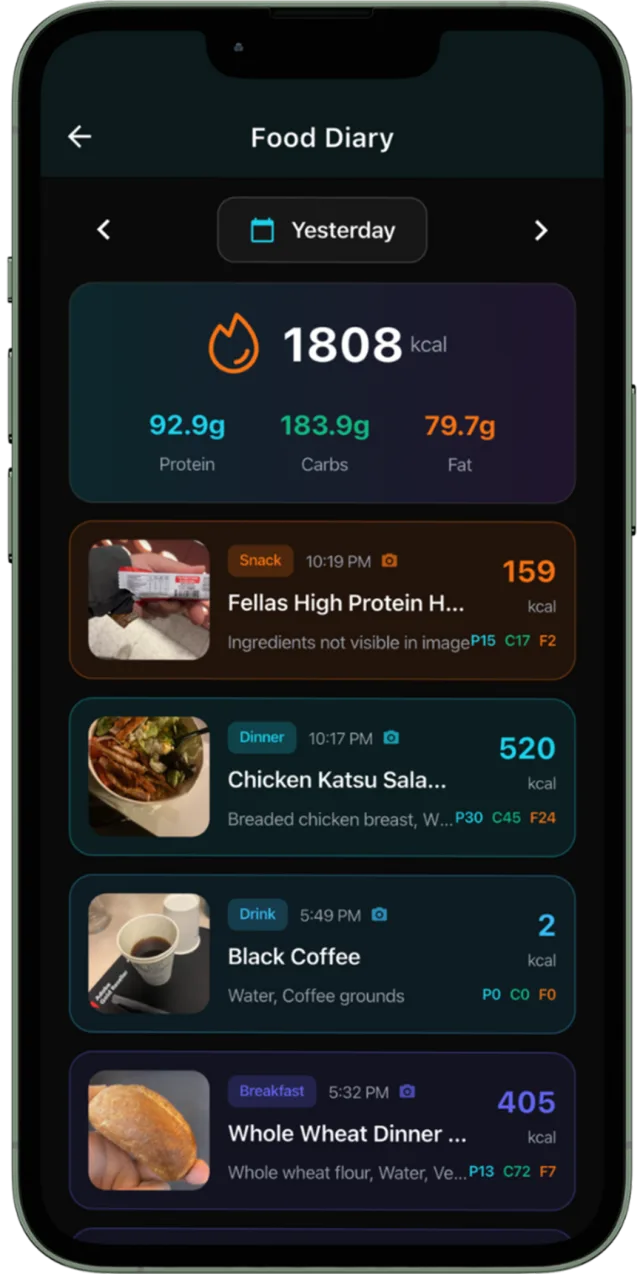
To see where your protein stands on a normal day, log a meal in DietX by photo, description, voice or barcode. It estimates calories, protein, carbs and fat, and you can edit any item before you save it. It's free to download with a free trial, and Premium is a subscription. For the math behind a daily target, see how to track macros.
Frequently asked questions
What food has the most protein?
Among common foods in USDA data, roasted chicken breast (31.0 g per 100 g) and roasted turkey breast (30.1 g) are at the top. Per calorie, canned light tuna in water leads at 22.6 g of protein per 100 kcal.
What are the best high protein, low calorie foods?
Canned tuna in water, turkey breast, chicken breast and nonfat Greek yogurt all give you more than 17 g of protein per 100 kcal. Cottage cheese follows at 13.0 g. Among plant foods, firm tofu gives 12.0 g per 100 kcal.
Which plant foods have the most protein?
Per 100 g, peanut butter (22.2 g), almonds (21.0 g) and firm tofu (17.3 g) are high, but nuts come with far more calories. Per 100 kcal, tofu gives 12.0 g, lentils 7.8 g and black beans 6.7 g.
How much protein is in an egg?
A hard-boiled egg has 12.6 g of protein per 100 g, according to USDA data. A 50 g egg therefore gives you about 6.3 g of protein and about 78 kcal.
Does cooking change how much protein is in food?
Cooking mostly changes the weight, which changes the numbers per 100 g. White rice has 7.1 g of protein per 100 g raw and 2.7 g cooked because it absorbs water. Use the raw or cooked value that matches what you weighed.
Sources
- USDA FoodData Central (SR Legacy)
- WHO: Healthy diet
- Leidy et al. (2015), Am J Clin Nutr: The role of protein in weight loss and maintenance
General information, not medical advice. Talk to a doctor or dietitian before changing your diet, especially if you are pregnant, under 18 or have a health condition. If tracking food makes you anxious or you have a history of disordered eating, please skip calorie counting and ask a professional for support.