How Many Calories Should I Eat a Day? A Simple Calculation
By the DietX team · Updated · 5 min read
As a rough guide, the NHS puts the average man at 2,500 kcal a day and the average woman at 2,000 kcal. Your own number can sit hundreds of calories either side, because it depends on your age, height, weight and how much you move.
The good news is that you can get a solid personal estimate in about two minutes with a pen, or skip the maths and let an app such as DietX set the target for you.
How to calculate your daily calories
You need two numbers: your basal metabolic rate (BMR), which is what your body burns at rest, and your activity level.
Step 1: find your BMR
The formula with the best track record is Mifflin-St Jeor. A systematic review of the common equations found it was the most reliable, landing within 10% of measured values for more people than any other. Here is the formula:
- Men: (10 × weight in kg) + (6.25 × height in cm) − (5 × age) + 5
- Women: (10 × weight in kg) + (6.25 × height in cm) − (5 × age) − 161
Step 2: multiply by your activity level
These multipliers are commonly used with the formula. They are rough, so pick honestly, and choose the lower one if you are torn between two.
| Your typical week | Multiply BMR by |
|---|---|
| Mostly sitting, little exercise | 1.2 |
| Light exercise 1 to 3 days a week | 1.375 |
| Moderate exercise 3 to 5 days a week | 1.55 |
| Hard exercise 6 to 7 days a week | 1.725 |
| Physical job plus daily hard training | 1.9 |
The result is your maintenance calories: roughly what you can eat each day without your weight changing. We explain the terms in more detail in our guide to BMR, TDEE and maintenance calories.
Two worked examples
| Woman, 35, 165 cm, 70 kg | Man, 35, 180 cm, 85 kg | |
|---|---|---|
| BMR | 700 + 1,031 − 175 − 161 = 1,395 kcal | 850 + 1,125 − 175 + 5 = 1,805 kcal |
| Activity | Light (× 1.375) | Moderate (× 1.55) |
| Maintenance | about 1,920 kcal | about 2,800 kcal |
Notice how far apart these are, and how neither one matches the 2,000 or 2,500 average. That is why a personal estimate beats a general rule.
How many calories to lose, maintain or gain weight
Once you have your maintenance number, adjust it for your goal.
| Goal | Daily target | What to expect |
|---|---|---|
| Lose weight | Maintenance minus about 300 to 500 kcal | Gradual loss, roughly 0.3 to 0.5 kg a week at first. The NHS suggests 0.5 to 1 kg a week as the aim, so this is the gentle end |
| Maintain | Maintenance | Stable weight over several weeks |
| Gain weight | Maintenance plus about 200 to 300 kcal | Slow gain, best paired with strength training |
Going gradually is not just the cautious option. The CDC notes that people who lose weight steadily are more likely to keep it off. Read our guide to a calorie deficit for how to set one up without feeling miserable.
Why your estimate will be slightly wrong
Every formula gives an estimate, and the same review that favored Mifflin-St Jeor still found errors for some people. So treat your number as a starting point, then let your results correct it:
- Eat at your target for two to three weeks and log as honestly as you can.
- Weigh yourself regularly and look at the trend, not single days. Daily ups and downs are normal.
- If the trend isn't moving the way you expected, change your target by about 100 to 200 kcal and repeat.
Your needs also change as you go. Research on energy balance shows that weight responds slowly to a change in intake, and that loss tapers off over time. So it's worth recalculating every time your weight changes by a few kilos.
The easiest way to hit your number
Knowing your target is the easy part. Hitting it means knowing what you actually ate, and that is where most people quit: one study found that participants spent 23 minutes a day logging food in their first month.
Tracking does seem worth the effort. A review of 22 studies consistently linked self-monitoring with weight loss, although the authors called the evidence weak because of limits in how the studies were run.
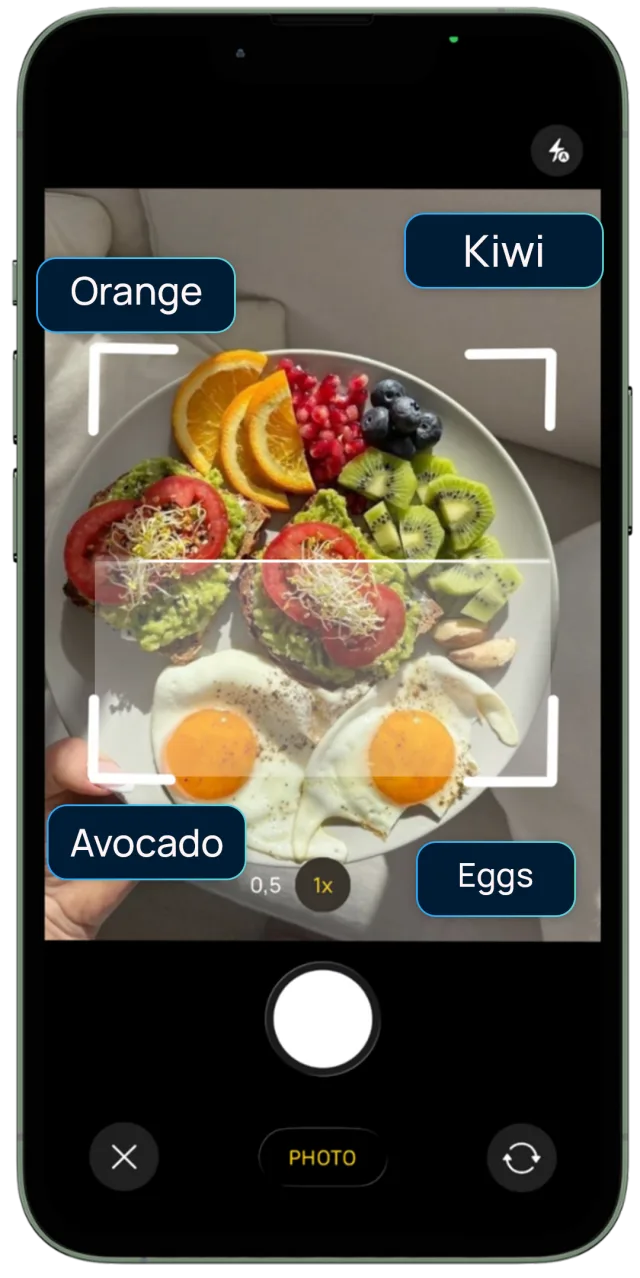
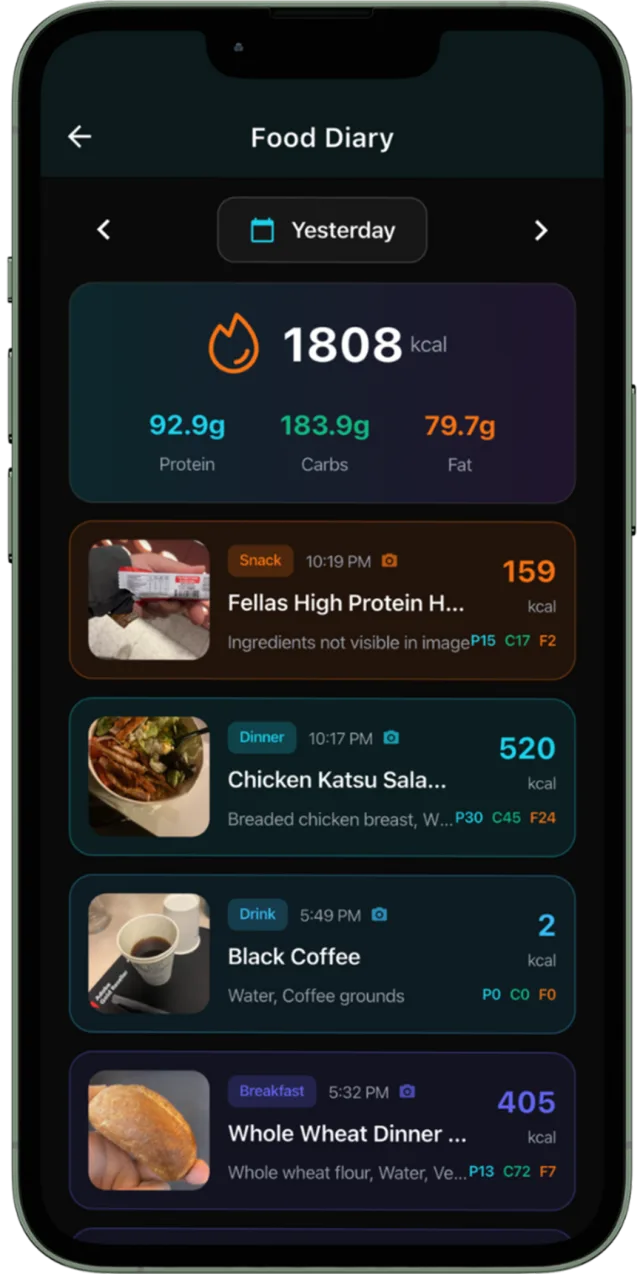
This is the problem DietX is built around. It works out your daily calorie and macro targets from your age, height, weight, activity level and goal. You then log a meal by taking a photo, describing it, saying it out loud or scanning a barcode, and you can edit any item before you save it. The estimates aren't perfect, which we cover in how accurate AI calorie counters are, but quick logging you keep doing beats perfect logging you drop after a week.
New to all this? Start with our beginner's guide to counting calories.
Frequently asked questions
Is 2,000 calories a day right for me?
It is a general reference, close to the average woman’s needs according to the NHS. Depending on your body and activity, your maintenance level may be several hundred calories higher or lower, so calculate your own with the Mifflin-St Jeor formula.
How many calories should I eat to lose weight?
Start with your maintenance calories and subtract about 300 to 500 kcal a day. That works out to roughly 0.3 to 0.5 kg a week at first, the gentle end of the 0.5 to 1 kg a week the NHS suggests. If that puts you below about 1,200 kcal, talk to a doctor or dietitian first.
Is it dangerous to eat too few calories?
It can be. Severe restriction is hard to sustain and may leave you short of nutrients. Very low-calorie diets are something to do only with medical supervision. If tracking food makes you anxious or you have a history of disordered eating, skip calorie counting and ask a professional for support.
Should I eat back the calories I burn exercising?
If you used an activity multiplier, your workouts are already counted. Fitness trackers are also unreliable here: in one test, no wrist device got its calorie estimate within 20%. Adding those numbers on top can easily cancel your deficit.
How often should I recalculate my calories?
Recalculate when your weight changes by a few kilos, your activity changes, or your weight trend has stalled for several weeks.
Sources
- NHS: Understanding calories
- Frankenfield et al. (2005), J Am Diet Assoc: Predictive equations for resting metabolic rate, a systematic review
- Mifflin et al. (1990), Am J Clin Nutr: A new predictive equation for resting energy expenditure
- NHS: Tips to help you lose weight
- CDC: Steps for losing weight
- Hall et al. (2011), Lancet: Quantification of the effect of energy imbalance on bodyweight
- Harvey et al. (2019), Obesity: Log Often, Lose More
- Burke et al. (2011), J Am Diet Assoc: Self-monitoring in weight loss, a systematic review
General information, not medical advice. Talk to a doctor or dietitian before changing your diet, especially if you are pregnant, under 18 or have a health condition. If tracking food makes you anxious or you have a history of disordered eating, please skip calorie counting and ask a professional for support.