Are AI Calorie Counters Accurate? What the Evidence Shows
By the DietX team · Updated · 8 min read
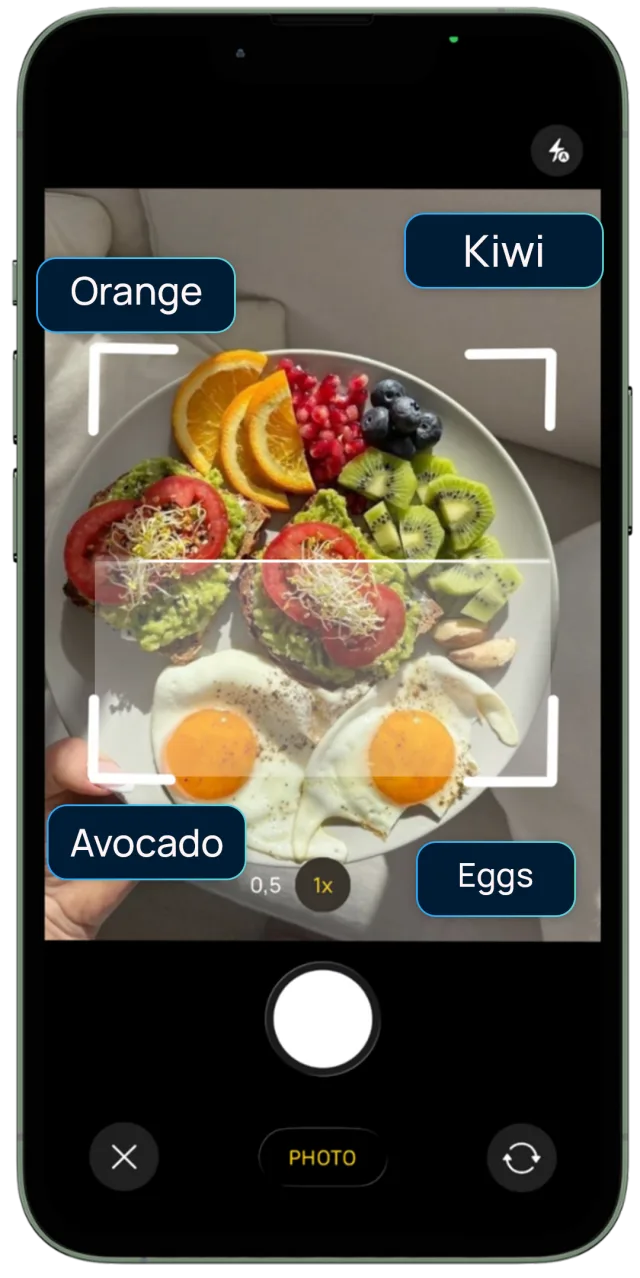
Are AI calorie counters accurate? Partly: they are good at identifying food, weaker at estimating portions, and they can't see hidden ingredients such as cooking oil. The research we drew on contains no independent head-to-head test of consumer calorie apps, so nobody can honestly tell you which app is most accurate or give you one reliable percentage.
That includes us. We make DietX, which estimates calories from photos, and we have no accuracy figure for it. Its App Store listing says that estimates may vary. Here is what the evidence does show and what you can do about it.
What the studies say about AI calorie counter accuracy
Five papers are worth knowing. None is a head-to-head comparison of consumer apps and none tests DietX, so they tell you more about the technology than about any product you might download.
| Source | What it looked at | What it found |
|---|---|---|
| ChatGPT study, 2025 | ChatGPT estimating nutrients from meal photos | Good at naming foods, small portions and ranking meals by nutrients. Poor on medium and large portions and exact values. Tended to underestimate |
| App validation, 2022 | One smartphone image-recognition app | Improved when users corrected its result by hand |
| Review, 2020 | Image-assisted dietary assessment | Less burdensome methods are less accurate. No method suits every setting |
| Review, 2024 | AI dietary assessment from food images | Real progress in identifying food and estimating portions. Dietitians should stay involved |
| GPT-4o validation, 2025 | A customized AI model against weighed food records | Accuracy depends on clear images with visible food and on accurate portion sizes. Expert oversight still matters |
Identifying food is the stronger part. Portion estimates have made progress, according to the 2024 review, but they are where the ChatGPT study fell down, and the 2025 validation names them as something accuracy depends on. The tendency to underestimate in the ChatGPT study is also the unhelpful direction if you're trying to lose weight. We can't say every app shares it, because nothing in these sources compares them.
We aren't quoting an error percentage for AI logging in general, because a result from one model and one set of meals wouldn't carry over to the app on your phone.
How accurate are calorie counting apps compared with other methods?
AI isn't the only imprecise option, and it helps to know what you're comparing it with.
- Weighing food. Weighed food records are what the 2025 validation measured AI against. A kitchen scale is the most reliable thing most people have at home, and also the most effort.
- Food labels. US rules treat food as misbranded if calories run more than 20% over the label, so a label can be off and still legal.
- Restaurant menus. Across 269 restaurant foods, stated calories were accurate overall, with an average difference of 10 kcal a portion, but 19% had at least 100 kcal more per portion than stated.
- Your own memory. In a small study of 10 adults who called themselves diet-resistant, people under-reported their food by 47%. That's a specific group, so don't read it as typical, but self-reports can clearly be far off.
None of this lets AI off the hook. A photo estimate puts a portion guess on top of nutrition data that is itself approximate, and the 2020 review found that less burdensome methods are less accurate. A photo is low effort, and you pay for that in precision. If a number really has to be right, weigh the food.
What about the accuracy percentages on app websites?
Some calorie apps advertise a percentage. Those figures are the vendors' own, and nothing in the sources we use independently confirms them. Before you trust one, ask:
- Who ran the test, and can you read how it was done?
- What was it measured against? Weighed food means something. Another app's number means much less.
- What does the percentage measure? Naming the food correctly is a different thing from getting the calories right.
- Which foods were in it? A single item on a white plate is far easier than a stew.
We can't answer those questions for DietX because we have no benchmark, so we don't quote a figure.
Where the errors matter most
Errors stack. Here is an illustration using USDA values, where an estimate gets the chicken and broccoli right, reads the rice 50 g low and misses the cooking oil. It's our own arithmetic, with no app involved.
| Item | On the plate | A low estimate |
|---|---|---|
| Roasted chicken breast, 150 g | 248 kcal | 248 kcal |
| Cooked white rice | 200 g, 260 kcal | 150 g, 195 kcal |
| Boiled broccoli, 100 g | 35 kcal | 35 kcal |
| Olive oil, 1 tbsp | 120 kcal | Not seen |
| Total | 663 kcal | 478 kcal |
That estimate is 185 kcal too low, or about 28%. Two meals like that in a day leave about 370 kcal unlogged, which can cancel a modest calorie deficit without you noticing.
Errors do the most damage with:
- Large portions. These were the weak spot in the ChatGPT study.
- Calorie-dense foods. Misjudge almonds by 50 g and you're off by about 299 kcal. Do the same with boiled broccoli and it's about 18 kcal (USDA).
- Mixed dishes. Stews, curries and casseroles keep their ingredients out of view, and accuracy depends on the food being visible.
- Medical needs. If you manage a condition with diet or medication, don't base decisions on an app estimate. DietX's listing says plainly it is not a medical device, and the studies above still call for experts to stay involved. Talk to your doctor or dietitian.
How to make AI calorie estimates more accurate
- Give it a clear picture. Keep the food visible and well lit. Our guide to counting calories from a photo covers angles and scale.
- Correct the result. In the app validation, results improved when users corrected them. Check portions first.
- Add hidden fat yourself. One tablespoon of olive oil is about 13.5 g, so about 120 kcal.
- Weigh dense foods for a week or two. Oil, nuts, cheese, rice and pasta are good places to start. You'll learn what your usual portion looks like and spot when an estimate is off.
- Use the label for packaged food. A barcode or label removes the guess about what the food is, though you still have to get the amount right.
- Check your app on a few weighed meals. Weigh a meal, add it up from labels or USDA values, then compare with the app's estimate. A handful of meals won't give you a percentage, but it can show whether the app runs high or low on the food you eat. Our guide to AI calorie counter apps has more on judging one.
Plenty of errors have nothing to do with AI, so look through the common calorie counting mistakes as well.
Why consistency counts for more than perfect numbers
Given those limits, is an AI estimate any use? For many people it can be, as long as they keep logging and check the log against real results.
A review of 22 studies consistently linked self-monitoring (keeping a record of what you eat and do) with weight loss, though the evidence was rated weak because of limits in the methods. In a study of 142 adults, logging more often went with more loss: people who lost at least 10% logged in 2.7 times a day, against 1.7 in the comparison group. These are associations, and they don't prove logging caused the loss. Results also vary from person to person.
An imperfect log is still useful because your weight trend can check it. If your log says you're eating below maintenance, the level where your weight holds steady, and your weekly average weight hasn't moved in several weeks, the log may be reading low or your target may be too high, so look for what's missing first. A consistent error is easier to correct than a random one. Consistency won't make a number right, though it does let you compare one week with the next.
Whatever the log says, please don't respond by cutting your food drastically. If you are pregnant or have a medical condition, talk to a professional about your targets.
When an AI estimate is good enough, and when it isn't
An AI estimate is usually good enough for learning what you eat, following a weight trend over several weeks, and logging on busy days when the alternative is logging nothing.
It isn't good enough for medical decisions, or for anything that needs exact nutrient values, which is where the ChatGPT study found it poor.
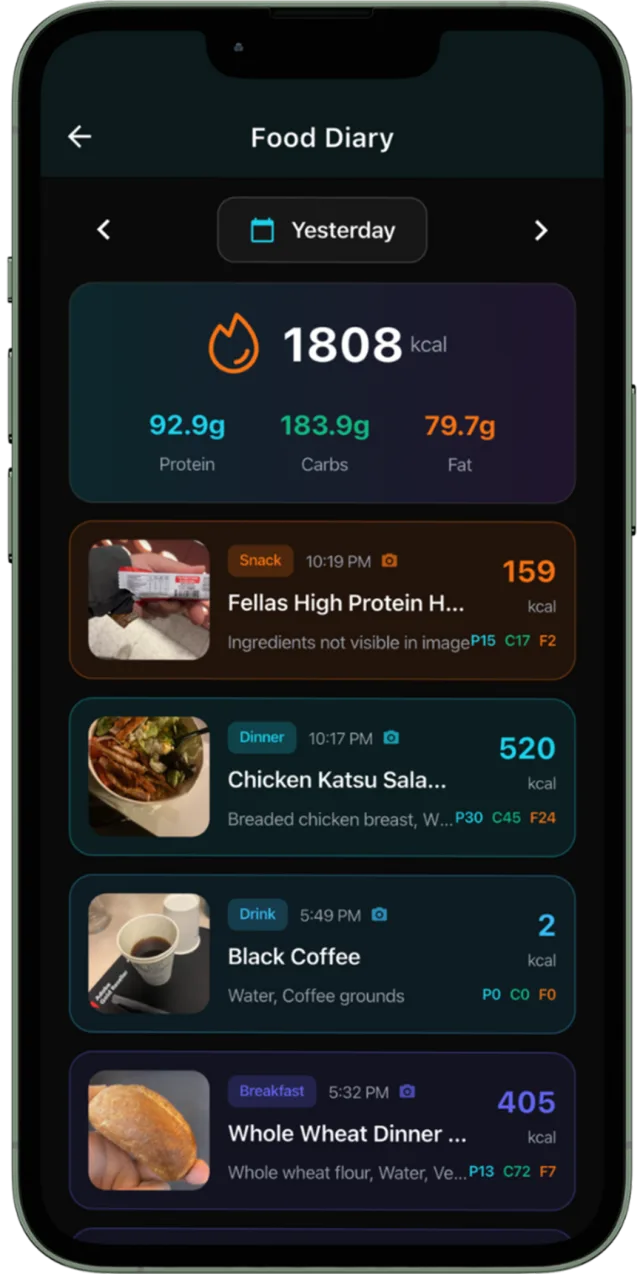
DietX has the same limits. It estimates calories, protein, carbs and fat, and you can edit any item before saving. We have no data showing it beats other apps, so we won't tell you it does.
Frequently asked questions
Are AI calorie counters accurate?
Partly. Research suggests they are good at identifying food and weaker at portions, and a camera can’t see hidden ingredients such as cooking oil. Treat the result as an estimate, correct it, and judge your log against your weight trend over several weeks.
How accurate are calorie counting apps?
There is no single honest figure. The sources we use contain no independent head-to-head test of consumer calorie apps, and percentages on app websites are the vendors’ own. Accuracy also depends on your photo, your portions and whether you correct the result.
Which AI calorie counter is the most accurate?
We can’t say, and we make one. Without an independent head-to-head test, any claim of being the most accurate has nothing solid behind it. You can check an app yourself by comparing its estimates with a few meals you have weighed.
Do AI calorie counters underestimate calories?
They can. One study of ChatGPT on meal photos found it tended to underestimate. That may not apply to every app, but missed oil and sauces push estimates in the same direction, so check portions and add fats yourself.
Is a food scale more accurate than an AI calorie counter?
Generally, yes. Weighed food records are what researchers use as the reference when they test AI estimates. A scale takes more effort, though, so many people weigh dense foods at home and use a photo or description when they are out.
Sources
- DietX on the App Store
- An evaluation of ChatGPT for nutrient content estimation from meal photographs (2025), Nutrients
- Nutrient and food group prediction by image recognition in a smartphone app (2022), JMIR Form Res
- Review of the validity and feasibility of image-assisted methods for dietary assessment (2020), Int J Obes
- Advancements in using AI for dietary assessment based on food images (2024), J Med Internet Res
- Customized multimodal GPT-4o and image-based dietary assessment against weighed food records (2025), Am J Clin Nutr
- US Code of Federal Regulations: 21 CFR 101.9, nutrition labeling
- Urban et al. (2011), JAMA: Accuracy of stated energy contents of restaurant foods
- Lichtman et al. (1992), N Engl J Med: Self-reported and actual caloric intake and exercise
- USDA FoodData Central (SR Legacy)
- Burke et al. (2011), J Am Diet Assoc: Self-monitoring in weight loss, a systematic review
- Harvey et al. (2019), Obesity: Log Often, Lose More
General information, not medical advice. Talk to a doctor or dietitian before changing your diet, especially if you are pregnant, under 18 or have a health condition. If tracking food makes you anxious or you have a history of disordered eating, please skip calorie counting and ask a professional for support.