BMR vs TDEE: What They Mean and How to Find Maintenance Calories
By the DietX team · Updated · 7 min read
The difference in BMR vs TDEE is simple: BMR (basal metabolic rate) is the energy your body burns at rest, and TDEE (total daily energy expenditure) is everything you burn in a day, including movement and exercise. Your maintenance calories are the same number as your TDEE, seen from the food side: what you can eat without your weight changing. For a 35-year-old woman of 165 cm and 70 kg with light activity, that means a BMR of about 1,395 kcal and a TDEE of about 1,920 kcal.
The rest of this guide covers what goes into those numbers, why calculators disagree, and how to find your true maintenance from real results.
BMR vs TDEE vs maintenance calories
| Term | What it means | Woman above | Man, 35, 180 cm, 85 kg, moderate activity |
|---|---|---|---|
| BMR | Energy burned at rest | 1,395 kcal | 1,805 kcal |
| TDEE | BMR plus digestion, daily movement and exercise | about 1,920 kcal | about 2,800 kcal |
| Maintenance calories | The intake that keeps your weight steady | about 1,920 kcal | about 2,800 kcal |
You may also see RMR or REE, short for resting metabolic rate and resting energy expenditure. These are measured under less strict conditions than BMR, and the Mifflin-St Jeor equation technically predicts resting energy. For everyday use you can treat them as the same thing.
What is TDEE made of?
Your daily burn has four parts:
- Resting metabolism (your BMR). Breathing, circulating blood, keeping warm and running your organs. For most people, this is the largest part.
- Digesting food. Turning a meal into usable energy costs a little energy.
- Everyday movement. Walking to the bus, housework, standing, fidgeting. This can vary a lot between people and from week to week.
- Exercise. Planned workouts. This part is easy to overrate.
In the two examples above, BMR makes up about 73% and 65% of TDEE. Those shares follow directly from the multiplier (1 ÷ 1.375 and 1 ÷ 1.55), so read them as illustrations, not measurements.
How to calculate your BMR and TDEE
It takes two steps. First, get your BMR from the Mifflin-St Jeor equation, which uses your weight, height, age and sex. A systematic review found it the most reliable of the common equations. Then multiply by an activity factor to get your TDEE. Our guide to how many calories you need a day has the full formula and walks through it step by step.
What that guide doesn't show is how much the activity factor matters. Here are the same two people at every level. The multipliers are rough, and commonly used rather than exact.
| Activity level | Multiplier | Woman (BMR 1,395) | Man (BMR 1,805) |
|---|---|---|---|
| Sedentary | 1.2 | 1,674 kcal | 2,166 kcal |
| Light | 1.375 | 1,918 kcal | 2,482 kcal |
| Moderate | 1.55 | 2,162 kcal | 2,798 kcal |
| Very active | 1.725 | 2,406 kcal | 3,114 kcal |
| Extra active | 1.9 | 2,651 kcal | 3,430 kcal |
Each step down the table adds about 244 kcal for her and about 316 kcal for him. From top to bottom the gap is 977 kcal and 1,264 kcal. So the box you tick moves the answer far more than rounding ever will. If you're torn between two levels, choose the lower one.
Why TDEE calculators give different answers
If two calculators gave you two numbers, one of them isn't necessarily broken. There are several honest reasons they differ.
- Different equations. Many use Mifflin-St Jeor and some use older formulas. Even the best one is only an estimate: the review found it landed within 10% of measured values for more people than any other. On a BMR of 1,395 kcal, 10% is about 140 kcal a day in either direction, and some people fall outside that.
- Different activity labels. One site's "moderate" is another's "light", and one row of the table above is worth 244 kcal or more.
- Exercise counted differently. Some calculators build workouts into the multiplier and others add them separately. Add your watch's number on top of a multiplier and you count the same workout twice. Our article on eating back exercise calories goes through this.
- They can't see you. A formula knows your weight, height, age and sex. It doesn't know how much muscle you carry, how much you fidget or whether a medical condition is involved.
Wearables have their own problem. In a test of 7 wrist devices, none got its energy expenditure error below 20%. On a reading of 2,500 kcal, 20% is 500 kcal, so don't trust the figure to the digit.
How to find your real maintenance calories
A formula gives you a starting point. Your own results give you the answer.
- Start with your estimated TDEE.
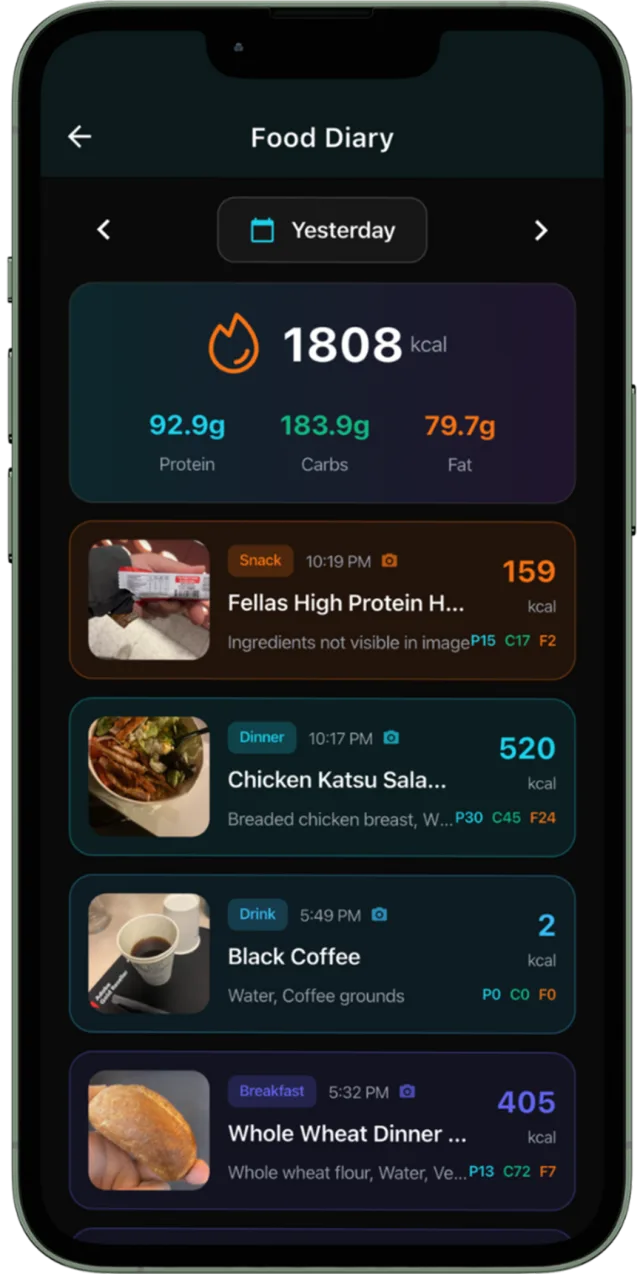
- Eat close to it for two to three weeks and log as honestly as you can, including cooking oil, drinks and bites.
- Weigh yourself a few mornings a week and take a weekly average, since daily ups and downs are normal.
- Read the trend. If your average weight is flat, your average logged intake is about your maintenance. If it's falling, your maintenance is higher than what you're eating. If it's rising, it's lower.
- Adjust by about 100 to 200 kcal and repeat if you need to.
Here is an invented example for the woman above:
| Week | Average logged intake | Average weight |
|---|---|---|
| 1 | 1,900 kcal | 70.4 kg |
| 2 | 1,940 kcal | 70.3 kg |
| 3 | 1,910 kcal | 70.4 kg |
Her intake averages about 1,917 kcal and her weight barely moves, so her working maintenance is about 1,920 kcal. Had she stayed flat while logging 2,100 kcal, she should trust 2,100 kcal over the formula.
One caveat: logs often run low. In a small study of 10 adults who described themselves as "diet-resistant", people under-reported their food by 47%. That's a specific group, so don't read it as typical. A maintenance number from your own log still works as long as you keep logging the same way, because it's calibrated to your habits. If you want to tighten those habits, see the most common calorie tracking mistakes.
Why your maintenance calories change over time
Your maintenance is a moving target. In the formula, each kilogram you lose lowers your BMR by 10 kcal, and the activity multiplier applies on top. For the woman above, losing 10 kg lowers her maintenance by about 138 kcal (10 × 10 × 1.375). Each year of age takes off another 5 kcal of BMR, which matters much less.
Research on energy balance adds that body weight responds slowly to a change in intake, with a half time of about 1 year, and that loss tapers off. So recalculate every few kilos, and whenever your activity changes, such as a new job or an injury.
What to do with your number
- To stay where you are, eat at your maintenance and check the trend now and then.
- To lose weight, subtract a modest amount. Our guide to a calorie deficit shows how to size it.
- Don't eat to your BMR as a goal. BMR is a building block for the calculation and isn't an intake target. If your plan leaves you under about 1,200 kcal, talk to a doctor or dietitian.
Calorie counting isn't for everyone. If it makes you anxious, you have a history of disordered eating, or you're pregnant or have a medical condition, get support or professional advice first.
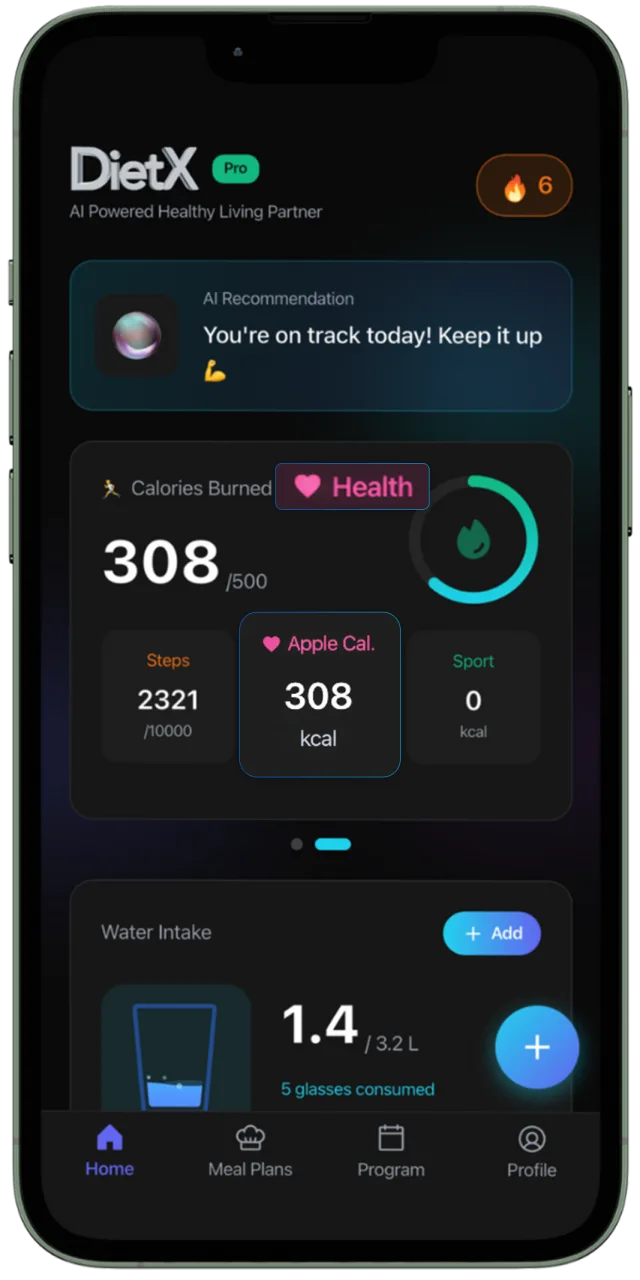
DietX works out a daily calorie and macro target from your age, height, weight, activity level and goal. It also shows your weight and trends alongside what you log, which is the comparison step 4 needs. It's free to download with a free trial, and Premium is a subscription.
Frequently asked questions
What is the difference between BMR and TDEE?
BMR is the energy your body burns at rest. TDEE adds digestion, everyday movement and exercise on top, so it is always the larger number. A woman with a BMR of 1,395 kcal and light activity has a TDEE of about 1,920 kcal.
Is TDEE the same as maintenance calories?
In practice, yes. TDEE is what you burn in a day and maintenance calories are what you can eat to match it. If you eat at your true TDEE, your weight should stay about the same over several weeks.
Should I eat at my BMR to lose weight?
No. BMR is a step in the calculation, not a target. Set your target from your TDEE, usually about 300 to 500 kcal below it. If that lands near or below about 1,200 kcal, talk to a doctor or dietitian.
Why do TDEE calculators give different results?
They may use different equations, describe activity levels differently and count exercise in different ways. A gap of a couple of hundred calories is normal. Use any one of them as a starting point, then correct it from your weight trend.
Can I trust the calories burned on my smartwatch?
Only roughly. In one test of 7 wrist devices, none got its energy expenditure error below 20%. Use the number to compare your own days, not as an amount to eat back.
Sources
- Mifflin et al. (1990), Am J Clin Nutr: A new predictive equation for resting energy expenditure
- Frankenfield et al. (2005), J Am Diet Assoc: Predictive equations for resting metabolic rate, a systematic review
- Shcherbina et al. (2017), J Pers Med: Accuracy of wrist-worn heart rate and energy expenditure
- Lichtman et al. (1992), N Engl J Med: Self-reported and actual caloric intake and exercise
- Hall et al. (2011), Lancet: Quantification of the effect of energy imbalance on bodyweight
- NHS: Eating disorders
General information, not medical advice. Talk to a doctor or dietitian before changing your diet, especially if you are pregnant, under 18 or have a health condition. If tracking food makes you anxious or you have a history of disordered eating, please skip calorie counting and ask a professional for support.