Should I Eat Back Exercise Calories? A Practical Rule
By the DietX team · Updated · 7 min read
Should you eat back exercise calories? If you're trying to lose weight, a sensible default is to eat back none, or only part of them, and let your weight trend decide from there. Many calorie targets already include your workouts, and in a test of 7 wrist devices, none got its energy expenditure error below 20%.
Eating back means adding the calories your watch or app says you burned to your food budget for the day. Below you'll find why that can wipe out a deficit, a rule to follow, and who may need to eat more.
Should I eat back exercise calories? The double-count problem
Many calorie calculators start with your basal metabolic rate (BMR), which is what your body burns at rest, and multiply it by an activity level. If you chose a more active level because you work out, your workouts are already in the number.
Take the woman from our guide to daily calories: 35 years old, 165 cm, 70 kg, with a BMR of 1,395 kcal. Say she works out three times a week.
| Activity setting | Calculation | Estimated daily burn |
|---|---|---|
| Sedentary | 1,395 × 1.2 | 1,674 kcal |
| Light | 1,395 × 1.375 | 1,918 kcal |
Choosing light over sedentary adds 244 kcal a day, which is about 1,700 kcal a week (244 × 7 = 1,708). The multipliers are rough, but the logic holds: that extra allowance exists because she's active.
Now say her watch reports 350 kcal per workout, or 1,050 kcal a week (3 × 350). If she adds those to her food as well, she's counting the same activity twice.
What that does to a deficit
Say her target is about 1,520 kcal: maintenance of about 1,920 kcal minus an example deficit of 400 kcal a day, which is 2,800 kcal a week.
| If she eats back | Food on a workout day | Eaten back per week | Planned deficit left |
|---|---|---|---|
| None | 1,520 kcal | 0 kcal | 2,800 kcal |
| Half | 1,695 kcal | 525 kcal | 2,275 kcal |
| All | 1,870 kcal | 1,050 kcal | 1,750 kcal |
Eating it all back removes more than a third of her planned deficit, and she may wonder why the scale is moving so slowly. These are sums on paper, and real results vary, but they show why the habit matters.
Why the calories on your watch are a rough guess
In that test of 7 wrist devices, heart rate readings were decent, but no device got its energy expenditure error below 20%. On a 350 kcal workout, a 20% error is 70 kcal either way, so the real burn could be around 280 or 420 kcal. It was a 2017 test, so newer models may do better or worse.
There's a second catch. Your BMR keeps running while you exercise, so any readout that counts your whole burn for that hour includes energy you'd have used anyway.
Our own impressions of how much we move aren't reliable either. In a small study of 10 adults who described themselves as "diet-resistant", people over-reported their activity by 51% and under-reported their food by 47%. That's a very small, specific group, so it may say little about you. It does show how easily activity gets overrated.
Your body makes up for part of the extra burn
Research on energy compensation found that weight loss from exercise is usually less than expected, because the body compensates. Energy compensation is the share of the extra burn that doesn't end up as a deficit. It was lower in short programs and approached 84% at about 80 weeks.
Taken at face value, 84% would leave about 16 of every 100 extra kcal burned. That's a research figure and not a prediction for you. It's still another reason to avoid treating a watch number as food money.
None of this is a reason to skip exercise. The WHO says adults should get at least 150 minutes of moderate activity a week, plus strength work on at least 2 days, and daily steps are linked to better health. Exercise is worth doing whatever it does for your food budget.
A practical rule for eating back calories
- Check how your target was built. If you picked an activity level that reflects your workouts, treat them as already counted and eat back none.
- If your target assumes a sedentary day, eat back part at most. Half of what your watch says is a simple starting point. It's a rule of thumb and doesn't come from research.
- Use one system. Count activity in your multiplier or log it separately, but not both. Our guide to BMR, TDEE and maintenance calories explains how those pieces fit together.
- Judge from the trend. Stick with your plan for two to three weeks, then compare weekly average weights. Daily ups and downs tell you very little.
Then use what you see. The NHS suggests aiming for 0.5 to 1 kg (1 to 2 lb) a week.
| Your trend after 2 to 3 weeks | What to try |
|---|---|
| Falling 0.5 to 1 kg a week and you feel fine | Change nothing |
| Flat | Check your logging, then eat back less if you've been eating back |
| Falling faster than 1 kg a week, or you feel run down | Eat back more, or raise your target by about 100 to 200 kcal |
If the trend stays flat after that, work through the other reasons you may not be losing weight.
Who may need to eat back more
The rule above is for everyday exercise while you're trying to lose weight. It fits less well in these cases:
- You train hard. Long, demanding sessions most days, or a physical job on top of daily hard training, can call for more food than a rough target suggests.
- You aren't trying to lose weight. If your goal is to maintain or gain, there's no deficit to protect, so eating back more can make sense.
- Your target is already close to 1,200 kcal. Adding hard workouts on top of that can leave you short. Talk to a dietitian instead of pushing through.
- Your energy, mood or training keeps getting worse. Those are signs to eat more or ease off, whatever the arithmetic says.
If you train a lot, protein matters too. The International Society of Sports Nutrition says 1.4 to 2.0 g per kg a day is sufficient for most exercising people, which is 98 to 140 g at 70 kg. Our guide to how much protein you need goes into more detail.
Keeping food and workouts in one place
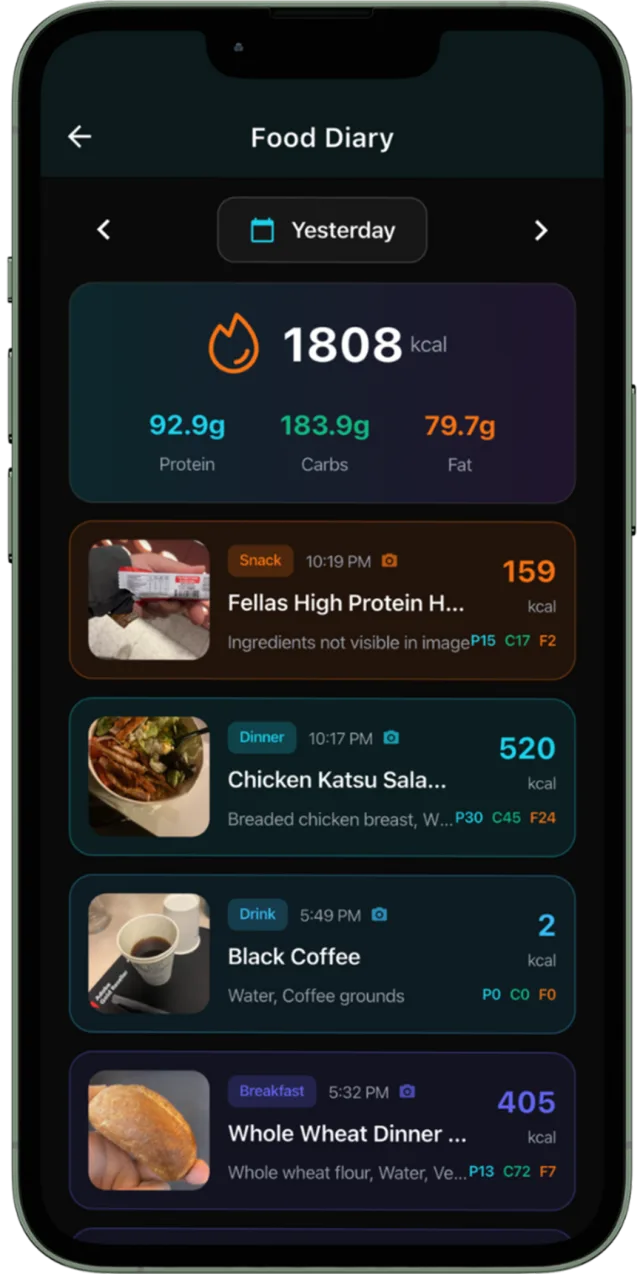
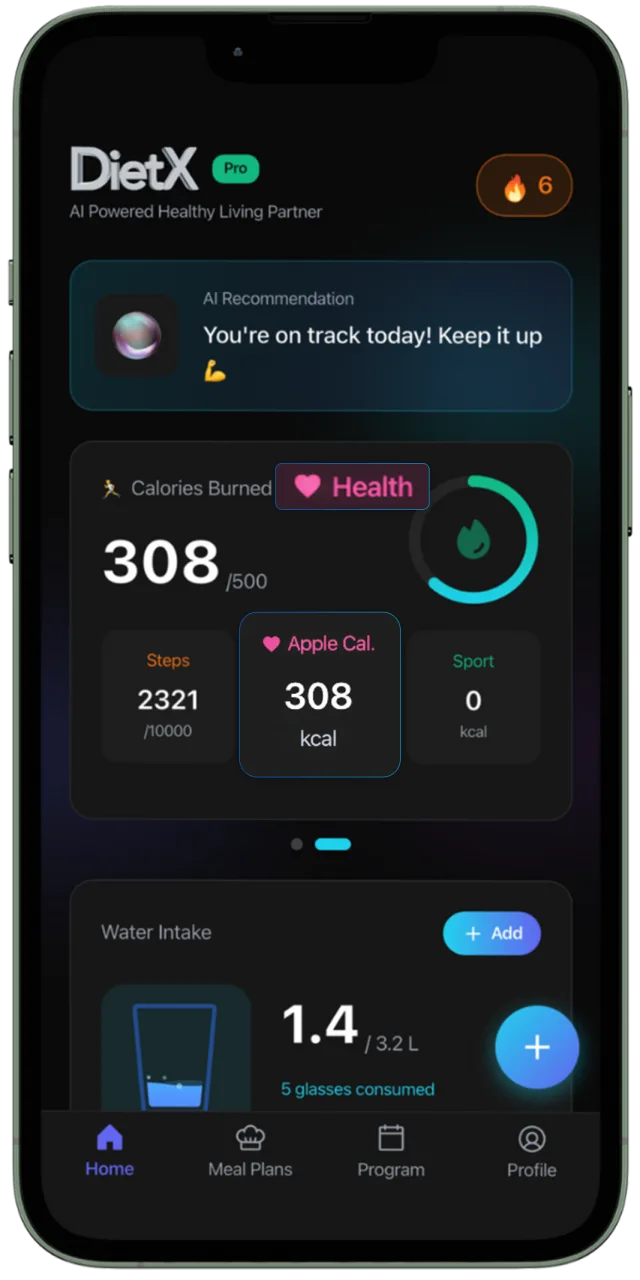
The rule is easier to follow when your food, workouts and weight are all in one log. DietX sets daily calorie and macro targets from your age, height, weight, activity level and goal, so choose an honest activity level and treat your usual workouts as counted. You can log workouts and steps next to your meals and follow your weight trend. It's free to download with a free trial, and Premium is a subscription.
Whichever app you use, check whether it raises your calorie target after a workout, so you know which system you're on.
Frequently asked questions
How many exercise calories should I eat back?
If your calorie target already includes your workouts through an activity level, eat back none. If it assumes a sedentary day, eat back part at most. Half is a simple starting point, though it’s a rule of thumb and doesn’t come from research. Then adjust based on your weight trend over two to three weeks.
Should I eat back the calories my watch says I burned?
Be careful with them. In a test of 7 wrist devices, none got its energy expenditure error below 20%, so a 350 kcal reading could easily be 70 kcal out in either direction. Treat the number as a rough guide and not as food you’ve earned.
What happens if I don’t eat back exercise calories?
If your target already allows for your activity, nothing special: you’re simply following your plan. If you lose faster than about 1 kg a week, feel run down or your training suffers, eat a bit more. If that keeps happening, talk to a doctor or dietitian.
Do I need to eat more if I train hard?
You may. Long, demanding sessions most days, or a physical job on top of daily hard training, can call for more food than a rough target suggests. Let your energy, your training and your weight trend guide you, and ask a dietitian if you’re unsure.
Sources
- Shcherbina et al. (2017), J Pers Med: Accuracy of wrist-worn heart rate and energy expenditure
- Mifflin et al. (1990), Am J Clin Nutr: A new predictive equation for resting energy expenditure
- Lichtman et al. (1992), N Engl J Med: Self-reported and actual caloric intake and exercise
- Riou et al. (2015), Nutrients: Predictors of energy compensation during exercise
- WHO: Physical activity
- NHS: Tips to help you lose weight
- Jäger et al. (2017), J Int Soc Sports Nutr: ISSN position stand on protein and exercise
- NHS: Eating disorders
General information, not medical advice. Talk to a doctor or dietitian before changing your diet, especially if you are pregnant, under 18 or have a health condition. If tracking food makes you anxious or you have a history of disordered eating, please skip calorie counting and ask a professional for support.