How Many Steps a Day to Lose Weight? No Magic Number
By the DietX team · Updated · 6 min read
How many steps a day to lose weight? There's no magic number, and no step count guarantees weight loss, because that depends on your overall calorie balance. For health the picture is clearer: one meta-analysis found benefits start around 2,600 to 2,800 steps a day, with the risk of dying falling progressively up to about 8,800.
So steps are worth building up, as long as you know what they can and can't do. Below you'll find what the research covers, where 10,000 fits, and how to increase your count from where you are now.
How many steps a day do you need to lose weight?
Weight loss comes down to using more energy than you take in over time, which is a calorie deficit. Walking adds to the energy you use. Whether that creates a deficit depends on what you eat and on how the rest of your day changes.
So two people could both walk 8,000 steps a day, and one could lose weight while the other doesn't. That's why you won't find a step target here that promises a result.
You won't find a calories-per-step figure either. The burn depends on your body size, your pace and the ground you're on, so a single number would be false precision.
What the research says about steps
A meta-analysis pools the results of many studies. Mortality means the risk of dying during the study, and cardiovascular means related to the heart and blood vessels.
| Steps a day | What was found | Source |
|---|---|---|
| About 2,600 to 2,800 | Benefits start around here | Stens |
| About 7,000 or more | Middle-aged adults had lower mortality than those under 7,000 | Paluch |
| Up to about 7,200 | Cardiovascular risk falls progressively | Stens |
| Up to about 8,800 | Mortality risk falls progressively | Stens |
Keep two limits in mind. These are health outcomes, so they don't tell you how much weight anyone lost. And the 7,000 finding comes from middle-aged adults, so it may not carry over exactly to other ages.
Is 10,000 steps a day necessary?
Neither finding above singles out 10,000. In the meta-analysis, the fall in risk ran up to about 8,800 steps for mortality and about 7,200 for cardiovascular events.
That doesn't make 10,000 a bad goal. If you reach it and enjoy it, keep going, since extra walking still uses energy. What the research does offer is some relief if you're at 3,000 steps a day and 10,000 feels impossible: benefits start well below that.
Why more steps don't always show on the scale
Adding walking can bring less change than you'd expect, for a few common reasons.
Your body makes up for part of it. Research on energy compensation found that weight loss from exercise is usually less than expected, because the body compensates. Compensation, the share of the extra burn that gets offset, was lower in short programs and approached 84% at about 80 weeks. That's a research figure and not a forecast for you, but it's a good reason not to budget food around a long walk.
Calorie readouts are rough. In a test of 7 wrist devices, heart rate was decent, but no device got its energy expenditure error below 20%. On a walk your watch scores at 300 kcal, a 20% error is 60 kcal either way, so the real figure could be 240 or 360. That finding covers heart rate and calories burned, so it doesn't tell you how well a device counts steps.
You may be eating it back. A snack after a long walk can cancel more than you think. Read whether to eat back exercise calories before you add them to your food budget.
Normal swings hide progress. A day's reading on the scale mostly reflects water and food, so daily weight fluctuations can mask a slow change for a while.
How to build up from your baseline
Start from your own number, since a target set for someone else may not fit you. Here's the method, using a made-up example.
- Find your baseline. Wear your phone or tracker for 7 normal days without changing anything, then average them. Our example person walks 3,200, 4,100, 2,900, 5,000, 3,800, 6,400 and 3,300 steps. That totals 28,700, and 28,700 ÷ 7 = 4,100 a day.
- Add a small amount. Try about 500 steps a day on top of your baseline. That's a rule of thumb and no study prescribes it, so choose an amount that feels easy.
- Hold it for a week, then add again. If a week feels too short, stay for two.
- Check your weekly average. A rainy Tuesday doesn't matter when you're looking at the whole week.
| Week | Daily goal in the example |
|---|---|
| Baseline | 4,100 |
| 1 | 4,600 |
| 2 | 5,100 |
| 3 | 5,600 |
| 4 | 6,100 |
| 5 | 6,600 |
| 6 | 7,100 |
Six weekly increases of 500 add 3,000 a day, taking this person past the 7,000 mark in the table above. If your knees or feet complain, slow down.
To fit the extra steps in, attach them to things you already do:
- Take a short walk after one meal a day.
- Walk during phone calls.
- Get off the bus a stop early, or park at the far end of the lot.
Steps, activity guidelines and strength work
The WHO and the NHS say adults should do at least 150 minutes of moderate activity a week, or 75 of vigorous activity, plus strength work on at least 2 days.
A brisk walk is a simple way to collect moderate minutes: 30 minutes on 5 days makes 150. A step count can't tell you how brisk those minutes were, and it misses strength work completely. So treat your steps as one part of being active, alongside the rest.
Other habits count too. Short nights can make a diet harder, as we explain in how sleep affects weight loss.
How to tell if it's working
Keep your eating roughly steady, add your steps, and compare your weekly average weight after two to three weeks. If the average is moving at a pace you're happy with, stay the course. If it isn't, look at your food log before adding even more walking. Results vary from person to person, and the scale isn't the only reason to walk.
Keeping steps next to your food
Seeing steps beside what you eat makes it easier to judge both against your trend.
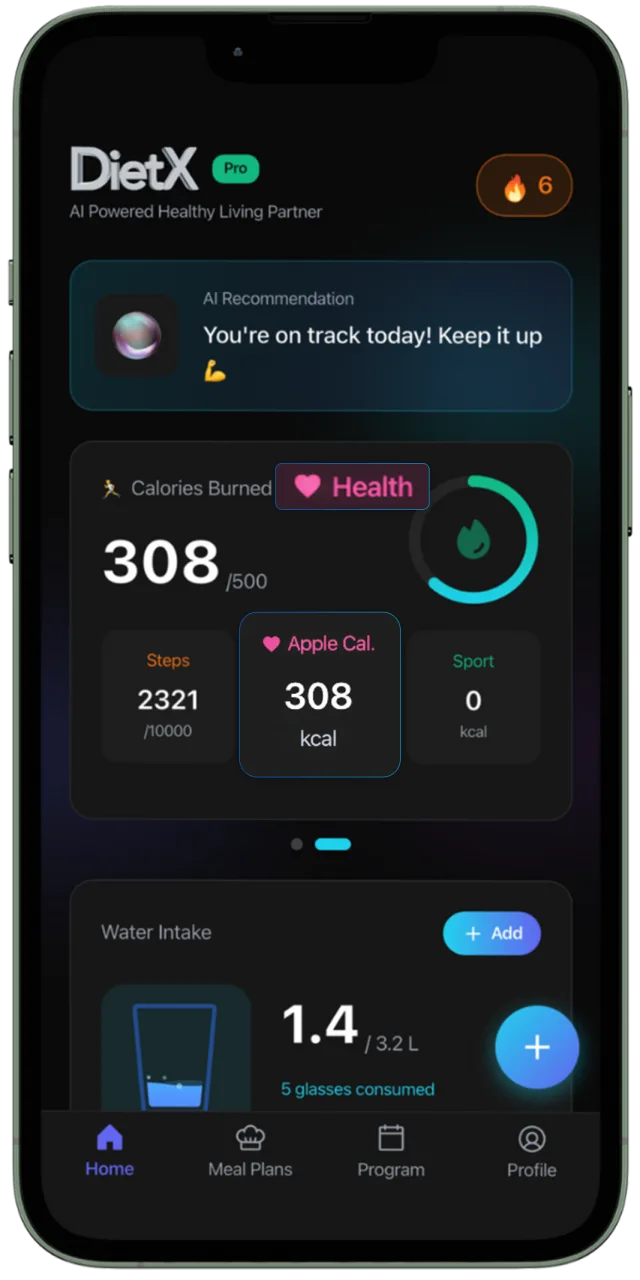
DietX lets you log steps, water, sleep and workouts next to your meals, and it can connect to Apple Health if you allow it. It's free to download with a free trial, and Premium is a subscription. Your phone's built-in step counter is enough if all you want is the count.
Frequently asked questions
Is 10,000 steps a day enough to lose weight?
It can help, but no step count guarantees weight loss. Whether you lose weight depends on your overall calorie balance, including what you eat. The health findings we cover don’t single out 10,000 either: in one meta-analysis, the risk of dying fell up to about 8,800 steps.
How many steps a day is healthy?
One meta-analysis found benefits start around 2,600 to 2,800 steps a day, with risk falling up to about 8,800 for mortality and 7,200 for cardiovascular events. Another study found that middle-aged adults taking about 7,000 or more had lower mortality than those under 7,000.
How many calories do you burn per step?
It depends on your body size, your pace and the ground you’re on, so a single figure would mislead you. Wrist trackers can’t give you a precise answer either: in a test of 7 devices, none got its energy expenditure error below 20%.
How do I increase my daily steps?
Average your steps over 7 normal days, then add a small amount, such as 500 a day. Hold that for a week or two before adding more, and judge your progress by the weekly average instead of single days.
Sources
- Stens et al. (2023), J Am Coll Cardiol: Daily step counts, mortality and cardiovascular events
- Paluch et al. (2021), JAMA Netw Open: Steps per day and all-cause mortality
- Riou et al. (2015), Nutrients: Predictors of energy compensation during exercise
- Shcherbina et al. (2017), J Pers Med: Accuracy of wrist-worn heart rate and energy expenditure
- WHO: Physical activity
- NHS: Physical activity guidelines for adults
- NHS: Eating disorders
General information, not medical advice. Talk to a doctor or dietitian before changing your diet, especially if you are pregnant, under 18 or have a health condition. If tracking food makes you anxious or you have a history of disordered eating, please skip calorie counting and ask a professional for support.