Does Sleep Affect Weight Loss? What Small Studies Show
By the DietX team · Updated · 6 min read
Does sleep affect weight loss? It appears to, though the evidence comes from small studies. In a study of 10 adults eating less for 14 days, the share of weight lost as fat fell 55% with 5.5 hours set aside for sleep instead of 8.5. In a study of 80 young adults with overweight who slept too little, extending sleep by about 1.2 hours a night cut intake by 270 kcal a day.
Neither result is a promise. Here's what these studies can and can't tell you, plus some habits and a simple way to check the pattern in your own log.
Does sleep affect weight loss? What the studies found
| Nedeltcheva | Tasali | |
|---|---|---|
| Who | 10 adults | 80 young adults with overweight who slept too little |
| Setup | 14 days of calorie restriction, with 5.5 h vs 8.5 h of sleep opportunity | Sleep extended by about 1.2 h a night |
| Finding | With less sleep: share of weight lost as fat down 55%, fat-free mass loss up 60%, more hunger | Intake down 270 kcal a day in real-life settings |
| Main limit | Very small and short | Covers one specific group |
Short sleep during a diet
Sleep opportunity is the time set aside for sleep, which can be longer than the sleep you actually get. Fat-free mass is everything in your body other than fat, including muscle, water and bone.
So with 5.5 hours set aside, less of the weight these 10 adults lost came from fat, more came from fat-free mass, and they were hungrier. If you're trying to lose fat and hold on to muscle, that's the wrong direction.
Still, 10 people over 14 days is a very small window. Read it as a warning sign about short sleep during a diet. It can't tell you what would happen to you over several months.
Sleeping longer and eating less
In the second study, about 1.2 hours works out to roughly 72 extra minutes a night. The drop in intake came in real-life settings, outside a lab.
For scale, 270 kcal is about what you'd get from 45 g of dry-roasted almonds, which have 598 kcal per 100 g.
Two cautions apply. The group was young adults with overweight who were short on sleep, so this doesn't tell you what extra sleep does if you already sleep enough or are older. And the finding is about calories eaten. Please don't turn 270 kcal a day into a predicted number of kilos, because weight responds slowly to a change in intake and results vary.
How much sleep do you need to lose weight?
These studies don't give you a number of hours that produces weight loss. The closest guide is the general recommendation that adults should sleep 7 or more hours a night regularly. That's advice for adults in general, so reaching 7 hours won't ensure any particular result on the scale.
To turn it into a bedtime, count back from your alarm. With a 6:30 am alarm, 7 hours means being asleep by 11:30 pm, so you'd want to be in bed a little before that.
If you sleep about 6 hours now, you don't need to fix it in one night. Try moving your bedtime 15 minutes earlier every few nights. That pace is only a rule of thumb, but five of those steps add 75 minutes, close to the extension in the study of 80 young adults.
Why short nights can make dieting harder
The studies above don't settle why sleep and eating are connected. What the 14-day study did report is more hunger when sleep was short.
The rest is everyday experience, not research. A short night gives you more waking hours to snack in, and it can leave you with less enthusiasm for a walk. If either sounds familiar, sleep is worth treating as part of your plan, alongside food and daily steps.
Sleep habits worth trying
These are common, low-risk habits and not findings from the studies above. Pick one or two to start.
- Keep your wake-up time steady, including most weekends.
- Set a reminder 30 minutes before the bedtime you counted back to, and start winding down.
- If caffeine keeps you awake, have your last one earlier in the day.
- Keep the bedroom dark, cool and quiet.
- Leave your phone out of reach, so you aren't scrolling in bed.
- Go easy on alcohol close to bedtime. It adds calories too, as our guide to calories in alcohol shows.
- Avoid going to bed very full. If you're regularly too hungry to sleep, your calorie deficit may be too large.
Log your sleep beside your food to spot patterns
Studies describe groups. Your own log can show whether short nights change things for you, and two to four weeks of notes can reveal a rough pattern.
| What to log | When | What to look for |
|---|---|---|
| Hours slept | Each morning | How often you fall under 7 hours |
| Food | Through the day | Whether calories rise after short nights |
| Hunger, scored 1 to 5 | Each evening | Whether it's higher after short nights |
| Weight | A few mornings a week | The weekly trend, not single days |
Then compare the two kinds of day:
- Split your days into two piles: after under 7 hours of sleep, and after 7 hours or more.
- For each pile, add up the calories and divide by the number of days.
- If the short-night pile runs higher, protect your sleep where you can, or plan a more filling day after a short night.
A gap in your own log shows a pattern and can't prove a cause. A late night out could raise your calories and shorten your sleep at the same time.
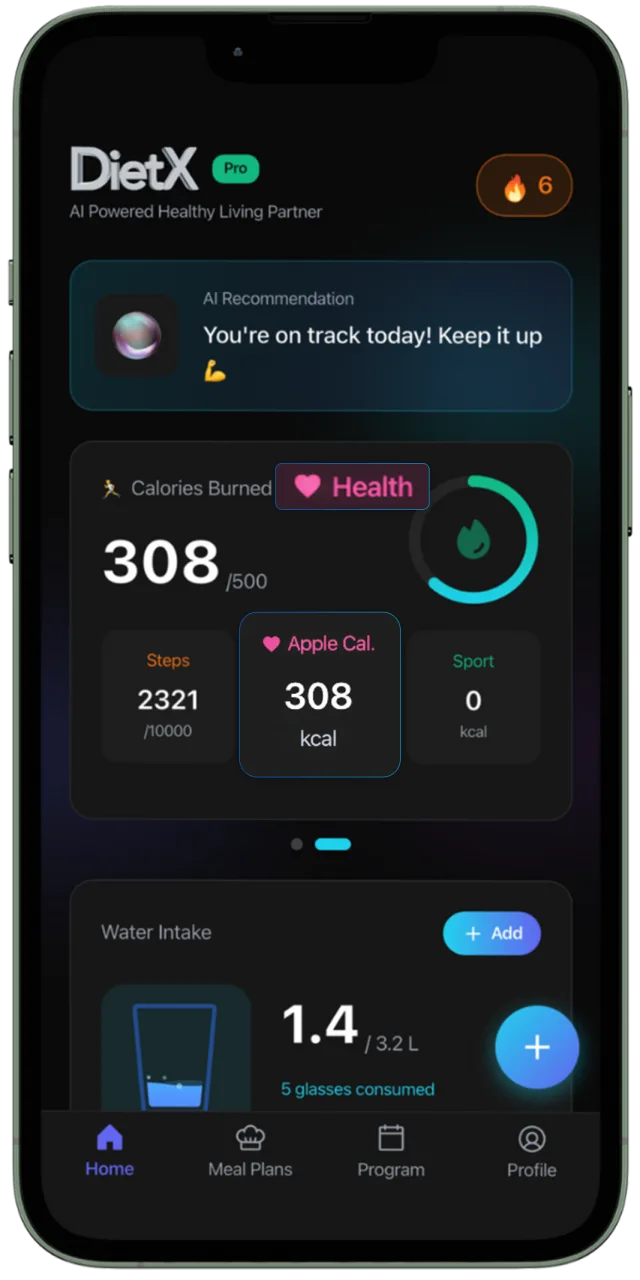
Keeping all of this in one place makes the comparison easier. DietX lets you log sleep, water, steps and workouts next to your meals, so they're together when you look back. It's free to download with a free trial, and Premium is a subscription. A paper notebook does the job too, as long as you fill it in.
When sleep isn't the whole story
If you're sleeping well and the scale still isn't moving, go through the other reasons you may not be losing weight. It's also worth a look at smaller habits, such as how much water you drink.
Frequently asked questions
Can lack of sleep stop you from losing weight?
It may make it harder, though the evidence is limited. In a very small 14-day study of 10 adults on reduced calories, less sleep meant a smaller share of the weight lost came from fat, and more hunger. That doesn’t show short sleep stops weight loss altogether.
How many hours of sleep do I need to lose weight?
The studies on sleep and weight loss don’t give an exact number. The general recommendation is that adults sleep 7 or more hours a night regularly.
Does sleeping more help you eat less?
It did in one study of 80 young adults with overweight who slept too little: extending sleep by about 1.2 hours a night cut intake by 270 kcal a day in real-life settings. It may not apply to people who already sleep enough.
Should I track my sleep if I’m trying to lose weight?
It can help if you enjoy having the data. Log your sleep next to your food for two to four weeks, then compare your calories after short nights with your calories after longer ones. Your log can show a pattern, but it can’t prove a cause.
Sources
- Nedeltcheva et al. (2010), Ann Intern Med: Insufficient sleep undermines dietary efforts
- Tasali et al. (2022), JAMA Intern Med: Sleep extension and energy intake
- USDA FoodData Central (SR Legacy)
- Hall et al. (2011), Lancet: Quantification of the effect of energy imbalance on bodyweight
- Watson et al. (2015), Sleep: Recommended amount of sleep for a healthy adult
- NHS: Eating disorders
General information, not medical advice. Talk to a doctor or dietitian before changing your diet, especially if you are pregnant, under 18 or have a health condition. If tracking food makes you anxious or you have a history of disordered eating, please skip calorie counting and ask a professional for support.