How Much Water Should I Drink a Day? The Real Numbers
By the DietX team · Updated · 6 min read
How much water should you drink a day? The NHS suggests 6 to 8 cups or glasses of fluid a day, and more when you're pregnant, breastfeeding, active or in hot weather. The bigger figures you may have seen, such as 2 or 2.7 L, also count the water in your food.
Below, we line up those numbers, look at the "8 glasses" idea, and go through what one small study found about water and weight loss.
How much water should I drink a day? The numbers side by side
Three respected bodies give answers that look very different. Part of the gap comes from what each one counts.
| Source | What it counts | Women | Men |
|---|---|---|---|
| NHS (UK) | Fluid you drink | 6 to 8 cups or glasses | 6 to 8 cups or glasses |
| EFSA (Europe) | Total water from food and drink | 2.0 L | 2.5 L |
| National Academies (US) | Total water, including food | 2.7 L | 3.7 L |
If you think in ounces, 2.0 L is about 68 fl oz, 2.5 L about 85, 2.7 L about 91 and 3.7 L about 125.
Two things are worth noticing. First, EFSA and the National Academies describe your total intake, so you don't have to drink all of it. A figure of 2.7 L doesn't mean 2.7 L from a bottle.
Second, those two bodies are counting the same thing and still land 0.7 L apart for women and 1.2 L apart for men. Both describe their figure as an adequate intake, which is a reference amount rather than a minimum you have to hit. Treat all of these numbers as rough guides.
Does the water in food count?
Yes, and that's one reason the total figures look so large. Fruit, vegetables, soup, yogurt and cooked grains all contain plenty of water, while crackers and toast contain very little. So the amount you get from food depends on what you eat.
Because it varies so much, there's no honest way to turn a total figure into an exact number of glasses for you. That's where the NHS advice is handy: it gives you a drinking target in plain cups and glasses, with no conversion needed.
Do you really need 8 glasses of water a day?
The popular version of this rule is eight 8-ounce glasses, which comes to 64 fl oz, or about 1.9 L. As a habit it's reasonable, since eight glasses sits at the top of the NHS range. It just isn't a number everyone has to reach.
Glass size changes the sum too. Taking 250 ml as an example:
- 6 glasses make 1.5 L
- 8 glasses make 2.0 L
The NHS wording is worth a second look as well. It says fluid, so water isn't the only drink that counts. The catch if you're tracking calories is that some fluids carry energy. Water has none, while whole milk has 61 kcal per 100 g. Log any drink that has calories.
Your needs also change from day to day. The NHS says to drink more when you're pregnant, breastfeeding, active or in the heat, so a winter day at a desk and a long summer hike shouldn't share a target.
How to tell if you're drinking enough
The simplest check from the NHS is color: pale yellow pee is a useful sign. If yours is darker, have another glass or two and see if it changes. This is a rough guide and can't diagnose anything.
If you struggle to remember, a simple routine helps. Here is one way to reach six 250 ml glasses, which is 1.5 L:
| When | Amount |
|---|---|
| After waking up | 250 ml |
| With breakfast | 250 ml |
| Mid-morning | 250 ml |
| With lunch | 250 ml |
| Mid-afternoon | 250 ml |
| With dinner | 250 ml |
| Total | 1,500 ml (1.5 L) |
A few other things make it easier:
- Tie a glass to something you already do, such as sitting down to a meal.
- Keep a bottle where you spend the day. Three 500 ml bottles also make 1.5 L.
- On a hot day or before exercise, drink before you head out and take some with you.
- Spread it out over the day, and don't force down far more than you need.
Does drinking water help you lose weight?
It might help a little, but the evidence is thin. In a study of 48 adults aged 55 to 75 on a calorie-reduced diet, drinking 500 ml of water before each meal led to about 2 kg more weight loss over 12 weeks.
That result comes with clear limits:
- It was a small study of 48 people.
- Everyone was an older adult, so it may not apply if you're younger.
- Everyone was on a calorie-reduced diet, so it says nothing about drinking water without one.
- It lasted 12 weeks, so it can't tell you what happens over a longer stretch.
If you'd like to try it, 500 ml before each of three meals adds up to 1.5 L, which fits inside the range above. Just don't count on the same 2 kg. Results vary, and one small study isn't a promise.
A simpler way water can help is by replacing drinks that have calories. The NHS lists swapping sugary drinks for water among its tips for losing weight.
Water also shows up on the scale in the short term. 500 ml weighs 500 g until your body passes it, which is one reason your weight moves up and down from day to day. What changes your weight over weeks is your overall calorie deficit, and water is one small habit that sits alongside it. Getting enough sleep and building up your daily steps are two others.
Logging your water
If you forget to drink during a busy day, writing it down can be enough of a nudge. Marks on a bottle work, and so does a note on your phone.
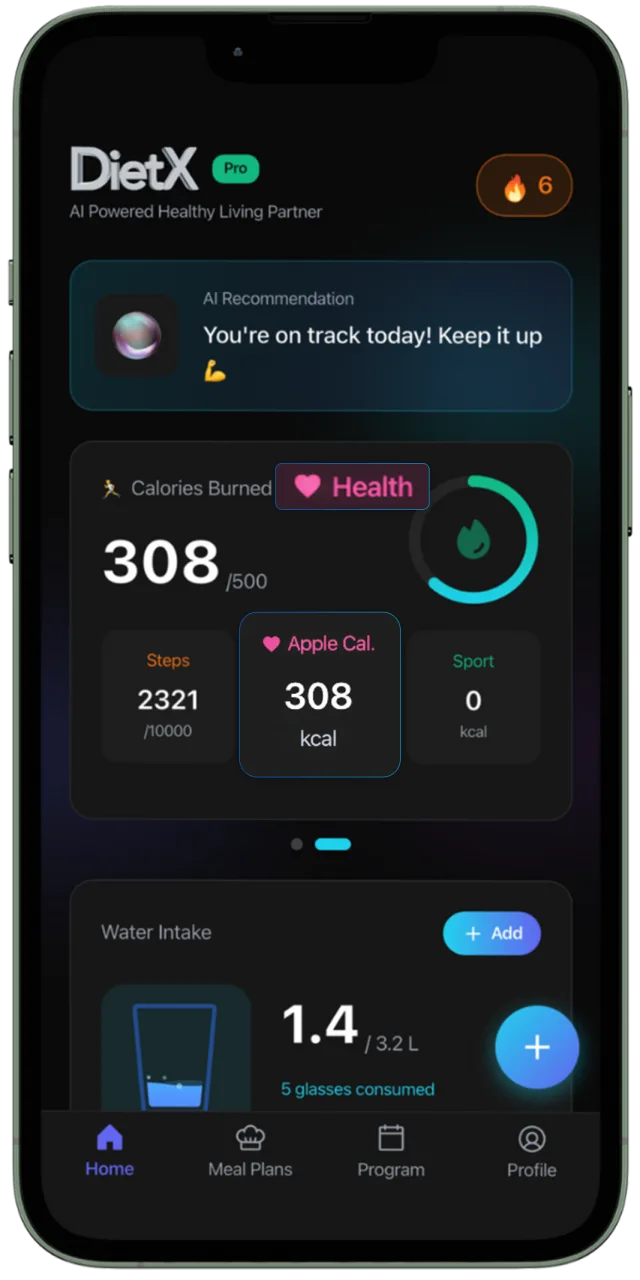
If you already track food, it's easier to keep everything together. DietX shows water on its home screen and lets you log it next to your meals, sleep, steps and workouts. It's free to download with a free trial, and Premium is a subscription.
Frequently asked questions
How many liters of water should I drink a day?
Reference values for total water, including food, are 2.0 L for women and 2.5 L for men from EFSA in Europe, and 2.7 L and 3.7 L from the National Academies in the US. The amount you drink will be lower than those totals. The NHS suggests 6 to 8 cups or glasses of fluid a day.
Is it bad if I don’t drink 8 glasses of water a day?
Not necessarily. The NHS range is 6 to 8 cups or glasses of fluid, and you also get water from food. Pale yellow pee is a useful sign. You need more when you’re pregnant, breastfeeding, active or in the heat.
Does the water in food count toward my daily intake?
Yes. The EFSA and National Academies figures are for total water, including what’s in your food. How much food adds depends on what you eat, since soup and fruit hold far more water than crackers.
Does drinking water help you lose weight?
It may help a little. In a small study of 48 adults aged 55 to 75 on a calorie-reduced diet, drinking 500 ml before each meal led to about 2 kg more loss over 12 weeks. That may not apply to everyone, and results vary.
Sources
- NHS: Water, drinks and hydration
- EFSA (2010): Dietary reference values for water
- National Academies: Dietary Reference Intakes for water
- USDA FoodData Central (SR Legacy)
- Dennis et al. (2010), Obesity: Water consumption and weight loss during a hypocaloric diet
- NHS: Tips to help you lose weight
- NHS: Eating disorders
General information, not medical advice. Talk to a doctor or dietitian before changing your diet, especially if you are pregnant, under 18 or have a health condition. If tracking food makes you anxious or you have a history of disordered eating, please skip calorie counting and ask a professional for support.