Tennis is hard at the start because you must judge a moving ball, move your feet and swing at the same time. You can make it easier by shrinking the court and slowing the ball, then adding distance and pace as you improve. The plan below does that over 6 weeks.
What a beginner should aim for first
Your first goal is to keep the ball in play. Winners and power can wait. The USTA's NTRP level descriptions show what early progress looks like.
| USTA NTRP level | How the USTA describes it (paraphrased) | A practice goal for you |
|---|---|---|
| 1.5 | Limited stroke development, mainly getting the ball into play | Drop a ball and hit it over the net into the service box |
| 2.0 | Needs on-court experience, struggles to find a good contact point | Rally 10 balls inside the service boxes |
| 2.5 | Learning to judge where the ball is going and how much swing is needed, ready for social matches | Rally 10 balls from the baseline and start a point with a serve |
The goals in the right column are our suggestions and not USTA standards. Six weeks may not be enough for everyone, and that is fine. Stay on a week until you reach most of its goals.
Racket grip basics for beginners
A grip is where your hand sits on the handle. Ask a coach to check yours early, because a wrong grip gets harder to change later.
| Shot | Common grip | How to find it |
|---|---|---|
| Forehand | Eastern or semi-western | Eastern: put your palm flat on the strings, slide your hand down to the handle and hold it as if you are shaking hands. Semi-western: turn your hand a little further under the handle. |
| Two-handed backhand | Bottom hand continental, top hand eastern forehand | Hold the racket with your bottom hand as if holding a hammer. Your top hand goes above it, in the grip it would use for a forehand on that side. |
| One-handed backhand | Eastern backhand | Start from the continental grip and turn your hand a little over the top of the handle. See one or two hands if you are unsure which to learn. |
| Serve and volley | Continental | Hold the racket like a hammer, with the edge of the frame pointing forward. |
Coaches differ on the serve. Many teach the continental grip from the start. Others let beginners begin with a grip closer to the forehand and change later. Ask your coach what they prefer.
The 6-week beginner tennis practice plan
This is a suggested plan of two sessions a week, 30 to 45 minutes each. Short sessions are fine: in a 1985 study of novices learning the serve, five 30-minute sessions worked as well as five 45-minute sessions. Practice one stroke at a time in the first weeks. In a study of 83 undergraduates in tennis classes, lower-skilled students did better with blocked practice than with an alternating schedule.
| Week | Focus | What to do | Goal to reach |
|---|---|---|---|
| 1 | Grip, contact, first hits | Drop a ball and hit forehands from the service line into the opposite service box. Then try backhands. | 7 of 10 forehands in the box |
| 2 | Mini-tennis, forehand | Rally inside the service boxes, forehands first. | A 10-ball rally |
| 3 | Mini-tennis, backhand | Add backhands and rally with both strokes. Practice the toss: toss and catch 10 times. | 10 backhands in the box and a 15-ball rally |
| 4 | Move back, first serves | Rally from halfway between the service line and the baseline. Serve from the service line. | A 10-ball rally from halfway and 5 of 10 serves in |
| 5 | Full court | Rally from the baseline. Serve from the baseline at half speed. | A 10-ball baseline rally and 5 of 10 serves in |
| 6 | Play points | Serve, rally and keep score. Play a full game, serving from the correct side. | Finish one game, and film it |
How to play mini-tennis, and why to start there
Mini-tennis is a rally inside the service boxes, with each player near their service line, 6.40 m (21 feet) from the net. It gives you many balls in a short time, because you do not need much running or power.
- Stand just behind your service line, facing your partner.
- Use a short, slow swing from low to high.
- Let the ball bounce, then make contact in front of your body.
- Count out loud together, and start again from 1 after a miss.
- If most balls go into the net, aim higher. If most go long, swing slower.
With no partner, use a wall or drop feeds. Our solo tennis drills explain how to set them up.
Serve basics for beginners
The rules are simple. Stand behind the baseline with your feet not touching it, between the center mark and the sideline, and hit the ball into the service box diagonally opposite. Start each game from the right side and change sides after each point. You get two tries, and two faults in a row lose the point.
- Practice the toss first and catch the ball 10 times. Catching a toss does not count as a fault.
- Start at the service line, where the box is close.
- Think of throwing your racket up at the ball, with your whole arm relaxed.
- After 5 of 10 go in, move back one step, until you reach the baseline.
- Hit slow serves at first. Getting the ball in comes before speed.
When you can do this from the baseline, read how to improve your serve.
When to get tennis lessons
Get lessons early, before you think you need them. A coach can correct your grip in a minute, feed you the right ball and catch habits that you cannot see yourself. Group lessons usually cost less per person and also give you people to practice with.
- Best case: a lesson before week 1 for your grips and contact.
- If you can only take a few: book one in week 1 for grips, one in week 4 for the serve and one in week 6 for points.
- Book sooner if: you are still far from a week's goals after two extra weeks, or your serve motion feels confusing.
- Stop and see a professional if any movement causes pain.
Film early so you can see your progress
In that same 1985 study of novices, video methods showed no clear advantage over traditional instruction, so do not expect video to replace practice or lessons. For a beginner it has a simpler use: it keeps a record. Six weeks from now, you will not remember how you looked today.
- Fix your phone on a tripod or fence clip, using our filming guide.
- Film 2 minutes of drop feeds or rallying in week 1, and the same from the same spot in week 6.
- Look at three things: is your contact in front of your body, are your eyes on the ball, and are you balanced at the finish?
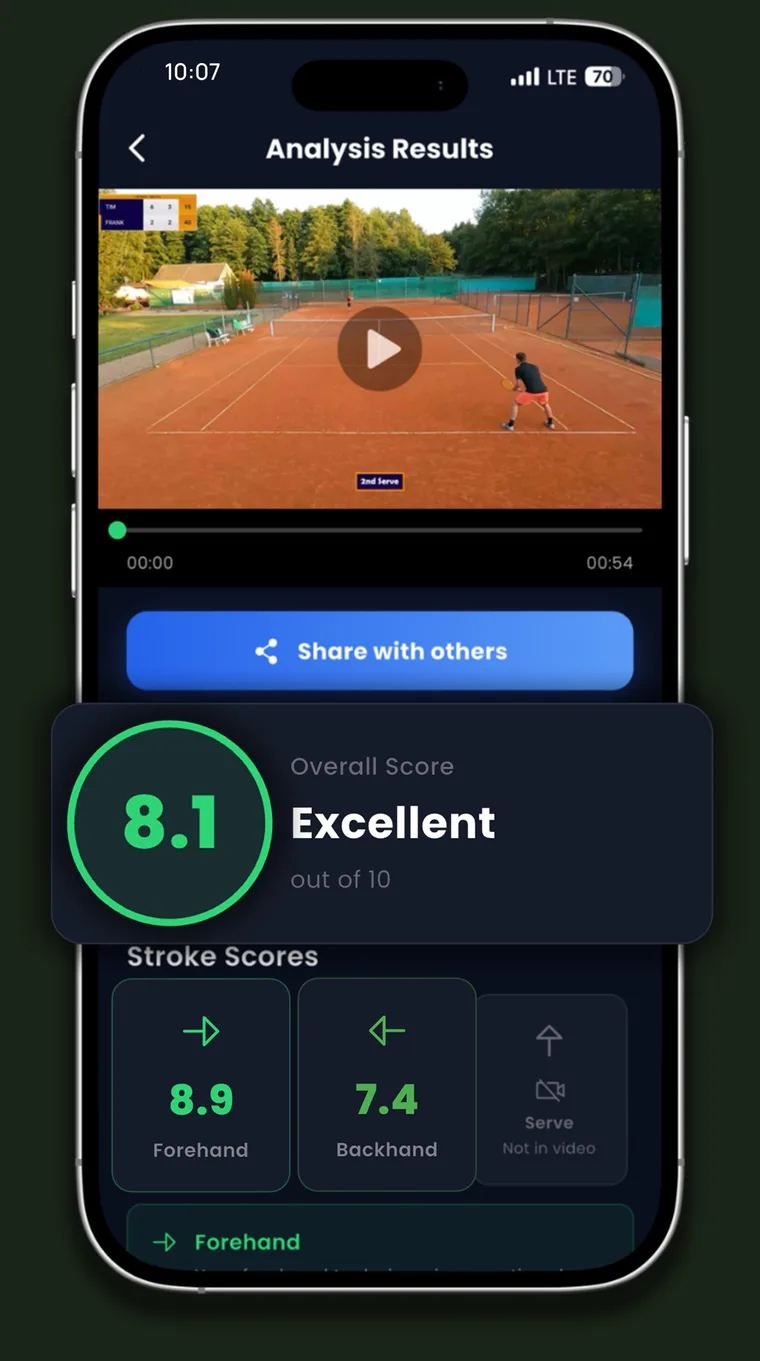
TennisAI's video analysis can add scores and feedback to the same clips. Results vary with camera angle and video quality, so treat early scores as a rough guide. The analysis is for training and does not replace a coach.
Frequently asked questions
How often should a beginner practice tennis?
We found no reliable source for an agreed number. As a suggestion, try two sessions of 30 to 45 minutes a week.
Can I learn tennis without lessons?
You can learn to rally without them, but a few early lessons are worth it for your grips, contact point and serve. A coach can see habits that you cannot see yourself.
What grip should a beginner use for a forehand?
An eastern or semi-western grip works for most beginners. To find the eastern grip, hold the handle as if you are shaking hands with it, and ask a coach to check it.
How long does it take to learn to rally in tennis?
It varies from person to person, and we found no reliable figure. This plan aims for a 10-ball rally in the service boxes by week 2 and from the baseline by week 5, but take longer if you need to.
See this in your own game
Upload a practice or match video to TennisAI and get feedback on your forehand, backhand and serve.

Sources
- USTA League support (Active Network): NTRP rating information
- Hebert, Landin & Solmon, Research Quarterly for Exercise and Sport (1996): Practice schedule effects on low- and high-skilled students
- Emmen et al., Journal of Sports Sciences (1985): Video-modelling and video-feedback in learning the tennis service by novices
- World Tennis (formerly the ITF): 2026 Rules of Tennis (court and service rules)
This article is general information about tennis training and does not replace a coach or medical advice. Stop and see a professional if something hurts. TennisAI is made by Pace, the publisher of this blog.
