Most serve advice gives you ten things to think about during one fast motion. A better method is to film your serve, find the earliest phase that goes wrong, and fix only that. Problems early in the motion often cause the ones you see later, so a drifting toss can look like an arm problem.
This guide splits the serve into five phases, shows which results point to which phase, and gives you one video check and one drill for each fix. Film two clips first: one side-on and one from behind the baseline. The guide to filming your tennis shows where to put the phone.
The five phases of the tennis serve
A research model by Kovacs and Ellenbecker in the journal Sports Health uses eight stages. Five are enough for reviewing your own clips.
| Phase | What should happen | Where to pause your video |
|---|---|---|
| 1. Grip and stance | Continental grip, relaxed hand, both feet behind the baseline | The first frame |
| 2. Toss and load | Tossing arm rises smoothly, knees start to bend, weight settles | The moment the ball leaves your hand |
| 3. Trophy position | Tossing arm up, hitting elbow up, racket up, knees bent | The frame where the racket first reaches its highest point |
| 4. Leg drive and swing | Legs push up, trunk rotates, racket drops behind you and then rises to the ball | The frames just before contact |
| 5. Contact and finish | Full reach, forearm rotates through contact, you land inside the court | Contact and the landing |
Which serve problem should you fix first?
Start from what you notice on court, then go to the matching fix below. If two problems appear, work on the one that happens earlier in the motion.
| What you notice | Check first | Why |
|---|---|---|
| The ball is flat, with little spin, and your second serve feels unsafe | Grip | A forehand-style grip makes it hard to brush the ball |
| Misses go long, wide and into the net with no pattern | Toss | A ball in a different place makes every swing adapt |
| The rhythm feels rushed and your tossing arm drops early | Trophy position | Your two arms are no longer working in time |
| You swing hard but the serve feels slow | Leg drive | Your arm is doing work your legs and trunk should start |
| The racket face feels like a frying pan at contact | Grip, then pronation | The strings face the ball too early |
Five serve fixes, each with a video check and a drill
The directions below are for a right-hander. Left-handers should reverse them. The targets are practice benchmarks we suggest, not research figures.
Fix 1: Use a continental grip
Hold the racket as if you were hammering a nail with its edge. A forehand grip feels easier at first because the strings already face the target, but it limits spin and forearm rotation.
Video check: pause as the racket starts up toward the ball. With a continental grip, the edge of the frame leads. If the strings face the ball the whole way up, your grip has moved toward a forehand.
Drill: stand on the service line and hit 20 easy serves with the edge leading. Expect the ball to curve. Target: 14 of 20 in the box. Each time you reach the target, move back one big step, until you reach the baseline.
Fix 2: Make your toss repeat
On a first serve, most coaches want the ball in front of your front foot and slightly toward your hitting side, so it would land inside the court if you let it drop. Lift it with a straight arm and open your fingers as the arm rises. Do not flick your wrist.
Video check: from behind, watch 10 tosses in a row. Does the ball rise to the same place? From the side, does it drift behind your head?
Drill: lay a racket on the court, just inside the baseline, where a good toss would land. Take your stance, toss without swinging, and let the ball drop. Target: 8 of 10 touching the racket. Under the Rules of Tennis from the ITF (now World Tennis), tossing the ball and catching it is not a fault, so in a match you can catch a bad toss and start again.
Fix 3: Check your trophy position
A meta-analysis of 27 studies defines the trophy position as the moment the racket first reaches its highest point. It reports average body positions, but the studies varied widely, so do not copy one pose or one set of angles. Use the trophy as a timing checkpoint.
Video check: pause on that frame. Your tossing arm should still be up, your knees bent and your hitting elbow away from your ribs. If the tossing arm has already dropped, your arms are out of time.
Drill: toss, reach the trophy position, stop, and catch the ball with your tossing hand. Do 10. Target: 8 of 10 caught without moving your feet. Then hit 10 serves at three-quarter speed, keeping the same rhythm.
Fix 4: Use your legs, in any stance
Kovacs and Ellenbecker report that the legs and trunk supply about 51% to 55% of the kinetic energy and force delivered to the hand. In one study of 12 high-performance men, peak racket speed was 43.6 m/s (about 98 mph) with a foot-up stance, 42.6 m/s (about 95 mph) with a foot-back stance and 39.4 m/s (about 88 mph) with minimal leg drive. Stance made little difference once the legs drove.
This is a small study of trained players, and it measures speed, not accuracy. Keep the stance that feels natural, and check that your legs really push.
Video check: from the side, compare the trophy frame with the contact frame. Your knees should go from bent to straight as the racket drops. Your feet leaving the court is a result of pushing up, and the rules allow it. If your knees hardly change, your arm is doing most of the work.
Drill: do 10 slow shadow serves, pushing up from bent knees. Then hit 10 serves at three-quarter speed and land on your front foot inside the baseline. Target: 8 of 10 landings you can hold, balanced, for two seconds.
Fix 5: Let the forearm rotate, without forcing it
Pronation is the forearm rotation that turns your palm away from you around contact. Many players chase it for power, but a biomechanics review by Elliott puts it at about 5% of racket speed in a power serve, against about 40% for upper-arm internal rotation and about 30% for hand flexion. Its main job is setting the racket face. Work on it when your strings face the wrong way at contact, and do not expect much extra speed from it.
Video check: use slow motion from behind. As the racket rises, the edge leads. At the contact point the strings face the ball, and right after contact your palm turns outward. If the strings face the ball all the way up, check your grip first.
Drill: throw an old ball high and far with an overhead throwing motion, 10 times, and let your palm turn outward at release. Then hit 10 serves from the service line with the same feeling. Target: 7 of 10 in the box.
How to practice so the fix holds up
Stay with one fix until you reach its target in two separate sessions. Hit at three-quarter speed first, then at normal speed, then in points. Here is a suggested 40-minute session, not a research-backed amount.
- 5 minutes: slow shadow serves, thinking only about today's fix.
- 10 minutes: the drill for that fix, with your target written down.
- 15 minutes: baseline serves, 10 to each box, counting how many land in.
- 10 minutes: one serve per point, using your second serve routine. Film this block.
Be realistic about what video does. In one trial with 66 intermediate players, serve sessions twice a week for five weeks beat no training, but video feedback was no better than traditional training. An older study of novices also found no clear advantage for video. So video does not replace practice. Its value is simpler: it shows you what you actually do, which often differs from what you feel.
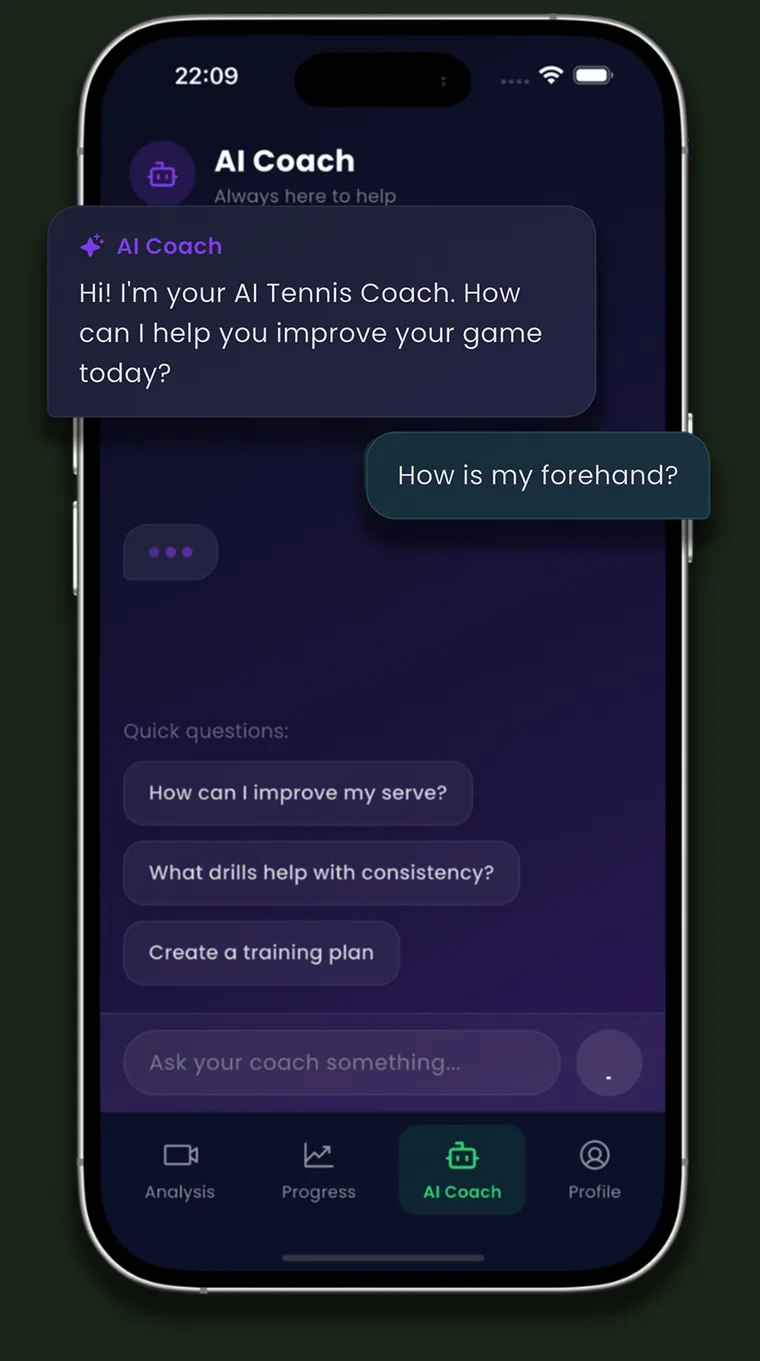
If you want a second opinion on your clip, TennisAI scores your serve from an uploaded video, and its AI Coach has a quick prompt for this exact question. Results vary with camera angle and lighting, and the output is an automated estimate that can be wrong, so film from the same spot and look at the trend over several clips.
Frequently asked questions
What is the fastest way to improve your serve?
Check your toss and grip first. They are simple to see on video, and the rest of the motion depends on them. Then work on one fix at a time.
What grip should I use for the serve?
A continental grip, the one you would use to hammer a nail with the edge of the racket. It lets the edge lead up to the ball, which makes spin and forearm rotation possible.
Does leg drive really add serve speed?
In one study of 12 high-performance men, minimal leg drive lowered peak racket speed by about 3 to 4 m/s (7 to 9 mph) compared with normal leg drive. Foot-up or foot-back made little difference. It is a small study of trained players.
Is pronation important on the serve?
Yes, mainly for setting the racket face. One biomechanics review puts its share of racket speed in a power serve at about 5%, so do not force it for power.
Can an app analyze my serve?
Some can. TennisAI gives a serve score and feedback from an uploaded clip, and shows "Not in video" if your clip has no serves. It is an automated estimate and does not replace a coach.
See this in your own game
Upload a practice or match video to TennisAI and get feedback on your forehand, backhand and serve.

Sources
- Kovacs and Ellenbecker, Sports Health: An 8-Stage Model for Evaluating the Tennis Serve
- Elliott, British Journal of Sports Medicine: Biomechanics and tennis
- Reid, Elliott and Alderson, Medicine & Science in Sports & Exercise: Lower-limb coordination and shoulder joint mechanics in the tennis serve
- Jacquier-Bret and Gorce, Frontiers in Sports and Active Living: Kinematics characteristics of key point of interest during tennis serve
- Van Wieringen et al., Journal of Sports Sciences: Video-feedback and the tennis service, intermediate players
- Emmen et al., Journal of Sports Sciences: Video-modelling and video-feedback, tennis service, novices
- ITF (now World Tennis): Rules of Tennis 2026
This article is general information about tennis training and does not replace a coach or medical advice. Stop and see a professional if something hurts. TennisAI is made by Pace, the publisher of this blog.
