The contact point has three parts: how far in front of your body you meet the ball, how high, and how far to the side. Everything you do before that moment matters because of where it puts the racket at that moment. The USTA even uses it as a level marker: its description of a 2.0 player says they struggle to find a good contact point.
The targets below are coaching norms and not exact measurements, so the video check later in this guide matters more than the table.
Where the contact point should be on each stroke
Treat these as zones. Your height, your grip and the incoming ball all shift them, and coaches do not all describe them in the same way.
| Stroke | How far forward | How high | Common mistake |
|---|---|---|---|
| Forehand, Eastern grip | In front of your hips | About hip height | Letting the ball get level with your body |
| Forehand, semi-western grip | Further in front | Hip to chest height | Hitting low balls without bending your knees |
| Forehand, Western grip | Furthest in front of the three | Waist to shoulder height | Contact too far back, which sends the ball low |
| Two-handed backhand | In front of your front hip, closer to your body than a one-hander | Hip to chest height | Standing too close, so both arms are cramped |
| One-handed backhand | Clearly in front of your front hip | Around hip height | Late contact, with no second arm to hold the racket steady |
| Slice backhand | Slightly in front of your front hip | Knee to shoulder height | Chopping down with contact beside the hip |
| Volley | In front of your body, where you can see it easily | Set by the ball; bend your knees on low ones | Swinging back, so contact slips beside you |
| Serve | Slightly into the court on a flat serve, closer to overhead on a kick serve | Near full reach | Letting the toss drop, so you hit below full reach |
How your grip moves the contact point
The further you turn your hand around the handle toward a Western grip, the further forward and higher your natural contact point moves. A 2013 review in the Journal of Sports Science and Medicine gives numbers for forehands on hard courts. Eastern-grip players typically hit about 4 cm (1.6 inches) below hip height. Semi-western and Western players hit about 6 cm (2.4 inches) above hip height or higher.
On the backhand, a 2015 review found that one-handed contact was significantly further forward relative to the hips than two-handed contact. Its authors warn that the reference point differs between the two strokes, so take it as a general direction.
Two practical rules follow from this:
- If you change your grip, change your contact point too. A Western grip used at an Eastern contact point tends to send the ball low, because the racket face is still closed at that moment.
- Choose balls that fit your grip. With an Eastern grip, a shoulder-high ball is outside your natural zone, so step in and take it earlier, or move back and let it drop. With a Western grip, very low balls are the hard ones, so bend your knees more.
How to check your contact point on video
What you feel on court and what the camera shows often differ. A paused frame settles it, and this test takes about 10 minutes.
- Put the phone on a tripod or fence clip, side-on and level with where you hit the ball. If the phone sits ahead of or behind that spot, the angle makes contact look earlier or later than it is. The guide to filming your tennis covers the setup.
- Record at 60 frames per second or in slow motion. iPhones film slow motion at 240 frames per second by default. A fast swing can still fall between two frames, so use the frames just before and just after contact.
- Hit 10 balls of one stroke at normal pace, then open the clip and pause at each contact.
- For each ball, check three things. Is the ball ahead of the front of your hips? Is it at a height you can swing through? Is your arm comfortable, neither cramped against your body nor fully stretched?
- Mark each ball as ahead, level or behind, and count them.
| Balls ahead of your hips, out of 10 | What it suggests | What to do next |
|---|---|---|
| 8 to 10 | Contact is reliable at this pace | Repeat the test in a rally or against a faster ball |
| 5 to 7 | Contact moves around from ball to ball | Use the drills below, then test again next week |
| 0 to 4 | You are late most of the time | Start with your preparation before you touch your swing |
These cut-offs are a suggested working rule, and no study set them. Run the test on the same stroke from the same camera position each time, so the counts can be compared. If you land in the bottom row, the guide to being late on the ball shows how to find where you lose the time.
A clip tells you what is happening, and you still need practice to change it. In one randomised trial of 66 intermediate players learning the serve, video feedback was no better than traditional training. Use the footage to decide what to work on, then use drills to work on it.
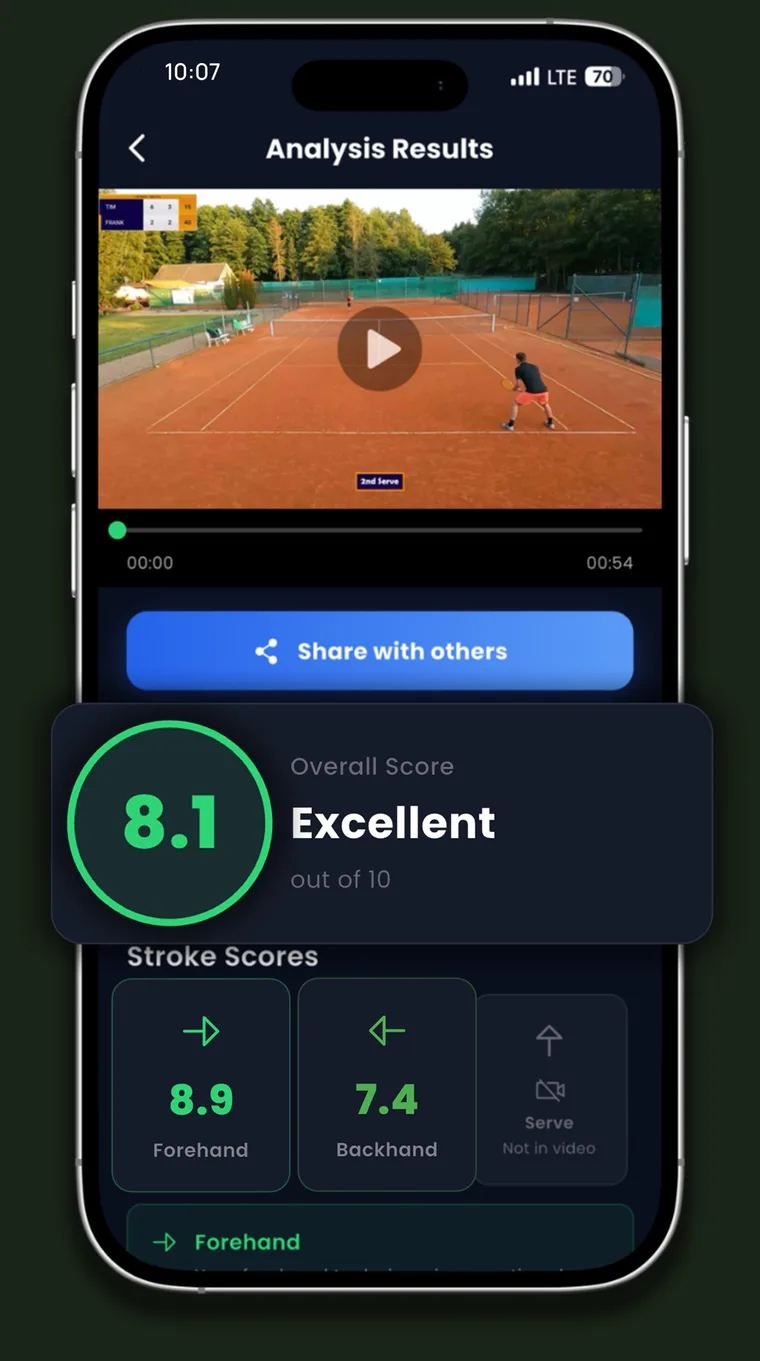
You can also upload the same clip to TennisAI, the iPhone video analysis app. Its feedback covers contact point along with timing and body position. It is an automated estimate and can be wrong, so compare it with what you see on the paused frame.
Drills for finding your contact point
Each drill works alone or with one partner feeding. Keep the ball slow. The aim is to meet it in the same place each time.
- Catch the ball (20 reps). Have a partner toss the ball underhand, or bounce it yourself. Turn as if to hit a forehand, then catch it with your hitting hand in front of your hips, with your palm facing where the strings would face. If you keep catching it beside your body, your contact is probably there too. Two-handed players can repeat this on the backhand side with the top hand.
- Freeze at contact (20 balls). Take an easy feed, hit with a short swing and stop the racket straight after the ball leaves the strings. Hold that position for two seconds and look at it. The racket should be in front of your hips and your arm should feel strong. Then progress to a half finish, then a full swing.
- Fence press (10 reps each side). Stand next to the fence, put your strings flat against it at your contact point and press gently. Slide the racket forward and back along the fence. You should feel stronger with the racket in front of your hips than beside them. If you feel pain at any point, stop and see a professional.
- Marked-spot drop and hit (20 balls). Put a marker on the court just in front of your front foot, at the distance where your arm is comfortable. Drop the ball so it bounces near the marker, and hit it as it comes back up to about hip height.
- Early, late, middle (15 balls). Hit five balls deliberately too late, five deliberately too early and five in between. On a right-handed forehand, late balls tend to go right and early balls tend to go left. Feeling both extremes makes the middle easier to find.
What a wrong contact point does to the ball
If you have no camera, the ball flight gives you clues. Directions here are for a right-handed forehand, so mirror them if you are left-handed.
| Contact problem | What the ball tends to do | What it feels like |
|---|---|---|
| Late (beside or behind your hips) | Goes right, and often low or long depending on the racket face | Rushed and weak, with the arm doing most of the work |
| Too early | Pulls left, often low | You swing before the ball arrives |
| Too close to your body | Weak, often hit near the throat of the racket | Elbow jammed against your side |
| Too far from your body | Short, often off the tip of the racket | Reaching, with your balance going sideways |
| Too low | Hits the net | Bending from the waist |
| Too high | Often goes long | The racket face is hard to control above your shoulder |
If one kind of miss keeps showing up, the two diagnostic guides go further: why shots go in the net and why shots go long.
Frequently asked questions
Where should the contact point be on a forehand?
In front of your hips, at a comfortable distance from your body. With an Eastern grip that is about hip height, and semi-western and Western grips move it further forward and higher.
How far in front of your body should you hit the ball?
There is no single distance, because it depends on your grip, your height and the stroke. Use the side-on video test: the ball should be clearly ahead of the front of your hips, with your arm neither cramped nor fully stretched.
Is the contact point the same on a one-handed and a two-handed backhand?
No. The one-handed backhand is generally hit further in front, because one arm has to hold the racket against the ball without help. The two-handed backhand can be hit a little closer to the body.
What happens if I make contact too late?
You lose power and control, and a right-handed forehand tends to go to the right. Late contact usually starts with late preparation, so look at what happens before the swing first.
Where is the contact point on a serve?
Up near your full reach and slightly into the court on a flat serve. Spin serves are usually hit closer to overhead, and coaches differ on exact toss placement.
See this in your own game
Upload a practice or match video to TennisAI and get feedback on your forehand, backhand and serve.

Sources
- Journal of Sports Science and Medicine: Mechanics and Learning Practices Associated with the Tennis Forehand (Reid, Elliott and Crespo, 2013)
- Journal of Sports Science and Medicine: Performance Factors Related to the Different Tennis Backhand Groundstrokes (Genevois et al., 2015)
- USTA League: NTRP rating information
- Apple: Change video recording settings on iPhone
- Journal of Sports Sciences: The effect of video-feedback on the learning of the tennis service by intermediate players (Van Wieringen et al., 1989)
This article is general information about tennis training and does not replace a coach or medical advice. Stop and see a professional if something hurts. TennisAI is made by Pace, the publisher of this blog.
