A forehand is a chain of simple movements: turn early, let your body start the swing, meet the ball in front, and finish. Most club players do not need a new swing. They need one link in that chain repaired.
This guide covers grip choice, the five parts of the stroke, and five common club-level mistakes, each with a way to confirm it on video.
Which forehand grip should you use?
Your grip sets where you meet the ball. A research review by Reid, Elliott and Crespo reports that eastern-grip players on hard courts typically hit about 4 cm (1.6 inches) below hip height, while semi-western and western players hit at least 6 cm (2.4 inches) above it.
| Grip | Usual contact height | Strength | Weakness |
|---|---|---|---|
| Eastern | Around the hip | Flatter drives, easier on low balls | Harder to control high balls or add heavy topspin |
| Semi-western | Between hip and chest | A good mix of spin and drive, handles high balls | Very low balls need more knee bend |
| Western | Chest height or higher | A lot of topspin, strong on high balls | Low, fast balls are hard to handle |
Decision rule: choose the grip that lets you hit comfortably at the height you meet most often. If most balls reach you at the waist or below, start with an eastern or a mild semi-western grip. If they bounce high, use a semi-western grip. Coaches differ on how far around the handle to go. If your forehand already works, you do not need to change grip because a tour player uses a different one.
Forehand technique in five parts
1. Unit turn
Start as soon as you see the ball coming to your forehand. Turn your shoulders and hips together, with your free hand on the racket to help it move back. The shape of the backswing matters less than many players think. The same review points to older work suggesting that repeatable positions at impact matter more than the exact path of the swing, so a loop or a straighter backswing can both work if you arrive on time.
Video check: pause when the ball bounces on your side. Your shoulders should already be turned and your racket should be on its way back. If it is not, read why you are always late on the ball.
2. Spacing and stance
Give yourself room. Your hitting arm should be comfortably extended at contact, with your elbow away from your ribs. Use small steps to get there. A neutral stance suits a short ball you can step into. An open stance suits a ball you have little time for or one that pulls you wide. Coaches differ on how much to use each, so let the ball and your time decide.
3. Forward swing and lag
Push from your legs, then rotate your hips and trunk, and let your arm follow. Reid, Elliott and Crespo name pelvis and trunk rotation, plus the upper arm moving across the body and rotating inward, as the main sources of racket speed. They report about 21 to 24 m/s (47 to 54 mph) for club players and about 33 m/s (74 mph) for professionals.
"Lag" is the coaching word for what happens when your body turns and a relaxed arm and racket trail behind it for a moment. You cannot create it by force, and a tight grip usually removes it. Keep your grip firm enough to hold the racket and no firmer.
4. Contact in front
Meet the ball in front of your front hip, at the height your grip prefers. The contact point guide covers how to find it. For spin, one study of 13 NCAA Division I men linked more topspin to faster upward racket speed and a more closed racket face. A longer hitting zone was not linked to more spin. None of the racket measures predicted total accuracy, so more spin does not automatically mean more balls in. The guide on how to hit topspin has the drills.
Video check: pause on the contact frame. The ball should be in front of your front hip. The review describes shoulders that are about parallel with the net by impact, so check that yours have turned forward too.
5. Finish
Let the swing slow down on its own. Common finishes are over the opposite shoulder, around your body, or back over the hitting shoulder on wide balls. The review calls the follow-through an important but poorly investigated part of the stroke, so treat it as a result of the swing and not as a position to copy. If your racket stops near the target, you probably slowed down before contact.
Do not try to roll your wrist over the ball. A biomechanics review by Elliott lists forearm pronation as negligible for racket speed in the topspin forehand, against about 40% for upper-arm internal rotation.
Five common forehand mistakes: symptom, cause and fix
Start with what you see on court, then confirm it on video before you change anything. "Hitting side" below means the right side for a right-hander.
| Symptom | Likely cause | Check on video | Fix |
|---|---|---|---|
| Ball sprays to your hitting side, contact feels jammed | Late contact | At contact the ball is level with or behind your hip | Turn before the bounce. Say "turn, bounce, hit" for 20 balls. |
| You swing hard but the ball has little pace | Arm-only swing | Your shoulders barely turn on the backswing | Hit 20 balls at half speed, letting your hips start the swing. |
| Balls fly long, even easy ones | Level swing path or open racket face, often with your weight falling back | The strings tilt up at contact and you lean away from the ball | Swing more up the ball, keep your weight moving forward. See why shots go long. |
| You hit the frame or feel cramped | Poor spacing | Your elbow is close to your ribs at contact | Take small steps until the last moment, and move back from the ball if you feel crowded. |
| Ball lands short with little spin | The swing slows down at contact | The racket stops near the target with no finish | Hit 20 balls high over the net with a full finish, aiming past the service line. |
If you see more than one, work on the earliest in the stroke. Late contact often causes the others, because you cannot rotate fully when you are rushed.
A forehand practice block with clear targets
Try this block with a partner or ball machine. The structure and targets are our suggestion, not a research-backed amount.
- Freeze at the finish, 10 balls. Drop feed, swing, then hold your finish for two seconds. Target: balanced on 8 of 10.
- Turn, bounce, hit, 20 balls. Say the words out loud as you play. Target: you say "turn" before the bounce on every ball.
- Depth, 20 balls. Rally or feed cross-court and count balls landing past the service line. Target: 14 of 20.
- Mixed feeds, 20 balls. Your partner feeds short, wide and deep balls in random order. Target: 14 of 20 in the singles court.
The mixed feeds are there for a reason. In one study of 80 males aged 9 to 10 and 18 to 19, over 18 sessions in 40 days, variable practice beat constant and specialized practice on a transfer test of accuracy. It is one study, but the change is easy to make.
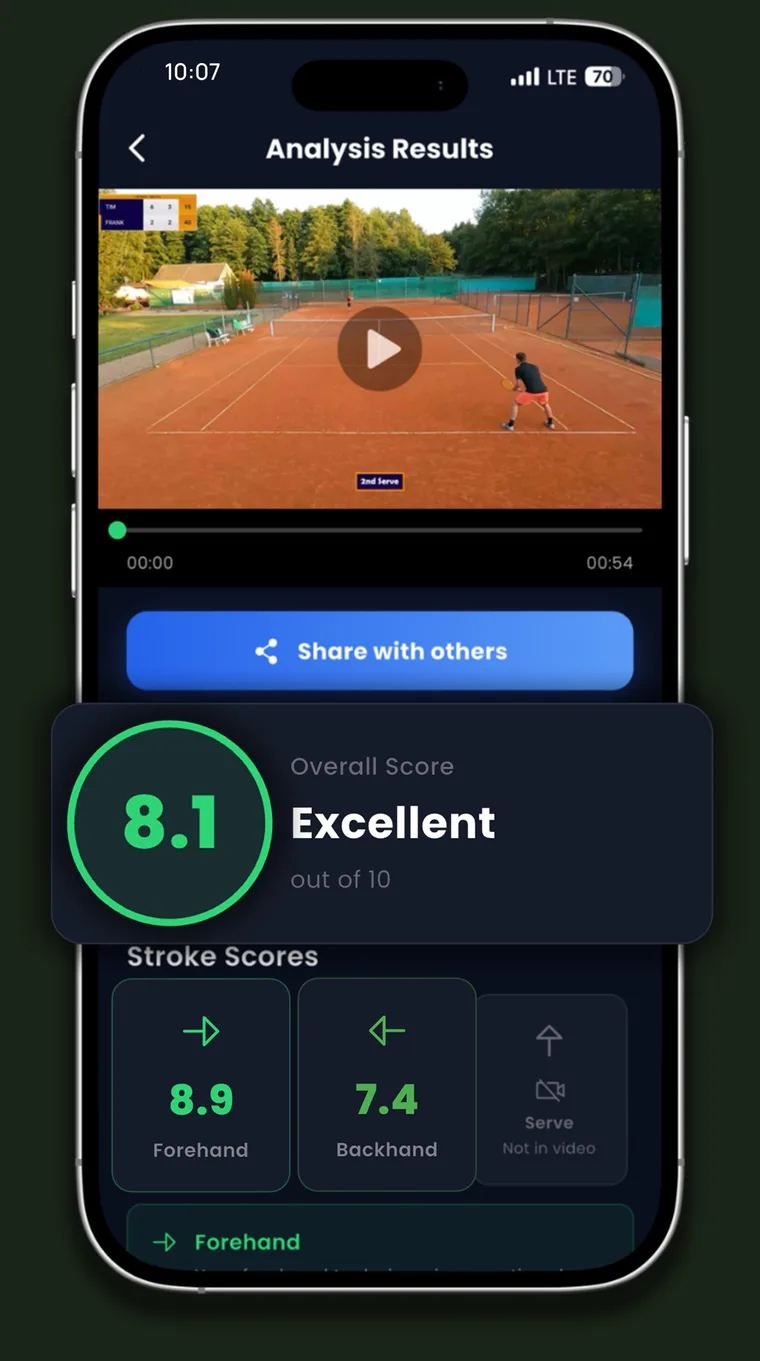
Film the last block side-on from the same spot each week, and pause on the same two frames: the bounce and the contact. For another view of the same clip, TennisAI analyzes your forehand from an uploaded video and gives a separate forehand score. Results vary with camera angle and lighting, and the score is an automated estimate that can be wrong, so look at the trend over several clips.
Frequently asked questions
What is the best grip for a tennis forehand?
There is no single best grip. Many players use a semi-western grip because it mixes spin and drive, but the right choice is the grip that lets you hit comfortably at the height you meet most often.
Where should I make contact on a forehand?
In front of your front hip, with your arm comfortably extended. The height depends on your grip: around the hip for an eastern grip, and higher for semi-western and western grips.
How do I get more power on my forehand?
Use your legs, hips and trunk to start the swing, and keep your arm and grip relaxed. Swinging harder with the arm alone usually costs you timing and adds little.
Should I use an open or neutral stance on my forehand?
Use both. A neutral stance suits short balls you can step into, and an open stance suits balls that rush you or pull you wide. Coaches differ on how much to use each.
See this in your own game
Upload a practice or match video to TennisAI and get feedback on your forehand, backhand and serve.

Sources
- Reid, Elliott and Crespo, Journal of Sports Science and Medicine: Mechanics and Learning Practices Associated with the Tennis Forehand
- Elliott, British Journal of Sports Medicine: Biomechanics and tennis
- Kwon et al., Journal of Sports Science and Medicine: Influence of Tennis Racquet Kinematics on Ball Topspin Angular Velocity and Accuracy
- Douvis, Perceptual and Motor Skills: Variable practice in learning the forehand drive in tennis
This article is general information about tennis training and does not replace a coach or medical advice. Stop and see a professional if something hurts. TennisAI is made by Pace, the publisher of this blog.
