A review of tennis skill learning by Reid and colleagues describes two common patterns: repetitive hitting with little connection to a match, and poorly structured play with no specific goals. It says neither is likely to give the best learning. This plan tries to avoid both. Every session has a goal and a score, and practice gets closer to match play each week.
What the research says about how to practice tennis
| Study | Finding | How the plan uses it |
|---|---|---|
| Douvis, 2005: 80 male learners aged 9 to 10 and 18 to 19, 18 sessions | Varied targets gave better forehand accuracy on a transfer test than a single target | Targets start changing in week 2 |
| Hebert et al., 1996: 83 undergraduates in tennis classes | Lower-skilled students did better with blocked practice, with no difference for higher-skilled students | Week 1 stays blocked. If a stroke is new or breaking down, stay there longer |
| Broadbent et al., 2015: training players to anticipate tennis shots | Random practice beat blocked practice at 7-day retention, with faster decisions in a field test. This was anticipation, not stroke mechanics | Mixed situations in weeks 2 and 3 |
| Macnamara et al., 2016: meta-analysis across all sports | Deliberate practice explained 18% of the variance in performance overall and 1% among elite performers | Practice matters but is not the only factor, so judge the plan by your own numbers |
| Van Wieringen et al., 1989: 66 players with 2 or more years of experience | 40-minute sessions twice a week for 5 weeks improved the serve more than no training | Two sessions a week can work, though this does not show it is the best amount |
| Menayo et al., 2026: 24 recreational youth players, 12 sessions over 6 weeks | With practice volume controlled, short-rest consecutive-day and long-rest non-consecutive-day schedules did not differ significantly | Choose the days that fit your week |
Before you start: pick your goals and take a baseline
- Film 10 minutes of rallies or points from one view, so you can compare in week 4. Our filming guide covers the setup.
- Run three counts: your best crosscourt rally in three tries, first serves in out of 20, and double faults in 10 two-serve points. Our consistency drills have more tests.
- Look at a recent match. Note which side makes the most errors. Our match video routine shows you how to tally them.
- Pick one stroke goal and one match goal. Choose the stroke that costs you the most points, even if you would rather work on another.
- Write each goal as a number: for example, "second serve: 7 of 10 in" or "crosscourt rally: from 12 to 20".
The 4-week tennis training plan
Each session is about 60 minutes, starting with a 10-minute warm-up and ending with a quick note of your scores. Session C is optional. With only two sessions, skip it.
| Week | Focus | Session A | Session B | Session C (optional) |
|---|---|---|---|---|
| 1 | Baseline and technique | Your goal stroke to one target, repeated, for 30 minutes. Then 20 serves to one target. | Crosscourt counts for 20 minutes. Then 20 second serves. Then points with one rule, such as every ball past the service line. | Practice match. Tally errors by side and do not think about technique. |
| 2 | Add variation | Your goal stroke, changing the target every 5 balls, for 30 minutes. Then serves, changing side and target every 3 balls. | Patterns for 30 minutes: serve plus first ball, crosscourt then down the line. Then points from those patterns. | Points that start from your weaker side. |
| 3 | Add pressure | Scored drills where a miss sends you back to zero. Second serves: 7 of 10 or repeat the set. | Tiebreak games, then games that start at 30-30. | Full match with one tactic to test. |
| 4 | Test and reduce | Repeat your three counts and film from the same view. Then light hitting. | A shorter session of 40 minutes: points only, using your game plan. | Match. Tally the same errors as in week 1. |
After week 4, compare your numbers with week 1. If you reached a goal, replace it. If you did not, keep it for another cycle and look at what changed and what did not.
How to adjust the plan
| If this happens | Do this |
|---|---|
| You reach a goal early | Raise the number, or add movement or pace |
| Your scores drop when you add variation in week 2 | Some drop is common. Stay for one more session, and go back to one target only if your score falls below half of your week 1 score |
| A stroke works in drills but fails in points | Cut the drills by a third and add scored points |
| You miss a session | Do session A next, and do not add extra sessions to catch up |
| You miss a full week | Repeat the week you missed |
| Your legs are heavy and your quality drops | Shorten the session, or replace a hitting block with serves or shadow swings |
| Your numbers have not moved after 4 weeks | Check your clips, change one focus or book a lesson. A coach can often see the cause sooner |
| You feel pain | Stop and see a professional before you continue |
Where video and the AI coach fit
Use video to see what you actually do, and do not expect it to work by itself. Two older trials on the serve found no added benefit from video over traditional training. A 2024 study of 23 intermediate players found that those who chose when to get video feedback improved tactical performance more than those on a fixed schedule, though it had no group without video. A practical reading: film on test days, then look at video when you have a specific question.
- Weeks 1 and 4: upload a clip from the same view and compare. Results vary with video quality, camera angle and lighting, so one score is a rough reading, and a change across several sessions says more.
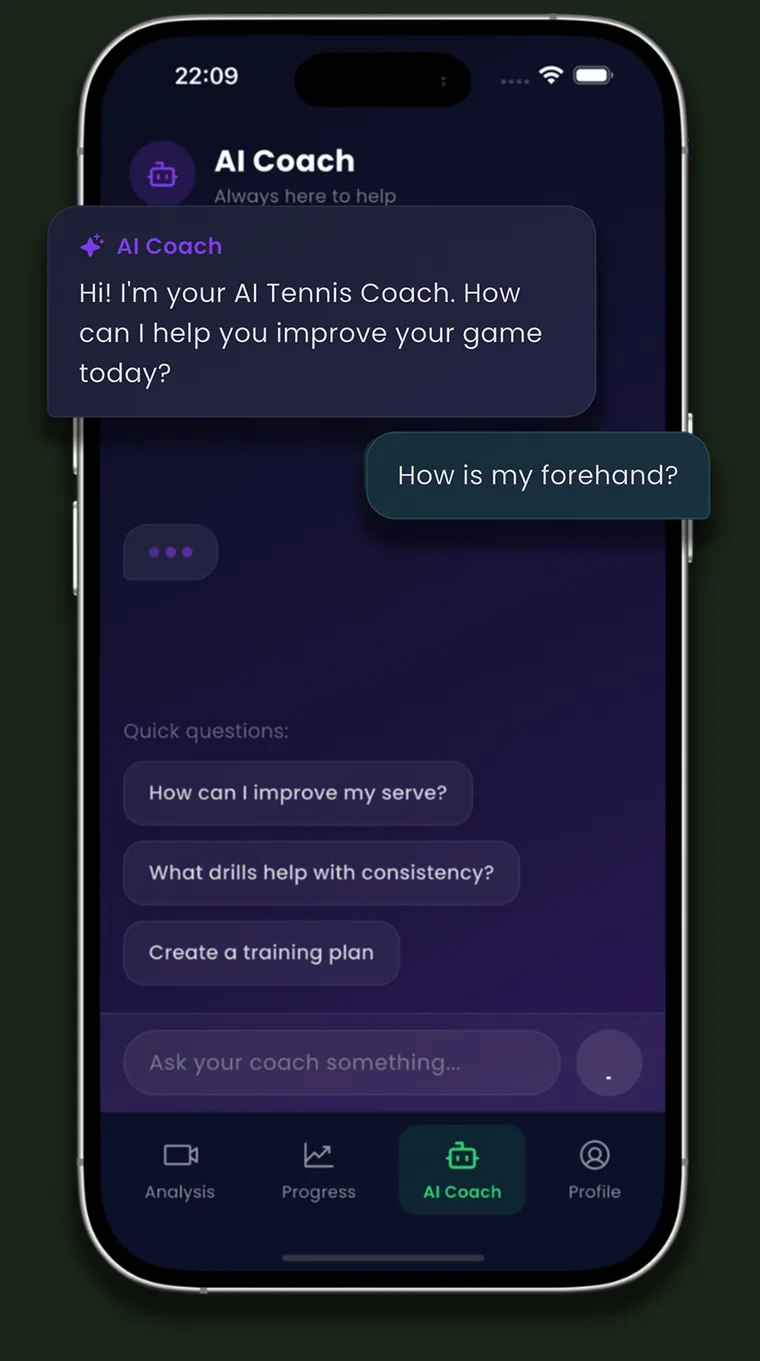
- When you need ideas: TennisAI's AI Coach has a quick prompt, "Create a training plan". Give it your sessions per week, your goal and your counts so that the answer fits you. Chat is session-based and not stored permanently, so copy what you want to keep into your notes.
- From week to week: the Progress tab shows your session history and technique scores, and lets you filter sessions by stroke.
Do not use a rating to judge four weeks of work. UTR uses a weighted average of up to 30 of your most recent match ratings from the last 12 months, so it moves on match results over time. See how to improve your UTR. The NTRP and UTR numbers in TennisAI are estimates from your video analyses and are not official ratings. Your own counts are a better test of this plan.
Frequently asked questions
How many times a week should I train for tennis?
We found no reliable source for a fixed number. A 1989 study of 66 players found that 40-minute sessions twice a week for 5 weeks improved the serve more than no training, which shows a schedule that worked and not an optimum. This plan suggests two sessions, with an optional third.
What should a tennis training session include?
A warm-up, one focused block with a score, some serves, points or a pressure game, and a note of your numbers. Keep one main goal per session.
Can I follow a tennis training plan without a coach?
Yes, if your goals are counts you can measure yourself. For a large technique change, a coach is the better choice, and analysis apps do not replace coaching.
How long until a training plan shows results?
It varies, and we found no reliable figure. Practice counts such as rally length or second serves in may change within a few weeks, while official ratings tend to move more slowly because they depend on match results.
See this in your own game
Upload a practice or match video to TennisAI and get feedback on your forehand, backhand and serve.

Sources
- Reid, Crespo, Lay & Berry, Journal of Science and Medicine in Sport (2007): Skill acquisition in tennis
- Douvis, Perceptual and Motor Skills (2005): Variable practice in learning the forehand drive in tennis
- Hebert, Landin & Solmon, Research Quarterly for Exercise and Sport (1996): Practice schedule effects on low- and high-skilled students
- Broadbent et al., Medicine & Science in Sports & Exercise (2015): Contextual interference effect on perceptual-cognitive skills training
- Macnamara, Moreau & Hambrick, Perspectives on Psychological Science (2016): Deliberate practice and performance in sports
- Van Wieringen et al., Journal of Sports Sciences (1989): Video-feedback and the tennis service in intermediate players
- Menayo et al., Journal of Motor Behavior (2026): Temporal spacing of practice and tennis serve retention
- Emmen et al., Journal of Sports Sciences (1985): Video-modelling and video-feedback in learning the tennis service by novices
- van der Meer et al., Research Quarterly for Exercise and Sport (2024): Self-controlled video feedback and tactical skills in tennis
- UTR Sports Help Center: How the UTR Rating is calculated
This article is general information about tennis training and does not replace a coach or medical advice. Stop and see a professional if something hurts. TennisAI is made by Pace, the publisher of this blog.
