Consistency means hitting a similar quality of ball many times in a row, including when you are moving or under pressure. You can measure it, which is why every drill here has a count. The goals are suggested starting points and not official standards.
Why rally length and unforced errors matter
An unforced error gives your opponent the point even though their shot caused you no real problem. A small study of 8 men's professional matches on hard courts found that game winners hit more winners and made fewer unforced errors. Evidence at club level is thinner. The largest public data we found comes from a vendor: SwingVision, a tennis app, published the numbers below from its own users.
| NTRP level (SwingVision's data) | Unforced errors per match | Winners per match |
|---|---|---|
| 2.5 | 7.87 | 4.89 |
| 3.0 | 11.42 | 7.77 |
| 3.5 | 12.37 | 8.60 |
| 4.0 | 12.39 | 8.77 |
| 4.5 | 11.74 | 8.57 |
| 5.0 | 11.31 | 9.13 |
SwingVision reports these figures from more than 86 million shots in over 250,000 sessions. They come from its app users only, and it does not say how levels were assigned or how errors were classified, so read them with care. In that data, players at 5.0 make about as many errors per match as players at 3.0. The table cannot tell you how many balls each error took, and that is the number you can train.
For a per-ball figure, a preprint (not peer reviewed) using Match Charting Project data on professional matches gives an average of 8.0% unforced errors per ball on the ATP tour and 8.6% on the WTA tour. That is about one error every 12 balls. Those players face far harder balls than you meet in a practice rally, so this is not a target. It does show a useful way to measure yourself: balls per error.
Self-test: where does your consistency break down?
Do this before you start the drills. It takes about 15 minutes with a partner.
- Rally count: rally crosscourt from the baseline at medium pace. Take three tries and write down your best count.
- Depth count: hit 20 balls from the baseline and count how many land past the service line.
- Miss tally: keep rallying until you have missed 20 balls. Mark each miss as net, long or wide.
The tally tells you what to fix first.
| Most of your misses | Check first | Next step |
|---|---|---|
| In the net | Target too low, late contact, flat swing | Read why shots go in the net |
| Long | Too much pace, open racket face, not enough spin | Read why shots go long |
| Wide | Aiming too close to the lines, changing direction late | Do the target zones drill below |
| An even mix | Late preparation, poor spacing, rushing | Slow your swing by about a third and test again |
Six consistency drills with numeric goals
The net is 0.914 m (3 feet) high at the center and 1.07 m (3.5 feet) at the posts, so a crosscourt ball crosses the lowest part of the net. The service line is 5.49 m (18 feet) from the baseline.
| Drill | Setup | Goal | Trains |
|---|---|---|---|
| Mini-tennis count | Both players inside the service boxes | 30 in a row | Contact and control |
| Crosscourt count | Baseline to baseline on one diagonal, medium pace | 20 in a row on both diagonals | Rally length |
| Depth line | Aim past the service line, then past a mark 2.74 m (9 feet) inside the baseline | 14 of 20 past the service line, then 10 of 20 past the mark | Depth |
| Height window | Aim about 1 m (3 feet) above the net. Your partner calls "low" on anything lower | 15 of 20 with no call | Net clearance |
| Target zones | Mark a zone 1.5 m (5 feet) inside each sideline and aim for it | 12 of 20 in the zone | Direction and margin |
| Ten before you play | Play a normal point only after a 10-ball rally. A miss before 10 means you start the rally again | Reach 7 points with no more than 5 restarts | Consistency under pressure |
Target zones sit inside the lines for a reason. If you aim at the line, any small miss to the outside goes out. If you aim 1.5 m (5 feet) inside it, the same miss still lands in. The height window is only a starting point: coaches differ, and the right height depends on your pace, your spin and where you stand. With no partner, use the wall versions in our solo tennis drills.
How to make a drill harder
Change one thing at a time, in this order: pace, then direction, then movement, then pressure. Move up when you reach the goal in two separate sessions. Move back a step if your count falls below half the goal.
Research supports changing targets, with limits. One study of 80 male learners (ages 9 to 10 and 18 to 19) over 18 sessions found that practice with varied targets gave better forehand accuracy on a transfer test than practice with one target. Another study of 83 undergraduates in tennis classes found that lower-skilled students did better with blocked practice, repeating one stroke at a time. A simple rule follows: if the stroke is still new, keep one target. If it is stable, change the target often.
How to track your consistency over weeks
| What to record | How | What it tells you |
|---|---|---|
| Crosscourt best | Best of three tries at the same pace | If it is flat for 3 weeks, check your miss tally |
| Depth score | Balls past the service line, out of 20 | Above 14, move your mark deeper |
| Height score | Balls with no "low" call, out of 20 | Below 10, raise your target |
| Miss tally | Net, long and wide, out of 20 | If your top miss changes, change your focus |
| Balls per error | Count from a filmed 10-minute rally: your balls hit divided by your errors | Your main number from week to week |
Repeat the self-test every two weeks, with the same partner if possible, because a stronger partner changes the numbers.
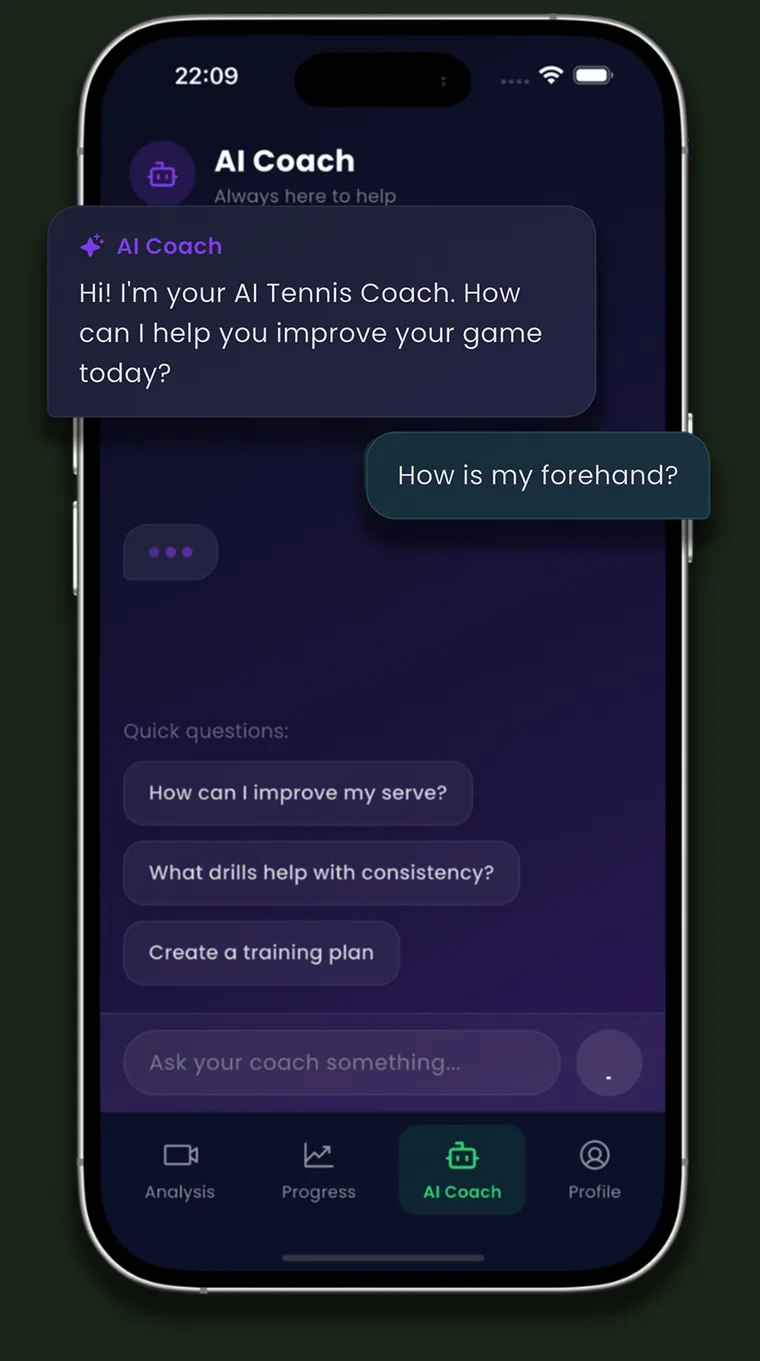
Counts tell you that a rally broke, and video helps show why. Film one rally block every two weeks and compare your first balls with your last. If your preparation gets later as the count rises, pressure or tiredness is changing your technique. In TennisAI's Progress tab you can see session history and technique scores, filter sessions by stroke and see the percentage change per session. Treat each score as an automated estimate, keep the camera angle the same and look at the trend. If you are unsure which drill to try next, you can ask the AI Coach: one of its quick prompts is "What drills help with consistency?".
To fit these drills into a full week, use our 4-week training plan.
Frequently asked questions
How do I become more consistent in tennis?
Aim further inside the lines and higher over the net, slow your swing slightly, and train with counts you can beat. A tally of your misses shows which problem to fix first.
What are good rally goals for tennis practice?
There is no official standard. As a suggestion, aim for 30 in a row in mini-tennis and 20 in a row crosscourt from the baseline at medium pace, then raise the pace.
How many unforced errors is normal in a tennis match?
In data SwingVision published from its own app users, the average was about 11 to 12 per match from NTRP 3.0 to 5.0, and 7.87 at 2.5. SwingVision does not say how it classified errors, so treat this as a rough guide.
How high over the net should I hit my groundstrokes?
A common starting target in a rally is about 1 m (3 feet) over the net. Coaches differ, and the right height depends on your pace, your spin and your position.
See this in your own game
Upload a practice or match video to TennisAI and get feedback on your forehand, backhand and serve.

Sources
- SwingVision blog: The real data behind every NTRP level (vendor data)
- Peiris, Epasinghege Dona & Swartz, arXiv preprint (2024): Analysis of the impact of unforced errors in tennis
- Martínez-Gallego et al., Journal of Sports Medicine and Physical Fitness (2019): Analysis of men's professional tennis on hard courts
- Douvis, Perceptual and Motor Skills (2005): Variable practice in learning the forehand drive in tennis
- Hebert, Landin & Solmon, Research Quarterly for Exercise and Sport (1996): Practice schedule effects on low- and high-skilled students
- World Tennis (formerly the ITF): 2026 Rules of Tennis (court and net dimensions)
This article is general information about tennis training and does not replace a coach or medical advice. Stop and see a professional if something hurts. TennisAI is made by Pace, the publisher of this blog.
