Photold
Which Parent Will Our Baby Look Like? What Genetics Says
By the Photold team · · 6 min read
Nobody can tell in advance which parent a baby will look like. A child inherits half of their chromosomes from each parent, but the half from each side is a different mix for every child. Most visible traits, from eye color to height to the shape of the face, depend on many genes working together, so they do not follow the simple "dominant wins" rule many charts show.
What genetics can do is explain why siblings look so different, why a baby's eyes may change color, and which guesses are safer than others. This guide covers the main traits one by one, using what the US National Library of Medicine and published studies say. It is general information, not genetic counseling.
Half from each parent, shuffled every time
Each parent passes on one copy of each chromosome, and which copy goes to which child is a matter of chance. That is why two children of the same parents can look like they come from different families, and why a baby can resemble a grandparent more than either parent.
The face is especially complex. A 2021 study in Nature Genetics linked facial shape to 203 genetic signals across the genome. With that many pieces involved, the overall look of a face cannot be worked out from two parents' photos.
Eye color: many genes, not one
According to MedlinePlus, eye color involves multiple genes. The two with the biggest effect, OCA2 and HERC2, sit on chromosome 15, and at least eight others play a part. That is why the old school rule "brown always beats blue" is too simple. MedlinePlus notes that, although it is uncommon, parents with blue eyes can have children with brown eyes.
A newborn's eye color is not final either. The American Academy of Pediatrics explains that it takes about a year for the pigment cells in the iris to finish their work, and that the change slows after about six months. A long-running twin study found that most children reach a stable eye color by about age 6, and that in 10 to 15% of the white participants it kept changing into adulthood.
Hair color and texture
Hair color is also determined by many genes. Red hair is the best-known case: one altered copy of the MC1R gene is linked to strawberry blond, auburn or red hair, and two altered copies almost always to very red hair. So two dark-haired parents who each carry one copy can have a red-haired child.
Hair also changes with age. MedlinePlus notes that many blond children have noticeably darker hair by their teens. Curly or straight hair texture involves many genes as well, so a baby's first wisps say little about the hair they will have at ten.
Height: mostly inherited, still hard to predict
MedlinePlus estimates that about 80% of the differences in height between people come from inherited DNA variations, and more than 700 such variations are known. Even so, it says it is difficult to accurately predict how tall a child will be. Nutrition, the mother's health during pregnancy and access to health care all play a part.
Dimples, earlobes, freckles and other "dominant" traits
Many school charts list these as simple dominant traits. The research is less tidy.
| Trait | What the evidence says | What it means for guessing |
|---|---|---|
| Dimples | Often called dominant, but MedlinePlus says there is no proof they are inherited, and the genes are unknown | Baby-fat dimples can also disappear as the face changes |
| Earlobes | A study of 74,660 people found 49 genetic regions linked to earlobe attachment | Not a one-gene, attached-or-free trait |
| Freckles | Largely genetic but brought out by sunlight | A freckle-prone child may show few freckles until they spend time in the sun |
| Face shape | Linked to more than 200 genetic signals | The overall resemblance is the hardest trait to guess |
Curious anyway? Photold's Baby Predictor turns two parents' photos into one imagined baby, just for fun.Try Photold
Do babies look more like their fathers?
You may have heard that newborns resemble their fathers so that fathers bond with them. The evidence is mixed. A short 1995 report found greater resemblance between one-year-olds and their fathers. A 1999 study that tried to repeat it found that children aged 1, 3 and 5 did not resemble their fathers significantly more than their mothers. So when relatives argue over whose nose the baby has, all of them can be right for a while: faces change a lot in the first years.
What a baby face generator can and cannot show
An AI baby face generator does not read genes. It blends what it sees in two photos into one plausible face. In Photold, the Baby Predictor takes two parents' photos and shows one baby around a year old, in a "most likely" or a "surprise" mode. It is made for fun and is not a genetic prediction, as our guide to what your baby might look like explains.

A more telling comparison costs nothing: your own baby photos. Here is a family game that works better than any chart.
- Ask both families for photos of each parent at about one year old.
- Put them side by side with a photo of your baby at the same age, once they get there.
- Compare one feature at a time: eyes, nose, mouth, ears, hairline.
- Write down who guessed what, and look again at age three and age six. Faces change, and the winner often changes too.
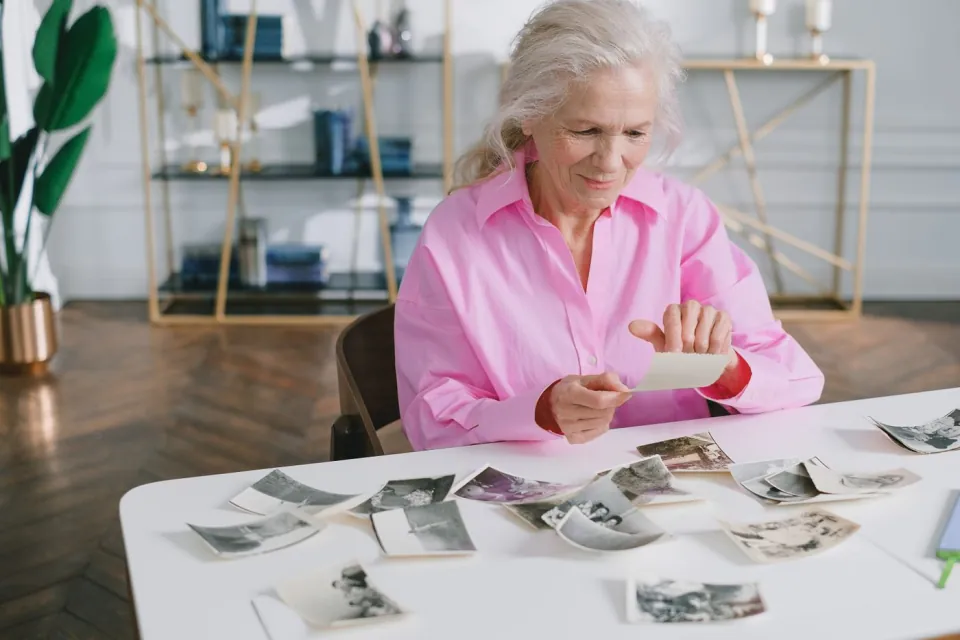
If those old prints are faded or scratched, scan them flat with your phone first and restore them so the faces are clear. Older relatives are usually happy to help name who is who.
Frequently asked questions
Which parent does a baby usually look like?
There is no reliable rule. A child gets half of their chromosomes from each parent in a new mix, and most visible traits depend on many genes, so a baby can resemble either parent, a grandparent or a blend.
Can two blue-eyed parents have a brown-eyed baby?
Yes, although it is uncommon, according to MedlinePlus. Eye color involves multiple genes, not one dominant gene for brown and one recessive gene for blue.
When do babies get their final eye color?
The American Academy of Pediatrics says it takes about a year for the pigment to finish developing, with most change in the first six months. A twin study found most children have a stable eye color by about age 6.
Are dimples genetic?
They are often called a dominant trait, but MedlinePlus says there is no proof that dimples are inherited, and the genes involved are not known.
Can an app predict what my baby will look like?
No. A baby face generator blends features from two photos into one imagined face. It does not analyze genes, so treat the result as a bit of fun, not a forecast.
Sources
- NHGRI Genetics Glossary: Chromosome
- MedlinePlus Genetics: Is eye color determined by genetics?
- HealthyChildren.org (American Academy of Pediatrics): Newborn eye color
- Bito et al., Archives of Ophthalmology (1997): Eye color changes past early childhood
- MedlinePlus Genetics: Is hair color determined by genetics?
- MedlinePlus Genetics: Is hair texture determined by genetics?
- MedlinePlus Genetics: Is height determined by genetics?
- MedlinePlus Genetics: Are facial dimples inherited?
- Shaffer et al., American Journal of Human Genetics (2017): Multiethnic GWAS of earlobe attachment
- Praetorius et al., Pigment Cell & Melanoma Research (2014): Sun-induced freckling
- White et al., Nature Genetics (2021): Insights into the genetic architecture of the human face
- Brédart and French, Evolution and Human Behavior (1999): Do babies resemble their fathers more than their mothers?