Three ratings compete for your attention, and a fourth, ITN, still turns up on old forms. They do not measure you in the same way, and each one matters only where somebody reads it. So the useful question is not which rating is best. It is who needs to see your number.
This article is a decision guide. For conversion charts, read UTR vs NTRP. For the ITF rating in depth, read the World Tennis Number explained.
The short answer, by player type
- U.S. adult league playerNTRP first. League level and team eligibility depend on it. Add UTR or WTN only if you enter other events.
- Junior aiming at college tennisUTR and WTN. Coaches look at UTR, and the USTA lists WTN for junior tournaments and college tennis.
- Player outside the U.S.WTN first. Ask your national federation, because some also use UTR.
- Tournament player at ITF levelWTN. A verified singles WTN is one of the ITF World Tennis Tour acceptance measures.
- Recreational player who wants fair matchesUTR or WTN, whichever your local group uses. Both update with every recorded match.
- CoachWhichever your players need. Know all three, track the one tied to each player's goal.
The three ratings side by side
UTR
UTR Sports
- Scale 1.00 to 16.50, higher is better
- Weighted average of up to 30 recent matches from the last 12 months
- Recalculated every 24 hours
- Read by college coaches, event organizers and local players
- Verified UTR counts only vetted events
NTRP
USTA
- Scale 1.5 to 7.0, higher is better
- Self-rate, then a computer rating from match results
- Released once a year
- Read by USTA League captains and organizers
- One number for singles and doubles
WTN
ITF (World Tennis)
- Scale 40 to 1, lower is better
- Compares scores with a prediction, three-year window since August 2026
- Updates weekly, on Wednesdays
- Read by the ITF, many national federations and the USTA for juniors
- Separate singles and doubles numbers
NTRP: the U.S. league rating
The USTA runs NTRP, the National Tennis Rating Program. You can self-rate for free in a USTA account at any time, and the USTA says that ultimately your rating is based on match results. It is described as static and released once a year. Players can appeal a year-end computer rating through TennisLink, within the USTA's rules. The USTA says NTRP remains the foundation of USTA League.
NTRP matters only where someone checks it, which is mostly USTA adult leagues. If that is where you play, it is the rating to know. See how to read your USTA NTRP rating and the background in NTRP explained.
UTR: the rating that follows your results
UTR Sports runs UTR, which rates every player from 1.00 to 16.50 regardless of age or gender. It is a weighted average of up to 30 recent match ratings, recalculated every 24 hours. A Verified UTR counts vetted events, such as sanctioned leagues, college and professional events. A standard UTR also counts casual matches. UTR Sports says that more than 90 percent of U.S. college coaches are on its platform. That is the company's own claim, but it matches why juniors treat Verified UTR as their recruiting number.
To read your own number, see how to read your UTR score, and for the mechanics, what is UTR.
WTN: the ITF rating, and what happened to ITN
WTN is free, covers all ages and genders, and runs from 40 down to 1, so lower is better. You get one number for singles and one for doubles. It updates weekly. The USTA lists WTN for tournament match play, selection and seeding in USTA junior and adult tournaments, ITF acceptance, collegiate tennis and junior team tennis. It says over 170 countries have adopted WTN.
- 40–28 Beginner range
- 28–12 Club and recreational range
- 12–1 Strong tournament and pro range
- 40 40
- 1 1
The bands in that chart are only a rough visual guide, and not official levels. The ITF defines the two ends of the scale and nothing in between.
ITN, the ITF's older International Tennis Number, also uses a lower-is-better scale. We could not find an official ITF statement retiring it, but WTN is what current ITF rules use. If a form still asks for an ITN, ask the organizer what it accepts.
Which one in your situation
U.S. adult league player
Track NTRP. It decides your league level. Your results in USTA League also feed your WTN, so you collect a second number without extra effort. UTR is useful if you want to find hitting partners across clubs.
Junior aiming at college tennis
Track Verified UTR and your WTN. College coaches use UTR to find and compare recruits, and the USTA says coaches can use WTN to evaluate prospects. Because standard UTR also counts casual matches, check that the matches that matter are in verified events.
Player outside the U.S.
NTRP is the USTA's program, so start with WTN, which national federations such as the LTA in Britain use. Look at what your own federation and local clubs read, and add UTR if your area uses it.
Tournament player at ITF level
WTN is the one. The ITF says that for World Tennis Tour singles, acceptance goes first to players with a WTA or ATP ranking, then those with an ITF World Tennis Ranking, then players with a verified singles WTN. Verified means a confidence level of 70% or higher, taken on the Monday before the entry deadline. That rule applied from April 2025, so check the current regulations for your event.
Recreational player who just wants fair matches
Pick one number your friends or local group already use, then play a few recorded matches. Compare numbers within the same system only. A UTR of 5 and a WTN of 25 are two different measures, so do not try to convert them in your head.
Coach
Let each player's goal choose the rating. A league player needs NTRP, a recruit needs Verified UTR and WTN, and an ITF-bound junior needs a verified WTN. Keep a short list of each player's numbers and the dates you checked them.
Can you hold several ratings at once?
Yes. NTRP, UTR and WTN are independent. Each has its own profile, results and algorithm. Some results, like USTA League matches, feed more than one. WTN separately needs its own login even if you have a USTA login. Two rules keep it sane: never convert one into another, and never give an organizer a number from a different system than the one they asked for.
Where TennisAI fits
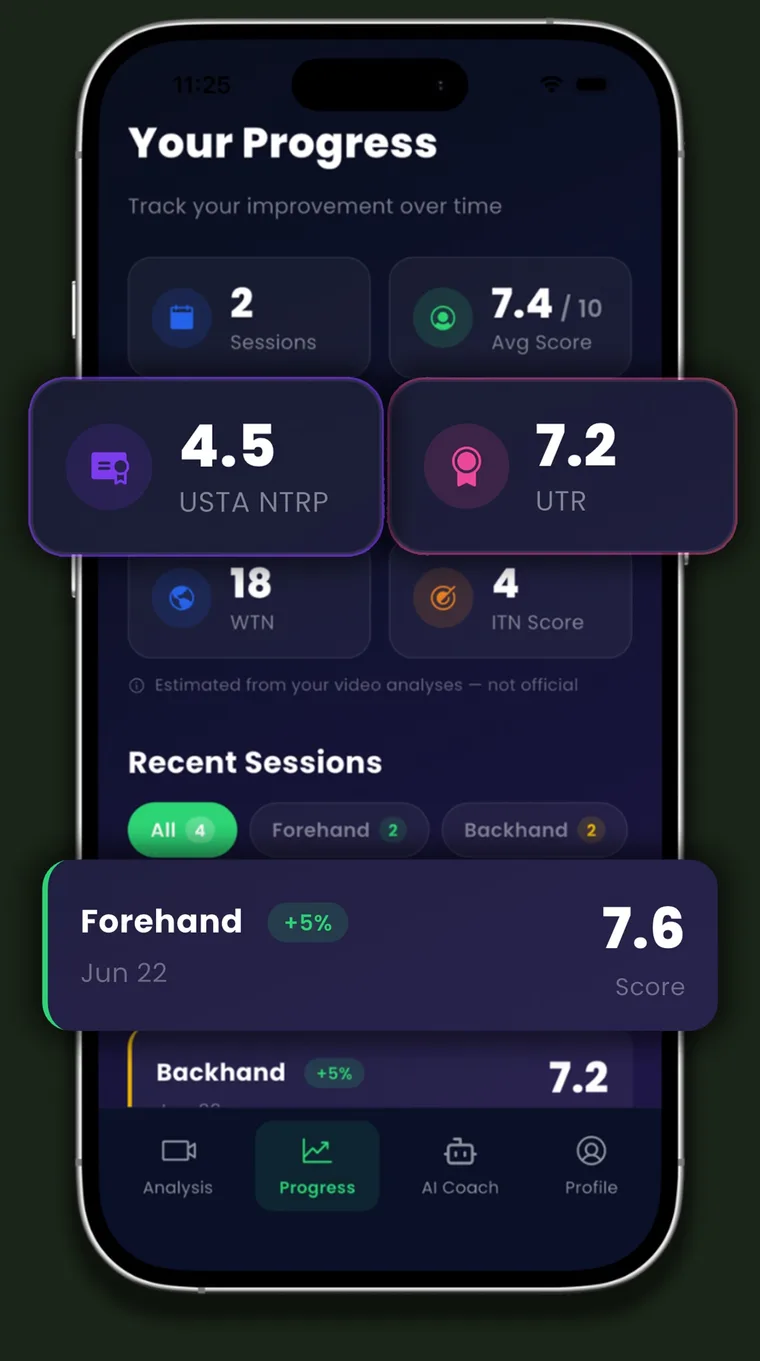
TennisAI is an iPhone app that analyzes video of your strokes and scores your forehand, backhand and serve. Its Progress tab keeps a session history and shows estimated NTRP, UTR, WTN and ITN numbers. They help you see whether your strokes are trending up between matches. They have no effect on your official ratings, and TennisAI is not affiliated with the USTA, UTR Sports or the ITF.
Frequently asked questions
Which tennis rating is the most accurate?
None is the most accurate for everyone. UTR and WTN update from every recorded match and NTRP is released once a year, but accuracy depends on how many recent results you have. Use the rating that the people you play with or enter events with actually use.
Do I need a UTR if I play USTA League?
No. NTRP is the foundation of USTA League. A UTR helps if you want to find matches outside the league or want a number that moves with each result, and your league results may count toward it.
Is a higher WTN better?
No. WTN runs from 40 for beginners to 1 for elite professionals, so a lower number means a stronger player. UTR and NTRP work the other way around.
Can I convert my UTR to NTRP or WTN?
Not officially. The USTA says there is no direct one-to-one comparison between NTRP and WTN, and published UTR to NTRP charts disagree. Our UTR vs NTRP article shows the charts side by side.
Is ITN still used?
We could not find an official ITF statement retiring ITN, but WTN is the rating in current ITF rules. If a form asks for an ITN, ask the organizer what it will accept.
Can TennisAI give me an official rating?
No. TennisAI shows estimated NTRP, UTR, WTN and ITN numbers from your video analyses. They are rough references and never official ratings.
See this in your own game
Upload a practice or match video to TennisAI and get feedback on your forehand, backhand and serve.

Sources
- USTA: ITF World Tennis Number
- USTA: About NTRP ratings
- World Tennis Number: Frequently Asked Questions
- World Tennis Number: WTN becomes part of the ITF World Tennis Tour singles acceptance criteria
- UTR Sports: How UTR Works
- UTR Sports Help Center: UTR Rating and Verified UTR Rating
- USTA: 2026 USTA League regulations (year-end ratings and appeals)
- LTA: World Tennis Number
This article is general information about tennis training and does not replace a coach or medical advice. Stop and see a professional if something hurts. TennisAI is made by Pace, the publisher of this blog. TennisAI is not affiliated with USTA, UTR Sports, the ITF or any official tennis association. Rating systems change, so check the official sources for current rules.
