This guide is about reading your own rating record, not about what each level means. For the levels and how to self-rate, see NTRP rating explained. For how to change your level, see how to move up an NTRP level. Here we cover the number you see, the letter next to it, and the dates and rules around it.
The NTRP scale you are being placed on
NTRP runs from 1.5 (beginner) to 7.0 (touring pro) in half-point steps. The number you see is always one of those steps. Behind each step, the USTA calculates a dynamic rating to the hundredth. Each level covers 50 dynamic points, so a 3.5 is anything from 3.01 to 3.50.
- 1.5–2.5 Starting out
- 2.5–5 Where USTA League mostly runs
- 5–7 Advanced to pro
- 3.5 3.5 = dynamic 3.01 to 3.50
Where to look up your rating
As of November 2026, USTA pages still point to TennisLink for rating information and self-rating. We found no official USTA page saying that lookup has moved to a new site. Some third-party pages claim TennisLink was replaced, but we could not confirm that. Tournament search is a different matter and may be moving. A section notice also says official ratings are posted on your player profile on usta.com or on TennisLink, and nowhere else.
- 1Sign inUse your USTA account. You need the account number, but no team or membership number.
- 2Open the rating lookupOn TennisLink, choose the USTA League tab and look for Find NTRP Rating Info.
- 3Read number and letterThe number is your level. The letter shows how it was generated.
- 4Check the dateNote when it was generated, since that decides when it expires.
Menus change, so if a button has a different name, ask your Local League Coordinator. The USTA will not accept a rating from a coach or an app as proof of level. A pro's opinion or an on-court assessment does not change a rating.
What the letter after the number means
The letter is the rating type. It tells you how the number was produced, and that decides how you can appeal it and whether you can be disqualified from it.
C and S
The usual starting points
- C, Computer or Year-End: generated from USTA League adult play
- S, Self: entry-level rating from the self-rate questionnaire
- A computer rating takes precedence over mixed
A and D
Changes of level
- A, Appealed: granted when you may play higher or lower
- D, Disqualified: after a dynamic disqualification or an upheld grievance
- Both A and S can be subject to strikes
M and T
One kind of event only
- M, Mixed: you only play USTA Mixed divisions
- T, Tournament: you only play sanctioned NTRP tournaments
- M and T players must self-rate to enter Adult
The USTA FAQ we read does not define a letter B, and we found no official definition of any other code, so we leave it out rather than guess.
What 3.5C means for the leagues you can play
A 3.5C is a year-end computer rating of 3.5. With a valid rating, you must enter at that level or higher, and you may play up one level. The exact level options also depend on your section and league, so confirm with your coordinator. Because a computer rating comes from real matches, computer-rated players are generally not subject to dynamic disqualification. A 3.5S works the same way for entry, but the USTA watches self-rated players and can move them up.
Year-end rating vs dynamic rating
| Year-end rating | Dynamic rating | |
|---|---|---|
| What it is | An NTRP level assigned at the end of the league championship year | A rating to the hundredth, updated as you play |
| Can you see it? | Yes, published at half-point levels | No, it is not disclosed to players |
| When it changes | Once a year, each December | After matches, but your published level does not move with it |
| What it is used for | Your level for the next league year | Strikes and disqualification for self-rated and appealed players |
Each year the previous year-end rating, to the hundredth, becomes your Start Rating, the first number in the new year's calculation. This is also why tools that claim to show your hidden decimals are guesses. The USTA does not publish them.
When ratings are published and when they expire
- Published: year-end ratings come out each December, and a section notice for the 2026 season said new ratings take effect on January 1.
- Year-end expiry: valid for up to three years if you are 59 or under, and up to two years if you are over 60, or until another rating is generated.
- Self-rating expiry: two years, or until a computer rating is generated.
- After expiry: you must self-rate again before playing USTA League, and you cannot choose a level below your last valid rating.
Check the generated date on your record in November, before registration for the next season opens.
Appeals, early starts and disqualification
You can appeal your level, but the rules depend on your rating type:
- Computer-rated and mixed-exclusive players can appeal up or down through TennisLink. Self-rated players can appeal up.
- A self-rated player moving down needs section review. All medical appeals need it too, and a medical appeal down is only for a permanently disabling injury or illness.
- If an appeal is denied, there is no further appeal. If it is granted, it cannot be reversed. A granted appeal gives you the A letter.
An Early Start League is one that begins before year-end ratings are out. If you entered at a level below your year-end rating, you are subject to dynamic disqualification. A computer-rated player who started in an Early Start League can be promoted. The page we read does not define a benchmark rating, so we do not cover it.
Doubles and mixed nuances
Singles and doubles results feed one NTRP rating. Mixed results affect only players who play exclusively in Mixed divisions. If you play enough Adult matches, you get a computer rating, and it takes precedence over a mixed rating. A mixed player who is disqualified must change level, and mixed matches played at the disqualified level after notification count as 6-0, 6-0 default losses.
Why your TennisAI number will not match
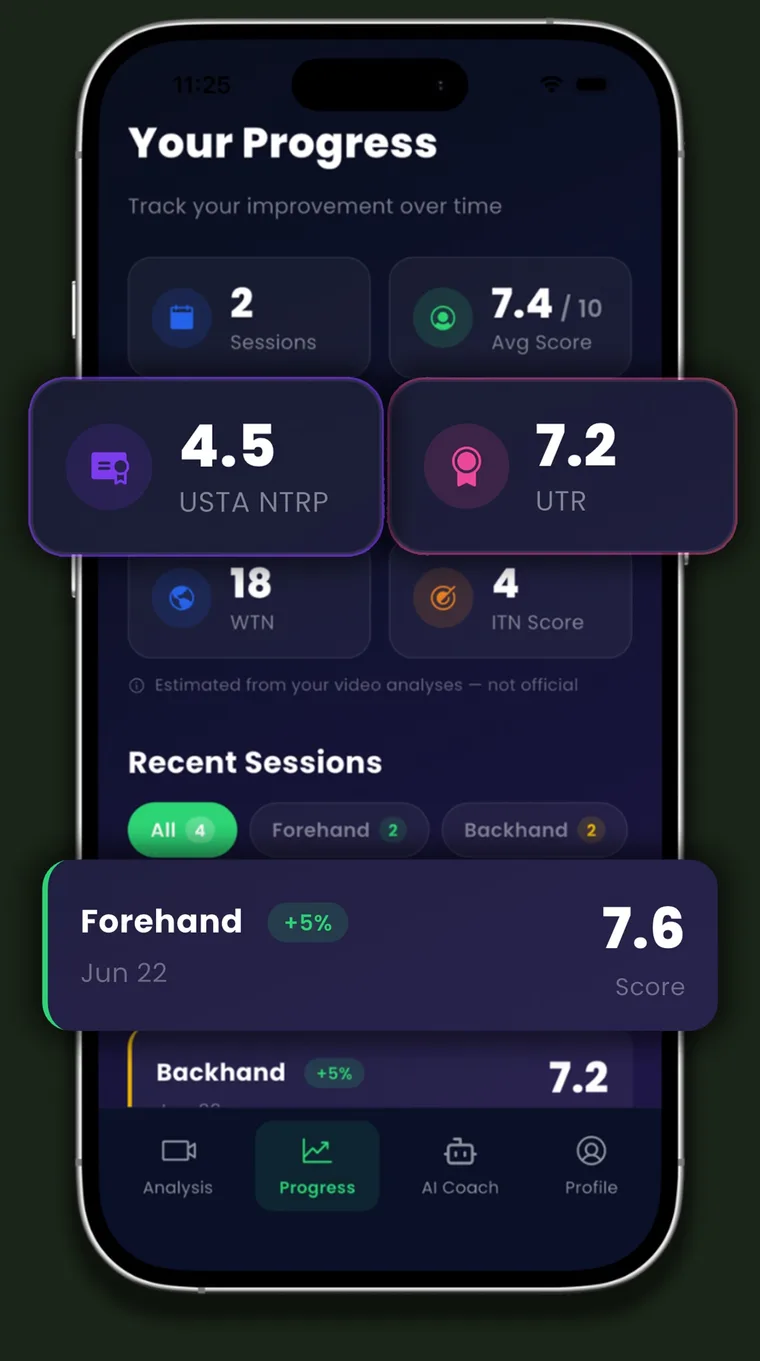
TennisAI shows an estimated NTRP in its Progress tab, built from your video analyses. It is not your USTA rating, it is not affiliated with the USTA, and you should not use it to self-rate, appeal or pick a league. Use it to watch the trend between seasons. To compare ratings across systems, read which tennis rating should you use.
Frequently asked questions
What does the letter after my NTRP rating mean?
It is the rating type. C is a computer (year-end) rating, S is self-rated, A is appealed, T is tournament, M is mixed and D is disqualified, as the USTA describes them.
When do USTA NTRP year-end ratings come out?
Each December. The USTA publishes them at half-point levels, and they apply to the next league year.
How long does my NTRP rating last?
A year-end rating is valid up to three years if you are 59 or under, and up to two years if you are over 60, or until another is generated. A self-rating lasts two years.
Can I see my dynamic NTRP rating?
No. The USTA calculates it to the hundredth but does not disclose it to players. Only year-end levels are published.
Can I appeal my NTRP level?
Yes, through TennisLink. Computer-rated players can appeal up or down, and self-rated players can appeal up. A denied appeal cannot be appealed again and a granted one cannot be reversed.
See this in your own game
Upload a practice or match video to TennisAI and get feedback on your forehand, backhand and serve.

Sources
This article is general information about tennis training and does not replace a coach or medical advice. Stop and see a professional if something hurts. TennisAI is made by Pace, the publisher of this blog. TennisAI is not affiliated with USTA, UTR Sports, the ITF or any official tennis association. Rating systems change, so check the official sources for current rules.
