Two things have to happen before your level changes. You have to become a better player, and that improvement has to appear in the score of a match the USTA counts. Lessons and practice can help with the first part. Only qualifying matches handle the second.
So this guide starts with the rating rules, then gives you the main skill step for each jump, then shows what to track while the official number stays out of sight. For the basics of the scale, read our NTRP guide.
How does an NTRP level actually change?
The USTA says dynamic ratings may move during the league year, but your level changes only in three cases:
- Year-end ratings are calculated. They are published each December, and this is the normal route.
- You generate enough strikes. This applies to players subject to dynamic disqualification, such as self-rated and appealed players. Reaching the disqualification level three times moves you up.
- A league grievance against you is upheld. It is a penalty, so never a goal.
A granted appeal can also change your level, and we cover that below. The 2026 regulations describe the computer system as a mathematical one that compares match results from USTA League and select NTRP tournaments. Each match has an expected outcome, set by the dynamic ratings of everyone on court. A result close to that expectation moves your rating a little, and a larger margin than expected moves it more.
This has two consequences. A loss can raise your rating, and a win can lower it. Your win-loss record, position and team standing also have no direct effect on the calculation. The USTA adds that ratings slowly rise or fall over time. Nothing official that we read says how long a jump takes, so distrust any promised timeline.
Which matches count toward a year-end rating?
| Type of play | Effect on your NTRP |
|---|---|
| USTA League adult divisions | Counts. A year-end rating needs at least three valid matches, and a match is valid once six games are completed. |
| NTRP tournaments | Count the same as league matches, where your section has opted in. |
| Mixed doubles | Affects only players who played Mixed exclusively. |
| Age-division tournaments | Not currently included. |
| Ladders, non-sanctioned leagues and tournaments | Not used. |
| Lessons, practice sets and a pro's opinion | Not used. Ratings come from matches, according to the USTA. |
So plan your season around counted matches. Without enough of them, your training has nothing to feed into. Sections can differ, so check the details with your Local League Coordinator.
The main step for each NTRP jump
The second column comes from the USTA level descriptions. The last two are our suggestions, because we found no USTA skills test.
| Jump | What the next USTA description adds | Main step to train | A check in practice sets |
|---|---|---|---|
| 3.0 to 3.5 | Directional control on moderate shots, more comfort at the net, developing teamwork. See the 3.5 description. | Sending the ball where you choose, and staying at the net once you get there | Share of rally balls hitting the side you called |
| 3.5 to 4.0 | Depth you can alter on both sides, success with lobs, overheads, approach shots and volleys. See the 4.0 description. | Depth on the weaker wing, then finishing the short ball | Share of rally balls past the service line, and approach shots won |
| 4.0 to 4.5 | Varied pace and spin, effective coverage, game plans, a first serve with power and accuracy, and a second serve that is placed. See the 4.5 description. | Serve and return that start points well, and shot choice when you are stretched | Points won on second serve, and on return |
How to go from 3.5 to 4.0
This is a suggested plan, and we found no official one. Measure your depth on each wing first, then work on the weaker wing until it matches the other. Next, build one pattern: a short ball, an approach to a big target, a split step, a volley. Then add the overhead and the lob, because the 4.0 wording lists both.
A simple session has three parts: depth targets, the approach pattern, and points begun with a second serve. Move each new skill into practice sets as soon as it works in a drill. The 4.0 wording also warns about impatience, so count the points you lose by attacking too early.
What to track when you cannot see your rating
The USTA alone issues a true NTRP, and it keeps dynamic ratings private. It also rejects numbers from third-party sites: it says they cannot rebuild its algorithm, are not accurate and will not be considered in appeals or grievances. So track the things that decide your matches. This list is our suggestion, and no number on it converts into a rating.
| What to track | How to record it | What it tells you |
|---|---|---|
| Scores in counted matches | Date, opponent's level, partner, games won and lost | Whether your margins improve against players at the same published level |
| Direction | From video, 20 rally balls on each wing | Progress on the 3.0 to 3.5 step |
| Depth | From video, balls past the service line, 20 on each wing | Progress on the 3.5 to 4.0 step |
| Approach shots | Tries and points won, from one set | Whether you use the shot and whether it works |
| Second-serve and return points | A tally of points won, from one set | Progress on the 4.0 to 4.5 step |
| Stroke scores | Session history in TennisAI's Progress tab | Whether your technique is changing. It cannot predict your rating. |
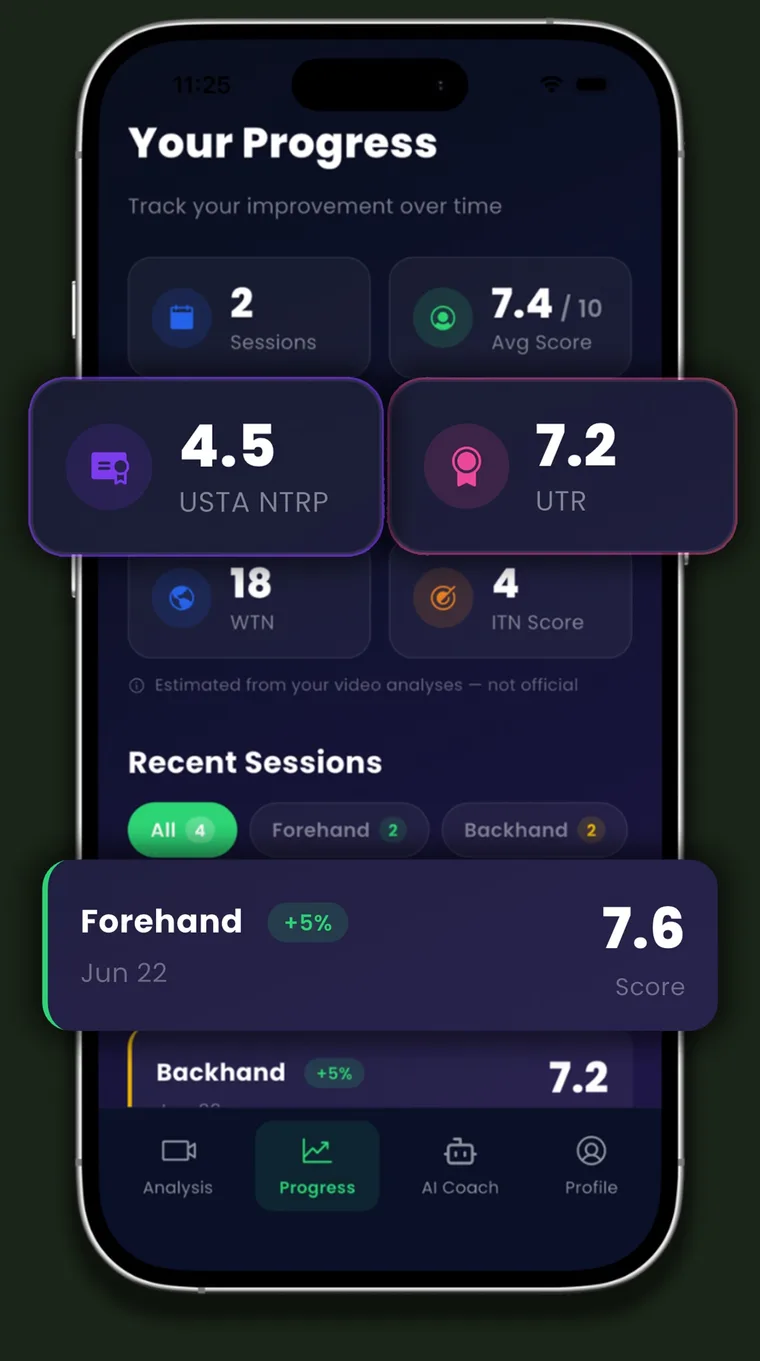
The estimated NTRP and UTR numbers on that screen come from your video analyses. Do not use them to self-rate, appeal or pick a league. For your own counts, use the same camera view each time, and do not read much into one match. Your rating depends on the people on court as well as on you, including your doubles partner.
Should you play up, appeal up or wait?
| Option | What it does | What to watch for |
|---|---|---|
| Play up one level | The 2026 regulations let you play up to one NTRP level above your current level. Your rating stays as it is until something changes it. | Team and section rules. We found no USTA statement that playing up raises a rating faster. The system still compares your score with the expected outcome. |
| Appeal up | Computer-rated players can appeal in either direction on TennisLink. Self-rated players can appeal upward. | You cannot reverse a granted appeal, and you must play at the new level at once. If the appeal is denied, there is no second appeal. Appealed players can be dynamically disqualified. |
| Wait for year-end | You keep playing at your level, and the December rating reflects your results. | It updates only once a year, and only if you play enough valid matches. |
Our decision rule is this. Play up when you want harder matches but are not sure about leaving your level. Appeal only if you would accept every future match at the higher level, because the USTA says not to appeal unless you are sure. Otherwise wait, and let the scores do the work.
Frequently asked questions
How do you go from 3.5 to 4.0 in tennis?
Build depth you can change on both wings, and get lobs, overheads, approach shots and volleys working in sets. Your level changes when results in counted matches support it, normally at the December year-end rating.
Can your NTRP go up if you lose?
Yes. The USTA compares the score with an expected outcome, so a close loss to stronger opponents can raise a rating, and a narrow win can lower one.
When do NTRP ratings update?
Published levels come out each December. Dynamic ratings are calculated nightly for local play, but the USTA does not publish them.
Can a coach move you up an NTRP level?
No. The USTA says pros have a general sense of how players may compete at each level, but it has not trained them to judge an exact rating. A pro's view will not change your number.
Does the estimated NTRP in TennisAI count?
No. It is estimated from your video analyses, with a not-official label in the app. Keep it out of self-rating, appeals and league choices.
See this in your own game
Upload a practice or match video to TennisAI and get feedback on your forehand, backhand and serve.

Sources
This article is general information about tennis training and does not replace a coach or medical advice. Stop and see a professional if something hurts. TennisAI is made by Pace, the publisher of this blog. TennisAI is not affiliated with USTA, UTR Sports, the ITF or any official tennis association. Rating systems change, so check the official sources for current rules.
