Feeling stuck and being stuck are different things. Ratings move slowly and memory is unreliable, so you can improve without noticing. You can also stay at the same level for a long time while feeling busy on court. The first job is to find out which one you are in.
Are you really stuck? Check before you change anything
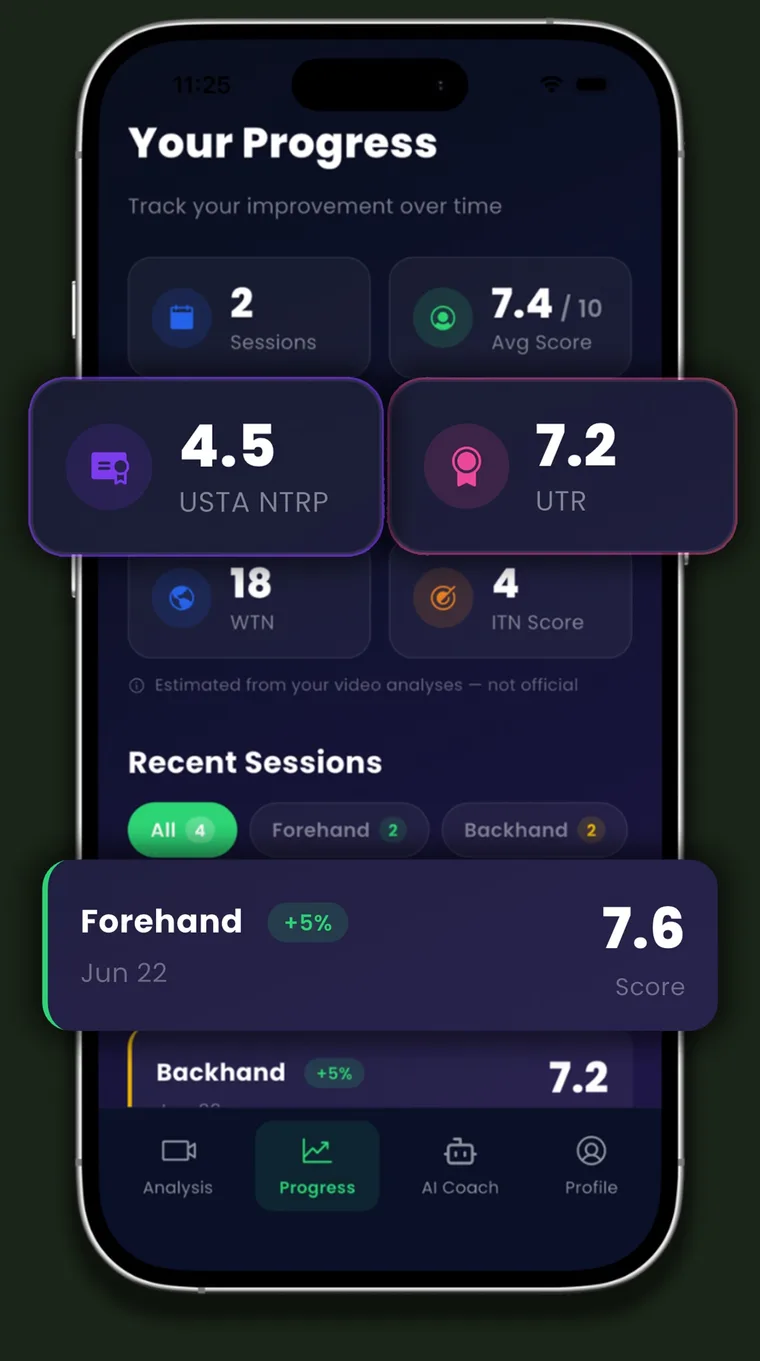
A flat rating does not prove flat tennis. The USTA generates NTRP ratings once a year in December, to the nearest half point, and each level spans 50 hundredths, so you can improve inside a level and see no change. A UTR is a weighted average of up to 30 recent match ratings, so one better month moves it only part of the way. If you use TennisAI, its NTRP and UTR numbers are estimates from your video analyses, labelled "not official", and results can vary with camera angle. Use a test you control instead.
This 15-minute baseline is our suggestion. There is no official standard for these counts, so compare them only with your own earlier numbers.
- Rally: rally crosscourt at medium pace. Take three tries and write down your best count.
- Depth: hit 20 balls from the baseline and count how many land past the service line.
- Second serve: hit 10 second serves to each box and count how many land in.
- Short ball: your partner feeds 10 short balls. Approach each one and count how many land past the service line.
Write the numbers down with the date, then add one match count from about six games, using our match video routine. Repeat everything after four weeks, with the same partner and on the same court if you can. If the numbers rose, you are improving and your rating has not caught up. If they stayed flat, use the table below.
Five plateau causes: find yours
| Cause | Signs | Check this week | First change |
|---|---|---|---|
| Same practice every week | The same partner, the same rally, the same doubles group. | Write down your last four sessions. If they look alike, this is you. | Give the first 20 minutes of a session to one target and a count. |
| No feedback | You cannot name your most common miss or say why it happens. | Name it, then check your answer against six games of video. | Film one block every two weeks, or book a coach for one lesson. |
| Too little match play, or only match play | You rally well but rarely play points. Or you only play matches and never train one thing. | Count your matches and your practice sessions from last month. | Add the side you are missing: a practice set with real calls, or one training block. |
| Too many changes at once | A new grip, a new toss and a new backhand in the same month. | List what you are changing. More than one technical item means this is you. | Keep one change and put the others on hold. |
| No measurement | "My serve feels better" is your only evidence. | Try to give one number from your last session. | Choose one number per session and write it down. |
More than one row may fit. Use the order in the section on what to change first. These causes are coaching judgment, and we did not find a study that ranks them.
What the evidence says about practice, and what it does not
Practice quality is not the whole story. A 2016 meta-analysis across all sports, not only tennis, found that deliberate practice explained 18% of the variance in performance overall and 1% among elite performers. Those numbers describe differences between people. They do not mean your own practice is useless, and they do not tell you how much you personally can gain. They do mean that two players with similar practice can end up in different places, so comparing yourself with a clubmate tells you little.
The tennis research is narrower, and it is mixed.
| Study | Who | What it found |
|---|---|---|
| Van Wieringen et al., 1989 | 66 players with 2 or more years of experience | Serve training twice a week for 5 weeks beat no training. Video feedback was no better than traditional training. |
| van der Meer et al., 2024 | 23 intermediate players | Players who chose when to get video feedback improved their tactics more than players on a fixed schedule. There was no group without video. |
| Reid et al., 2007 | A review of skill learning in tennis | Repetitive hitting and unstructured play are both unlikely to give the best learning. |
| Hebert et al., 1996 | 83 undergraduates in tennis classes | Low-skilled students did better with blocked practice. High-skilled students showed no difference. |
So research does not prove that video speeds up learning in tennis. Video is still plainly useful for one thing: it shows what you actually do, which can differ from what you feel. It helps only if it changes what you practice.
What to change first
This order is our suggestion. It starts with the steps that make the later ones testable.
- Start measuring. It costs little, and without a number you cannot tell whether any other change worked.
- Cut down to one technical change. A new movement often feels worse at first, and coaches commonly warn about this. If you are changing three things, you will not know which one caused the dip.
- Add what is missing: match play if you only drill, a training block if you only play matches, and feedback if you have none.
- Then change how you practice. If a stroke is stable, vary your targets. If it is still new, keep repeating one target for now.
A four-week test for one change
Four weeks is our suggestion and does not come from research. It is long enough to run a few sessions and short enough to keep your attention.
| When | What to do |
|---|---|
| Week 0 | Run the baseline and a six-game tally. Choose one cause and write one target with a number. |
| Weeks 1 to 3 | Give the first 20 minutes of a session to that target, and end the session with the same count. Keep your other tennis as it is. |
| Week 4 | Repeat the baseline and the tally, and compare them with week 0. |
At the end of week 4, find your result here.
| Result | What it may mean | What to do next |
|---|---|---|
| Better in the drill and in the match | The change is working. | Keep it, or move to the next cause. |
| Better in the drill but not in the match | The skill is not carrying over. | Make your practice more like a match. See why you play better in practice. |
| Flat, but the video shows your movement changing | The change may need more time. | Give it another two to four weeks. |
| Flat, and the video looks the same | You chose the wrong cause, or you need a second opinion. | Book a coach for one lesson, or go back to the table. |
TennisAI's Progress tab can hold part of this record, with session history, technique scores and percentage change per session for each stroke. Each score is an automated estimate, so keep the camera angle the same. For the week-by-week sessions, use our 4-week training plan. If your goal is a higher rating, read how to move up an NTRP level, because results decide that as much as training does.
Frequently asked questions
Why have I stopped improving at tennis?
Common causes are repeating the same session, having no feedback, playing too few matches or only matches, changing too many things at once, and measuring nothing. A few simple counts repeated after four weeks show whether you are really stuck.
How long does a tennis plateau last?
We found no reliable figure. It depends on what is causing it, so test one change for about four weeks, as a suggestion, and decide from your numbers.
How often should I practice tennis to improve?
No source we read gives a recommended amount. In one trial, 66 experienced players improved their serves with sessions twice a week for 5 weeks, compared with no training. That shows one schedule that worked, not the best one.
Do I need a coach to get better at tennis?
No rule says you must have one, but a coach can see what you cannot and help you choose what to work on. Even one lesson can help if you are unsure which cause applies to you.
Why do I play worse after changing my technique?
A new movement often feels worse at first, and coaches commonly warn about a temporary dip. Keep to one change, test it for a few weeks and judge it by your numbers.
See this in your own game
Upload a practice or match video to TennisAI and get feedback on your forehand, backhand and serve.

Sources
- USTA: NTRP ratings FAQs
- UTR Sports Help Center: how UTR is calculated
- PubMed: Macnamara, Moreau & Hambrick 2016, deliberate practice and performance in sports, a meta-analysis
- PubMed: Van Wieringen et al. 1989, video-feedback in learning the tennis service (intermediate players)
- PubMed: van der Meer et al. 2024, self-controlled video feedback and tactical skills in tennis
- PubMed: Reid, Crespo, Lay & Berry 2007, skill acquisition in tennis
- PubMed: Hebert et al. 1996, practice schedule effects on low- and high-skilled students
This article is general information about tennis training and does not replace a coach or medical advice. Stop and see a professional if something hurts. TennisAI is made by Pace, the publisher of this blog.
