Most club doubles points are not lost to a great shot. They are lost to a gap: a partner standing in the alley, two players watching a ball go between them, or a net player frozen while a weak return floats past. This guide is for recreational and league players, roughly NTRP 3.0 to 4.5.
How doubles works: the rules you need
The Rules of Tennis from World Tennis (formerly the ITF) set the doubles court at 10.97 m (36 ft) wide, against 8.23 m (27 ft) for singles, so each alley adds about 1.37 m (4.5 ft).
- The alleys are in after the serve. The serve must still land in the service box, which is the same as in singles.
- Partners alternate serving games. Each team picks who serves first in a set, so the order runs A, C, B, D.
- Each player receives from one side for the whole set. Either player can hit the ball after the return.
- The server's partner may stand anywhere on their own side. A serve that hits them is a fault.
Where all four players should stand
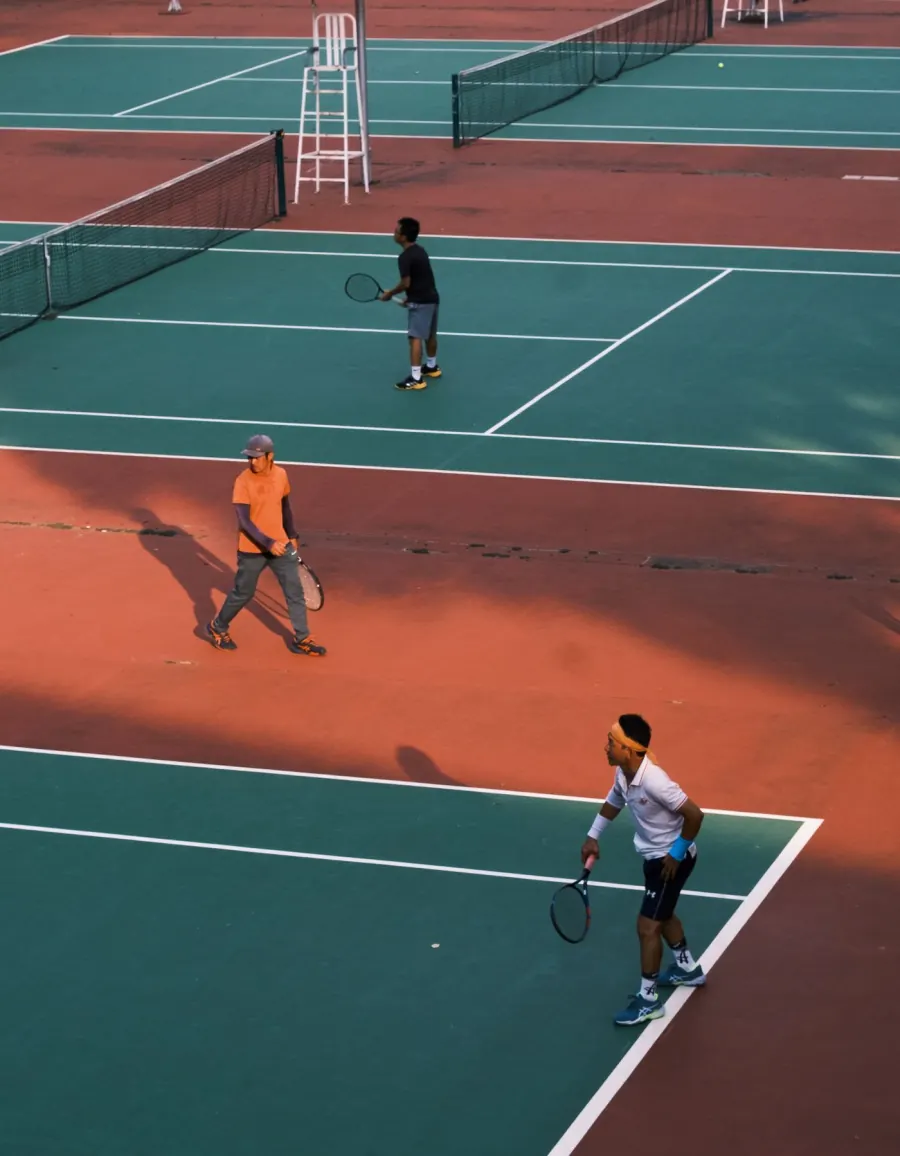
These are starting positions for one up, one back, the most common club formation. The service line is 6.40 m (21 ft) from the net, so the middle of the box is a little over 3 m (10 ft) from it.
| Player | Where to start | Main job |
|---|---|---|
| Server | Wider than in singles, about halfway between the centre mark and the doubles sideline | Serve in, then cover the crosscourt ball. |
| Server's partner | Middle of the service box, facing the returner | Take weak returns, poach and cover the middle. |
| Returner | Near the singles sideline, at your usual return depth | Return crosscourt, away from the net player. |
| Returner's partner | Around the service line, middle of the box | Watch the net player, defend the poach volley, move up after a good return. |
The LTA's doubles guide gives the net player a simple scale: push closer to the net when your team is attacking, stand in the middle of the box when the point is neutral, and drop toward the service line when defending.
The most common mistake: hugging the alley
Many club players stand next to the singles sideline because they fear being passed down the line. That protects a strip 1.37 m (4.5 ft) wide and hands the returner the whole middle. Louis Cayer, the LTA's doubles coach, answers this fear directly: when the opponent is under pressure, squeeze the middle instead of guarding the alley. You will be passed down the line now and then. That is a fair trade for reaching far more crosscourt balls.
One up, one back or both up?
One up, one back
The usual club start
- Defends lobs well, because one player is deep
- Suits steady baseline players
- Leaves a gap between the partners for angles
- Works only if the net player stays active
Both up
Pressure at the net
- Covers angles and cuts the other team's time
- Lets you volley at the deep player's feet
- Open to lobs, so both must track back together
- Needs a decent volley and overhead from both
Not every team rushes forward, even at the top. Cayer says the server stays back about 60% of the time at pro level and more at recreational level. A useful club rule: move up together after a shot that pushes the other team back, and stay one up, one back while the point is neutral. Do not stop halfway between the service line and the baseline, where balls land at your feet. Timing your move forward is covered in when to come to the net, and our 3.5 player guide shows how USTA level descriptions treat doubles teamwork.
Where to hit your return in doubles
The net player is the main danger on the return, so your first aim is to keep the ball away from them. For return technique against a fast serve, see how to return a big serve.
| Return | When to use it | Risk |
|---|---|---|
| Crosscourt, deep | Your default, especially when the server stays back | Low. It avoids the net player and pins the server back. |
| Crosscourt, low | When the server serves and volleys | Medium. It forces a low volley, but a floater gets poached. |
| At the net player's feet or hip | When they crowd the middle or poach often | Medium. It keeps them honest, but a high ball is a gift. |
| Lob over the net player | On a slow second serve, when the net player stands close | Medium. A good lob lets your team take the net. |
When a lob goes over the net player, the serving team switches: the server chases it and the net player crosses to the other side. The returning team can follow the lob forward.
Poaching and fake poaching
A poach is when the net player crosses to volley a ball heading to their partner, usually the return. Cayer describes three kinds: by reaction, going after a slow crosscourt ball; by anticipation, reading the crosscourt shot and moving early; and by agreement, planned with your partner before the point, as pros do.
Good moments to poach are a floating crosscourt return, a returner stretched wide by the serve, and a returner who hits the same return every time. Start moving as the returner commits to the swing. Too early and they redirect it behind you; too late and you volley from below the net. Move diagonally forward, not sideways. On how far to go, Cayer's guide is to get to the middle of the court without crossing it on a wide serve, and to finish with both feet just over the centre line on a serve down the T.
- 1SignalThe net player calls the poach before the serve.
- 2ServeA serve to the body or down the T invites a crosscourt return.
- 3GoThe net player moves diagonally forward as the returner swings.
- 4VolleyAim at the feet of the returner's partner or through the middle.
- 5SwitchThe server crosses to cover the side the net player left.
A fake poach is a step or lean toward the middle as the returner prepares, then a quick move back. The LTA guide lists pretending to cross as a way to push opponents into risky shots. Mixing real poaches with fakes is what makes a net player hard to read.
Communication and hand signals
In the system the LTA describes, the server's partner holds a hand behind their back before each serve and gives at least two signals: where to serve, and whether they will move.
| Signal | Meaning |
|---|---|
| A finger or the thumb | Serve wide, at the body or down the T. Agree which finger means which. |
| Open hand | I will cross to intercept. Server, switch behind me. |
| Closed fist | I will stay on my side. |
A sign for a fake is a team convention, not a standard, so agree it before the match. During the point, keep calls short: mine, yours, switch. Cayer also suggests a brief routine between points: encourage your partner, then agree the next play.
Covering the middle: "middle solves the riddle"
The club saying "middle solves the riddle" means hitting down the centre. The net is lowest there, 0.914 m (3 ft) against 1.07 m (3.5 ft) at the posts, the reply has little angle, and the two opponents may both leave it. The same reasons are why you must guard your own middle.
- Agree who takes the middle ball. Common rules are the player with the forehand in the middle, or the player closer to the net. Coaches differ, so pick one.
- Move as a pair. The LTA puts it simply: if your partner is pulled wide, move toward the middle.
- When both are up, know your lob cover. Cayer suggests crossing the service line behind you to intercept a lob.
Two doubles drills
Both need four players. Pass marks are suggestions.
- Crosscourt with a poacher. Two players rally crosscourt on the half court, alley included. A third stands at the net and poaches anything they can reach. A won poach scores 2; a crosscourt ball the net player cannot reach scores 1 for the baseliners. Play to 11 and rotate. Aim for at least four poach attempts per game.
- Signal and switch. Play normal points, but the net player signals before every serve. On an open hand they must go, and the server must switch. Score a bonus point for each switch with no gap. After 10 points, count signalled serves that landed where called. Aim for 7.
If your first step at the net is slow, add some split step work. Poaching starts with being balanced as the returner hits.
Check your positions on video
Film a set from behind one baseline with the whole court in frame. Pause each time the returner hits and note where your net player is: alley, middle of the box or crossing. Count poaches, fakes and points lost through the middle by hand. TennisAI scores your forehand, backhand and serve and comments on timing, contact, footwork and balance. It is an automated estimate, and its listing does not advertise formation analysis or ball placement tracking, so judge positions yourself.
Frequently asked questions
How does tennis doubles work?
Two teams of two play on a wider court, and the alleys count once the serve is in. Each player serves every fourth game, and each player receives from the same side for the whole set.
Where should I stand when my partner serves?
In the middle of the service box on the other side, a little over 3 m (10 ft) from the net, not on the alley. Move closer when attacking and back toward the service line when defending.
What are the hand signals in tennis doubles?
The net player gives them behind their back. A common system uses a finger or thumb for serve direction, an open hand for a poach and a closed fist for staying. Agree your own code.
Who takes the ball down the middle in doubles?
Agree before you play. Common rules are the player with the forehand in the middle or the player closer to the net. Any clear rule beats none.
Are the alleys in for the serve in doubles?
No. The serve must land in the service box, the same as in singles. The alleys count for every shot after the serve.
See this in your own game
Upload a practice or match video to TennisAI and get feedback on your forehand, backhand and serve.

Sources
- World Tennis (formerly the ITF): 2026 Rules of Tennis (court, Rules 14 and 15, server's partner position)
- LTA: Essential doubles tactics and hand signals (Matt Smith)
- LTA: How to improve your doubles skills, questions answered by LTA coach Louis Cayer
- USTA: Improve your game, Australian formation in doubles (Ben Zaiser)
This article is general information about tennis training and does not replace a coach or medical advice. Stop and see a professional if something hurts. TennisAI is made by Pace, the publisher of this blog.