We make TennisAI, which does a different job, and we have not tested either product. Everything here comes from Baseline Vision's website and app listing and SwingVision's App Store listing, read on 26 November 2026, plus an approval report from World Tennis (formerly the ITF). Prices are US list prices on that date and differ by country.
Baseline Vision
Net-post camera
- Its own smart camera
- Real-time voice line calls
- One-time camera price, free app
- Optional Pro plan
SwingVision
iPhone and iPad app
- Uses your iPhone or iPad
- Real-time line calls
- Free tier with 8 hours a month
- Plus, Pro and Max plans
Baseline Vision vs SwingVision: feature table
| Feature | Baseline Vision | SwingVision |
|---|---|---|
| What it is | A smart camera plus a companion app. The app works only while connected to the camera. | An app. No separate camera. |
| Where it goes | Mounted on the net post | Your iPhone or iPad mounted behind the court |
| Devices | The camera, plus an iPhone (iOS 17.4 or later) or Android phone for the app | iPhone or iPad on iOS 18 or later with an A12 chip or newer; Apple Watch for challenges |
| Line calls | Real-time voice calls. It recommends two cameras for professional-level calling, but says one camera calls lines. | Real-time calls from a single camera. The Pro plan lists line calling and automated scoring. |
| Ball and shot data | 3D tracking, speed, placement and net clearance | Shot speed, depth, accuracy and rally length |
| Scoring and stats | Match stats and replay video | Automated scoring and highlights |
| Setup | Under 20 seconds, with no power or Wi-Fi needed, by its own description | Mount the device with a full view of the court |
| Pricing model | One-time camera purchase; the app is free with every camera; optional Baseline Pro | Free tier; Plus, Pro and Max subscriptions |
| US price on 26 November 2026 | Camera $1,999; Baseline Pro $12 a month billed yearly, per camera | Plus $14.99 a month or $95.99 a year; Pro $24.99 or $179.99; Max $39.99 or $299.99 |
Two price notes. Baseline Vision's checkout page showed a pre-order discount and different figures from its pricing page on the day we checked, and several Baseline Pro features were marked as coming. SwingVision's listing text also quotes Pro as $179.99 a year, "$14.99 a month", which is the yearly plan expressed monthly. Check both official pages before you buy.
What each one costs over three years
The upfront prices are very different, so it helps to look further out. These are US list prices from 26 November 2026, assuming they stay the same, and they do not buy the same features.
- Baseline Vision camera, no Pro$1,999
- Baseline Vision camera with Baseline Pro$2,431
- SwingVision Pro, yearly$540
- SwingVision Plus, yearly$288
On list price alone, SwingVision is far cheaper over three years, as long as you already own a compatible iPhone or iPad. Baseline Vision makes more sense when a club or a family shares one camera on one court, when you do not want to tie up a phone, or when you want to avoid a subscription altogether.
When Baseline Vision fits
- One court, many players. A camera that stays with the court can serve everyone who plays there, and the app is free with the camera.
- No phone on the fence. The camera does the recording, and your phone runs the companion app.
- Android households. Baseline Vision has an Android app on Google Play as well as an iPhone app.
- You dislike subscriptions. The camera works without Baseline Pro.
When SwingVision fits
- You already own a recent iPhone or iPad. Then the only cost is the plan, and the free tier lets you try it with 8 recording hours a month.
- You play on different courts. An app on a device you carry goes wherever you play.
- You want Apple Watch challenges. Its listing describes challenging calls from the watch with slow-motion replays.
- You want a third-party approval report. World Tennis issued a Player Analysis Technology approval report for SwingVision in October 2025. That report says approval does not establish accuracy.
For a closer look at SwingVision's plans, see TennisAI vs SwingVision, and for other options by need, our list of SwingVision alternatives.
Questions to ask before you buy either one
- Do you need calls during the point, or would you mostly watch replays and stats afterward?
- Which devices do you own today? SwingVision needs a recent iPhone or iPad; Baseline Vision needs its camera plus a phone for the app.
- How many people will use it, and on how many courts?
- Will you use it every week? Count your sessions before you commit to a yearly plan or a camera.
- Does your league or club allow electronic line calls in matches, or only in practice? Ask the organizer.
Where TennisAI fits
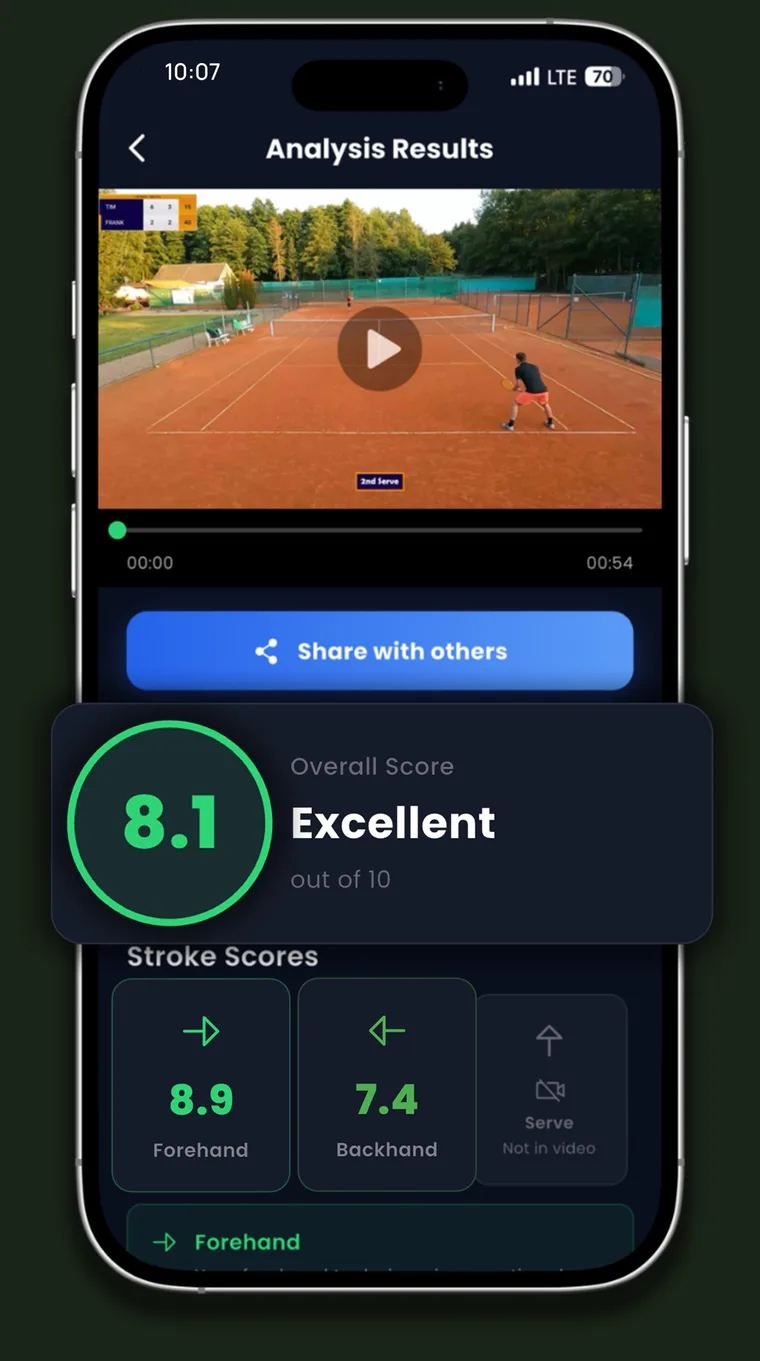
TennisAI is not a court camera and does not record whole matches. You film a practice or match with your phone, upload the clip, and get an overall score with separate scores and feedback for forehand, backhand and serve, plus a chat coach for drills and match preparation. It runs on iPhone. If what you want to know is why a stroke breaks down rather than where the ball landed, see what TennisAI shows you or read how AI swing analysis works.
Frequently asked questions
Is Baseline Vision or SwingVision better?
It depends on your setup. Baseline Vision is a net-post camera with a one-time price and a free app. SwingVision is an app for a recent iPhone or iPad with a free tier and subscriptions, and it costs far less over three years at US list prices.
Does Baseline Vision need a subscription?
No. Its pricing page says the app is free with every camera. Baseline Pro is an optional plan, listed at $12 a month billed yearly per camera on 26 November 2026.
Does SwingVision need extra hardware?
No separate camera. It runs on an iPhone or iPad on iOS 18 or later with an A12 chip or newer, which you mount behind the court. An Apple Watch is optional for challenges.
Can I use Baseline Vision with an Android phone?
Yes. Baseline Vision has an app on Google Play as well as on the App Store. The app works only while connected to the Baseline Vision camera.
See this in your own game
Upload a practice or match video to TennisAI and get feedback on your forehand, backhand and serve.

Sources
- Baseline Vision: official website
- Baseline Vision: pricing
- Baseline Vision: order page
- Apple App Store: Baseline Vision listing
- Google Play: Baseline Vision listing
- Apple App Store: SwingVision listing (US)
- ITF: Player Analysis Technology approval report for SwingVision (PAT-25-037)
- Apple App Store: Tennis AI listing
This article is general information about tennis training and does not replace a coach or medical advice. Stop and see a professional if something hurts. TennisAI is made by Pace, the publisher of this blog.